Unified Voice Command Interface
One voice interface for staff that works across old and new business software without rebuilding either.
- For
- Operations leads at mid-sized logistics companies
- Solves
- Staff spend excessive time switching between disparate software systems to answer simple questions or perform routine tasks.
- Delivers
- Structured data summaries, executed task confirmations, interaction logs.
- Built in
- 10 days of creation time, MVP in 2 days
- Investment
- $5,000 for the MVP, $15,000 for the full product
- Run it
- Inside your business, or as part of your offer to clients
What it does
For operations leads at mid-sized logistics companies, turn spoken questions and commands into direct data queries and task executions across multiple software systems.
- Parse natural language voice commands.
- Route queries to specific software APIs.
- Execute routine administrative tasks.
- Summarise complex data sets.
- Maintain user context across sessions.
- Provide feedback on command accuracy.
What goes in, what comes out
- Voice recordings
- User authentication tokens
- API credentials

AI drafts, people review. Source-linked assistant and administrator console.
- Structured data summaries
- Executed task confirmations
- Interaction logs
How it works
The workflow
- InStart with
Voice recordings, user authentication tokens, API credentials.
- 1
Define intent
- 2
Authenticate user
- 3
Route to system
- 4
Retrieve data
- 5
Synthesise response
- 6
Present output
- 7
Log interaction
- OutFinish with
Structured data summaries, executed task confirmations, interaction logs.
AI does the heavy lifting, people stay in charge
Use large language models to interpret intent and generate the correct API calls. Validate the output against business logic rules. A system administrator reviews the routing logic and security permissions before deployment.
What your team sees
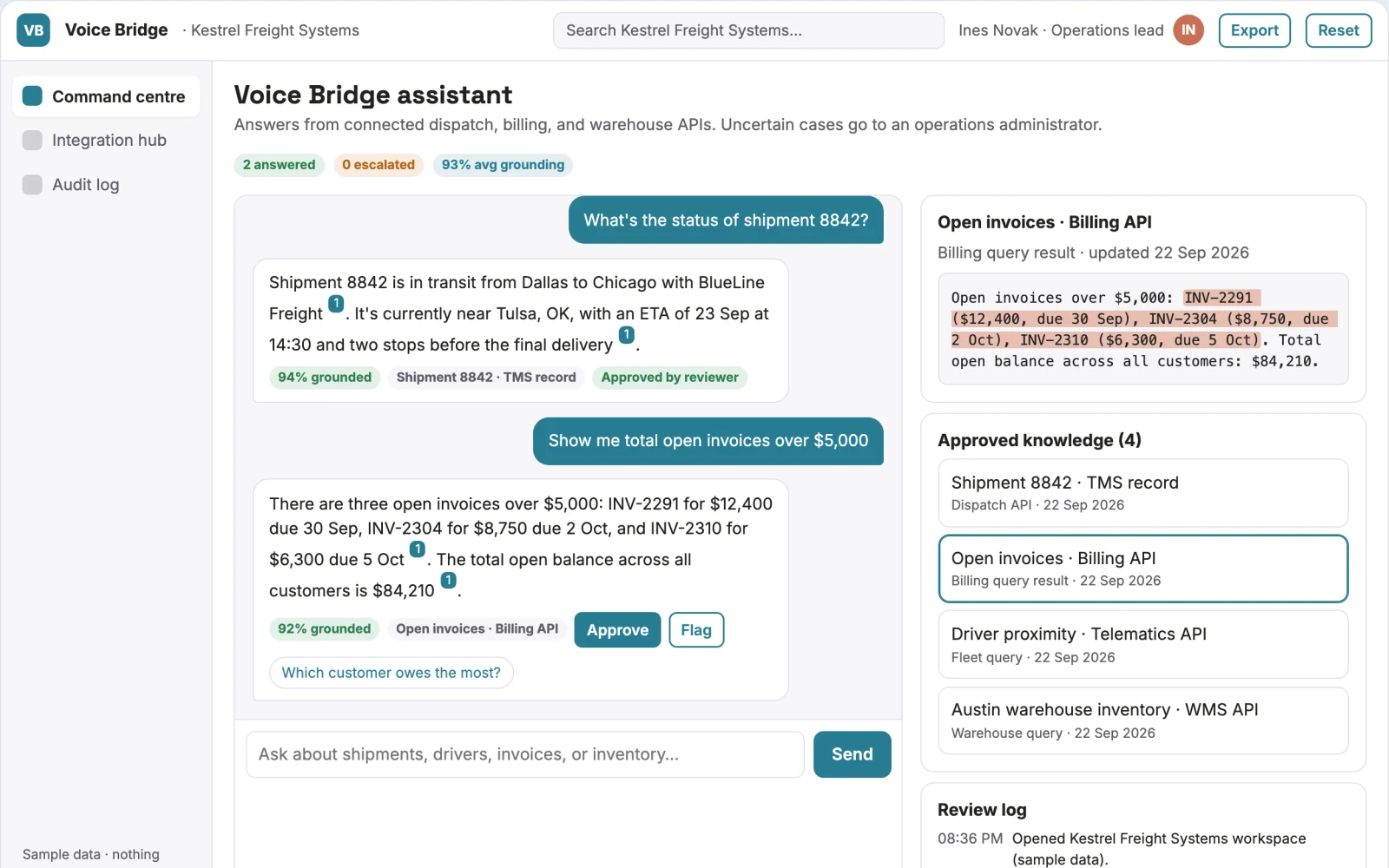
Key screens: Command centre, Integration hub, Audit log. The main screen is a command centre displaying a list of active voice sessions, recent queries, and system status indicators. It allows users to see the history of interactions and the current state of connected systems.
Accounts and administration
User roles, API key management, session history, permission levels, audit trails.
Integrations and data access
ERP systems, CRM platforms, Email servers.
How we build it
We build with our own AI software development factory, so most implementations take days to a few weeks of creation time, not months. You see working software at every step, and exact timing depends on availability.
- 1
Scoping call
Day 1Thirty minutes on your process, your data and how you want to run it: for your own team, or for your clients. You get a fixed scope and price for the MVP.
- 2
MVP
2 daysOne buyer segment, one recurring use case. Manual review in the loop. Built by our AI software factory.
- 3
Paid pilot
3 daysAccounts, roles, review states, audit trail and the first integration, hardened for two to three paying pilot customers.
- 4
Full product
5 daysSelf-serve onboarding, billing, monitoring and the wider integration set.
- 5
Run and improve
MonthlyWe host, monitor and improve it for a fixed monthly fee, or hand it over to your team. How the retainer works.
Why we start with an MVP
An MVP, or minimum viable product, is the smallest version that your users can actually work with. It is not a cheap version of the full solution. It is a test, built to answer the questions that decide whether the rest is worth building.
- Pick the riskiest assumption. Here: will operations leads at mid-sized logistics companies use it to solve "staff spend excessive time switching between disparate software systems to answer simple questions or perform routine tasks"?
- Build only what tests it. One team, one use case, a few core modules. People do the rest by hand for now.
- Run a paid pilot. Measure the reduction in time spent on routine queries and the number of context switches required to complete a task.
- Measure, then decide. Track average query resolution time and user adoption rate per week. Then expand, change course or stop, with evidence instead of opinions.
MVP scope for this solution. One logistics client, one use case for inventory checking, two core integrations (ERP and Warehouse Mgmt), manual review of API calls.
After the MVP. Automated execution of multi-step workflows, predictive analytics based on voice queries, custom voice training for industry jargon.
What the build depends on. Stable internet connection, compatible microphone hardware.
Investment
A planning range to start the conversation, not a quote. You pay per phase, so you can stop after the MVP.
- Phase 1
MVP
One buyer segment, one recurring use case. Manual review in the loop.
- Phase 2
Paid pilot
Accounts, roles, review states, audit trail and the first integration, hardened for two to three paying pilot customers.
- Phase 3
Full product
Self-serve onboarding, billing, monitoring and the wider integration set.
Indicative total, MVP to full product$15,00010 days of creation time · start with the MVP from $5,000
Running costs per month
A rough indication of monthly hosting and AI model costs once it is live, not tested. Real costs depend on usage, file sizes and the models chosen.
| Stage | Hosting and infrastructure | AI usage | Total per month |
|---|---|---|---|
| MVP and paid pilotabout 3 customers | $30–$60 | $60–$120 | $90–$180 |
| Full productabout 50 customers | $110–$210 | $530–$1,050 | $640–$1,260 |
Run it or resell it
For your own team
Operations leads at mid-sized logistics companies run it inside the business: voice recordings, user authentication tokens, API credentials. in, structured data summaries, executed task confirmations, interaction logs. out, reviewed by your people.
As part of your offer
Agencies, consultancies and software companies can offer it to their own clients under their brand. We build and maintain it; you sell and deliver it.
Your brand, or this one
Run it under your own brand, or start from this concept style.
- primary
#277c91 - accent
#c97054 - surface
#e4eef1 - ink
#22201e
- Headings
- Space Grotesk
- Text
- Inter
- Voice
- Technical, direct, no hype
Selling it to your own clients: the go-to-market playbook
Pricing to test
Hypothesis: 50 dollars per user per month.
Message to test
Speak your data, not your apps.
Where to find buyers
LinkedIn, industry conferences, tech review sites.
Lead magnet
Free 30-day trial of the command centre.
The first 30 days
- Week 1: System architecture and API mapping.
- Week 2: Voice model training and integration testing.
- Week 3: User acceptance testing and security audit.
- Week 4: Pilot launch and feedback collection.
Paid pilot
Measure the reduction in time spent on routine queries and the number of context switches required to complete a task.
Success metrics
Average query resolution time, user adoption rate per week.
Retention and expansion
Continuous updates based on new voice commands and system changes.
Why clients would pick it
The difficulty of mapping complex internal data structures to natural language and the need for ongoing maintenance of API integrations.
Alternatives and positioning
Native mobile apps, chatbots, manual data entry, hiring support staff.
Main delivery costs
Engineering time for integration, cloud hosting for voice processing.
Safeguards
Strict role-based access control, no access to sensitive financial data without explicit approval, blocking of commands that could delete data.