Brand voice implementation
A tested editorial workflow with examples of acceptable and unacceptable outputs.
- For
- Marketing teams using AI across multiple writers
- Solves
- Generated copy varies widely despite written brand guidelines.
- Delivers
- Configured brand writing workflow
- Built in
- about 5 weeks of creation time, MVP in 6 days
- Investment
- $10,000 for the MVP, $40,000 for the full product
- Run it
- Inside your business, or as part of your offer to clients
What it does
For marketing teams using AI across multiple writers, turn brand guide, approved samples and rejected examples into configured brand writing workflow.
- Translate voice principles.
- Build reusable instructions.
- Create examples.
- Test edge cases.
- Collect editor feedback.
- Version the writing system.
What goes in, what comes out
- Brand guide
- Approved samples
- Rejected examples

AI drafts, people review. Technical delivery workspace with managed implementation.
- Configured brand writing workflow
How it works
The workflow
- InStart with
Brand guide, approved samples and rejected examples
- 1
Scope one technical task
- 2
Inspect authorized material
- 3
Propose an implementation
- 4
Build in a controlled environment
- 5
Run relevant checks
- 6
Obtain the required change approval
- 7
Deliver with recovery instructions
- 8
Monitor the agreed operating scope
- OutFinish with
Configured brand writing workflow
AI does the heavy lifting, people stay in charge
Explain code or configuration, draft transformations and propose technical changes. Execute deterministic validation and meaningful tests. Engineers review correctness, access handling and failure behavior before deployment.
What your team sees
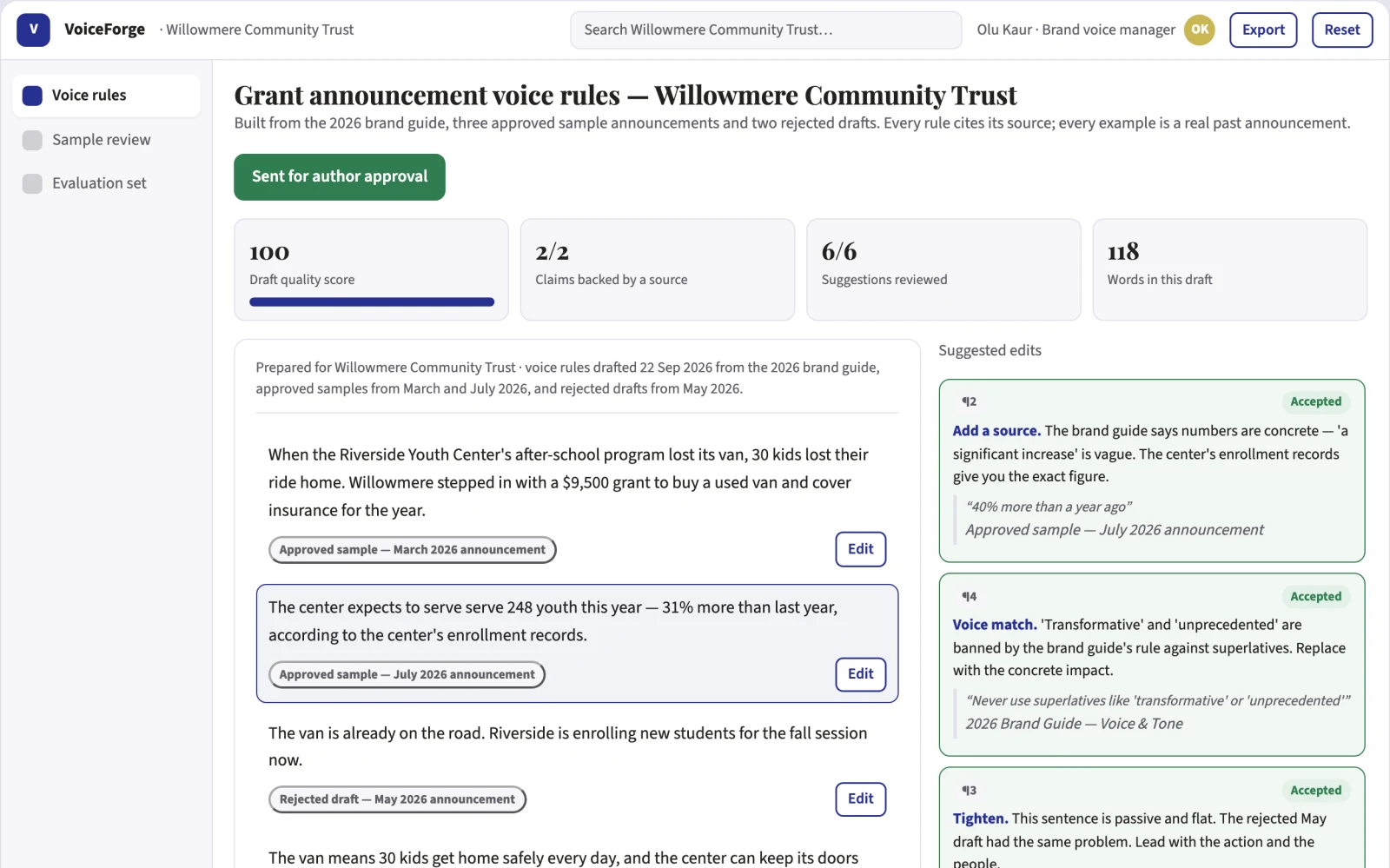
Key screens: Voice rules, sample review, evaluation set. Show a work backlog, proposed changes and verification results. Link each item to its source configuration, code or data mapping. Provide execution logs and an owner-facing health view. Keep environments and approval states clearly separated so a draft cannot be mistaken for a live change. In this product, the first view is voice rules, followed by sample review and evaluation set.
Accounts and administration
Project access, environment separation, versioned changes, test evidence, owner approvals, execution logs, rollback instructions and incident handling.
Integrations and data access
Approved brand material, campaign exports and authorized customer research. Approved repositories, application APIs, execution platforms and monitoring systems. Validate current API access and behavior during discovery before promising compatibility. These are candidate integration categories, not verified supported connectors.
How we build it
We build with our own AI software development factory, so most implementations take days to a few weeks of creation time, not months. You see working software at every step, and exact timing depends on availability.
- 1
Scoping call
Day 1Thirty minutes on your process, your data and how you want to run it: for your own team, or for your clients. You get a fixed scope and price for the MVP.
- 2
MVP
6 daysOne buyer segment, one recurring use case; first modules: translate voice principles; build reusable instructions. Manual review in the loop. Built by our AI software factory.
- 3
Paid pilot
7 daysAccounts, roles, review states, audit trail and the first integration, hardened for two to three paying pilot customers.
- 4
Full product
2 weeksRemaining modules: test edge cases; collect editor feedback; version the writing system. Self-serve onboarding, billing, monitoring and the wider integration set.
- 5
Run and improve
MonthlyWe host, monitor and improve it for a fixed monthly fee, or hand it over to your team. How the retainer works.
Why we start with an MVP
An MVP, or minimum viable product, is the smallest version that your users can actually work with. It is not a cheap version of the full solution. It is a test, built to answer the questions that decide whether the rest is worth building.
- Pick the riskiest assumption. Here: will marketing teams using AI across multiple writers use it to solve "generated copy varies widely despite written brand guidelines"?
- Build only what tests it. One team, one use case, a few core modules. People do the rest by hand for now.
- Run a paid pilot. Implement one bounded task in a safe test environment.
- Measure, then decide. Track editor acceptance and revision time. Then expand, change course or stop, with evidence instead of opinions.
MVP scope for this solution. Begin with marketing teams using AI across multiple writers and one recurring use case. Build the first two modules: translate voice principles; build reusable instructions. Provide operator assistance for the third module: create examples. Deliver configured brand writing workflow through a manual review queue. Perform other necessary full-scope functions manually during the pilot. Include all applicable access, accuracy and professional-review controls from the start.
After the MVP. After paid pilots establish value, automate the remaining modules: test edge cases; collect editor feedback; version the writing system. Add one validated source integration, reusable customer configuration and recurring delivery. Expand to additional teams, document formats or languages only after testing the new scope.
What the build depends on. Authorized technical access, suitable test environments, documented APIs or schemas, secrets management, meaningful checks and recovery procedures.
Investment
A planning range to start the conversation, not a quote. You pay per phase, so you can stop after the MVP.
- Phase 1
MVP
One buyer segment, one recurring use case; first modules: translate voice principles; build reusable instructions. Manual review in the loop.
- Phase 2
Paid pilot
Accounts, roles, review states, audit trail and the first integration, hardened for two to three paying pilot customers.
- Phase 3
Full product
Remaining modules: test edge cases; collect editor feedback; version the writing system. Self-serve onboarding, billing, monitoring and the wider integration set.
Indicative total, MVP to full product$40,000about 5 weeks of creation time · start with the MVP from $10,000
Running costs per month
A rough indication of monthly hosting and AI model costs once it is live, not tested. Real costs depend on usage, file sizes and the models chosen.
| Stage | Hosting and infrastructure | AI usage | Total per month |
|---|---|---|---|
| MVP and paid pilotabout 3 customers | $30–$60 | $60–$120 | $90–$180 |
| Full productabout 50 customers | $110–$210 | $530–$1,050 | $640–$1,260 |
Run it or resell it
For your own team
Marketing teams using AI across multiple writers run it inside the business: brand guide, approved samples and rejected examples in, configured brand writing workflow out, reviewed by your people.
As part of your offer
Agencies, consultancies and software companies can offer it to their own clients under their brand. We build and maintain it; you sell and deliver it.
Your brand, or this one
Run it under your own brand, or start from this concept style.
- primary
#272f91 - accent
#c9b654 - surface
#e4e6f1 - ink
#22201e
- Headings
- Playfair Display
- Text
- Source Sans 3
- Voice
- Energetic, specific, results-minded
Selling it to your own clients: the go-to-market playbook
Pricing to test
Test USD 1,000-4,000 for one bounded implementation or technical review, then USD 200-1,000 monthly for defined maintenance. Hosting, vendor fees and major feature changes are separate. Prices are hypotheses.
Message to test
Brand voice implementation for marketing teams using AI across multiple writers. A tested editorial workflow with examples of acceptable and unacceptable outputs. Demonstrate the claim through a voice consistency test on sample copy.
Where to find buyers
Brand agencies
Lead magnet
A voice consistency test on sample copy
The first 30 days
- Week 1: interview five prospective buyers in this segment: marketing teams using AI across multiple writers. Ask to see a recent example of the problem and their current process.
- Week 2: prepare this demonstration using authorized or synthetic material: a voice consistency test on sample copy.
- Week 3: present it through brand agencies and seek one narrowly scoped paid pilot.
- Week 4: review editor acceptance, revision time, total delivery effort and a concrete renewal decision before increasing scope.
Paid pilot
Implement one bounded task in a safe test environment. Demonstrate normal operation, failure handling and recovery with representative inputs. Have the responsible technical owner review the results. For this solution, use brand guide, approved samples and rejected examples and evaluate configured brand writing workflow. Agree success thresholds with the buyer before starting; collect a baseline for editor acceptance, revision time. A positive signal is payment and repeat use with acceptable quality and delivery cost, not a favorable demo reaction alone.
Success metrics
Editor acceptance, revision time
Retention and expansion
Maintain agreed integrations or technical assets, review failures and upstream changes, and sell additional scoped work only after the first implementation is stable.
Why clients would pick it
Reliable niche implementations, integration knowledge, representative tests and ongoing operational responsibility. For this solution, build around a tested editorial workflow with examples of acceptable and unacceptable outputs. This advantage requires execution and accumulated customer trust; the base model alone is not a defensible asset.
Alternatives and positioning
Developers, system integrators, existing automation products and internal engineering work. Differentiate on this specific proposed advantage: a tested editorial workflow with examples of acceptable and unacceptable outputs. Test it against the buyer's current method on the same task. Competitor coverage and uniqueness have not been established.
Main delivery costs
Engineering, testing, cloud execution, third-party API fees, monitoring, incident response and vendor-change maintenance.
Safeguards
Verify product claims and permissions. Distinguish observed campaign results from causal explanations and keep customer data collection authorized. Validate source access and reviewer availability during the pilot. Maintain customer-level access, data deletion controls and a record of final approvals.