Event attendee concierge
Agenda-aware answers with organizer-controlled updates.
- For
- Conference organizers with complex agendas
- Solves
- Attendees cannot quickly find relevant logistical information.
- Delivers
- Attendee guidance and organizer escalations
- Built in
- about 3 weeks of creation time, MVP in 3 days
- Investment
- $7,000 for the MVP, $24,000 for the full product
- Run it
- Inside your business, or as part of your offer to clients
What it does
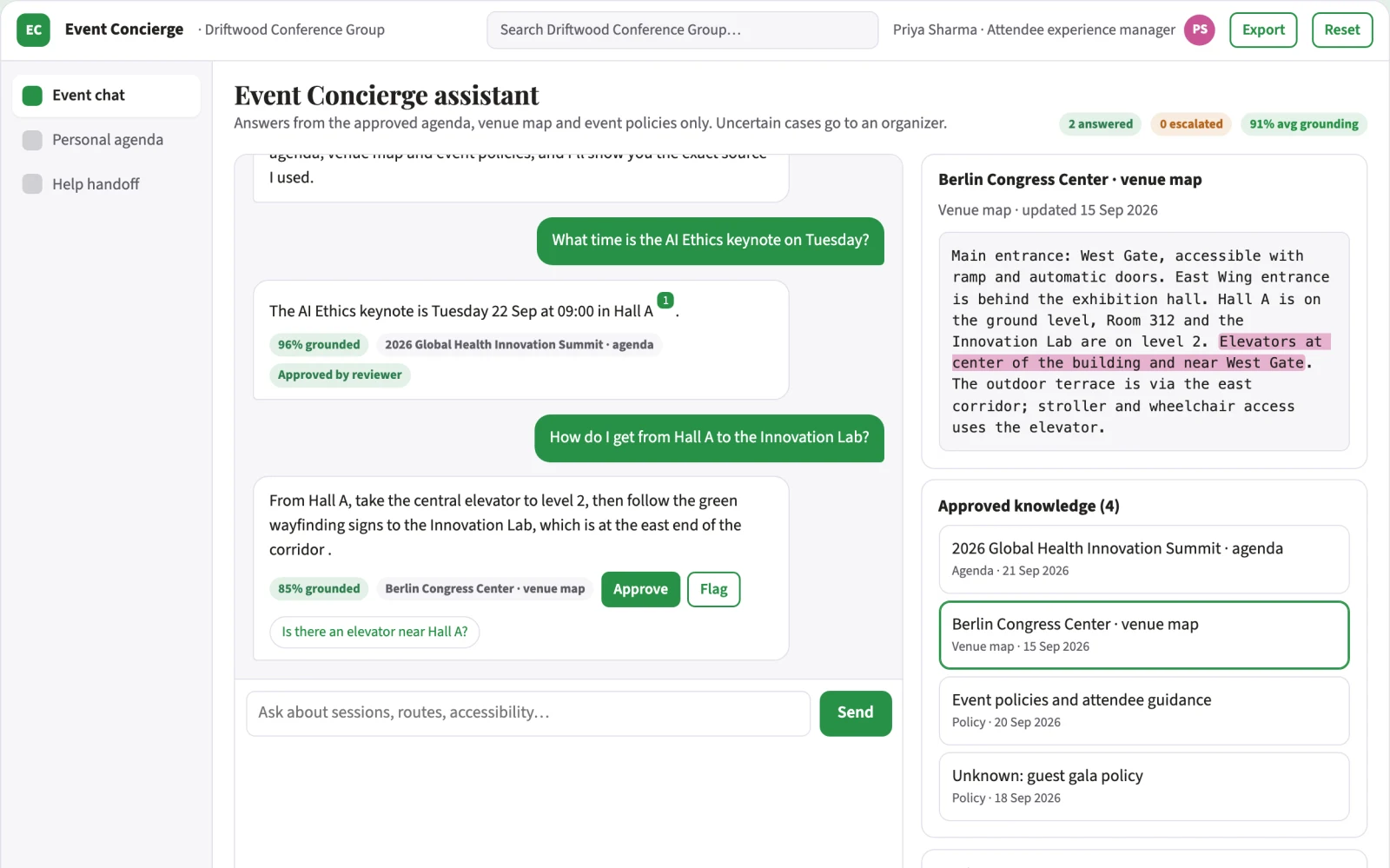
For conference organizers with complex agendas, turn approved agenda, venue map and event policies into attendee guidance and organizer escalations.
- Find sessions.
- Explain venue routes.
- Answer accessibility questions.
- Surface schedule changes.
- Save attendee interests.
- Route organizer help.
What goes in, what comes out
- Approved agenda
- Venue map
- Event policies

AI drafts, people review. Source-linked assistant and administrator console.
- Attendee guidance
- Organizer escalations
How it works
The workflow
- InStart with
Approved agenda, venue map and event policies
- 1
Add an approved collection
- 2
Assign source owners and access rules
- 3
Test representative questions
- 4
Let users ask questions
- 5
Retrieve supporting passages
- 6
Answer or request clarification
- 7
Hand off unresolved cases with their context
- OutFinish with
Attendee guidance and organizer escalations
AI does the heavy lifting, people stay in charge
Retrieve permitted passages and generate answers constrained to those sources. Use structured rules for transactional facts. Detect missing context and refuse to invent unsupported details. Store reviewer corrections for evaluation and controlled knowledge updates.
What your team sees
Key screens: Mobile event chat, personal agenda, help handoff. Give end users a simple search or conversation surface with short answers and expandable citations. Administrators get source status, unanswered questions and handoff queues. Show the source date beside relevant answers. Keep conversation context available to the staff member receiving an escalation. In this product, the first view is mobile event chat, followed by personal agenda and help handoff.
Accounts and administration
Source ownership, document permissions, freshness checks, conversation history, human handoff, feedback, test questions, usage limits and access logs.
Integrations and data access
Property records, event schedules, reservation exports and supplier information. Approved knowledge repositories, websites, service desks and staff messaging systems. Validate access inheritance and use read-only ingestion for the initial deployment. These are candidate integration categories, not verified supported connectors.
How we build it
We build with our own AI software development factory, so most implementations take days to a few weeks of creation time, not months. You see working software at every step, and exact timing depends on availability.
- 1
Scoping call
Day 1Thirty minutes on your process, your data and how you want to run it: for your own team, or for your clients. You get a fixed scope and price for the MVP.
- 2
MVP
3 daysOne buyer segment, one recurring use case; first modules: find sessions; explain venue routes. Manual review in the loop. Built by our AI software factory.
- 3
Paid pilot
4 daysAccounts, roles, review states, audit trail and the first integration, hardened for two to three paying pilot customers.
- 4
Full product
8 daysRemaining modules: surface schedule changes; save attendee interests; route organizer help. Self-serve onboarding, billing, monitoring and the wider integration set.
- 5
Run and improve
MonthlyWe host, monitor and improve it for a fixed monthly fee, or hand it over to your team. How the retainer works.
Why we start with an MVP
An MVP, or minimum viable product, is the smallest version that your users can actually work with. It is not a cheap version of the full solution. It is a test, built to answer the questions that decide whether the rest is worth building.
- Pick the riskiest assumption. Here: will conference organizers with complex agendas use it to solve "attendees cannot quickly find relevant logistical information"?
- Build only what tests it. One team, one use case, a few core modules. People do the rest by hand for now.
- Run a paid pilot. Restrict the assistant to one collection and test answered, ambiguous and unanswerable questions.
- Measure, then decide. Track correct answers and organizer help volume. Then expand, change course or stop, with evidence instead of opinions.
MVP scope for this solution. Begin with conference organizers with complex agendas and one recurring use case. Build the first two modules: find sessions; explain venue routes. Provide operator assistance for the third module: answer accessibility questions. Deliver attendee guidance and organizer escalations through a manual review queue. Perform other necessary full-scope functions manually during the pilot. Include all applicable access, accuracy and professional-review controls from the start.
After the MVP. After paid pilots establish value, automate the remaining modules: surface schedule changes; save attendee interests; route organizer help. Add one validated source integration, reusable customer configuration and recurring delivery. Expand to additional teams, document formats or languages only after testing the new scope.
What the build depends on. Permission-filtered retrieval, document versioning, a question evaluation set, staff handoff and a source update process. Reliability depends on source quality and scope.
Investment
A planning range to start the conversation, not a quote. You pay per phase, so you can stop after the MVP.
- Phase 1
MVP
One buyer segment, one recurring use case; first modules: find sessions; explain venue routes. Manual review in the loop.
- Phase 2
Paid pilot
Accounts, roles, review states, audit trail and the first integration, hardened for two to three paying pilot customers.
- Phase 3
Full product
Remaining modules: surface schedule changes; save attendee interests; route organizer help. Self-serve onboarding, billing, monitoring and the wider integration set.
Indicative total, MVP to full product$24,000about 3 weeks of creation time · start with the MVP from $7,000
Running costs per month
A rough indication of monthly hosting and AI model costs once it is live, not tested. Real costs depend on usage, file sizes and the models chosen.
| Stage | Hosting and infrastructure | AI usage | Total per month |
|---|---|---|---|
| MVP and paid pilotabout 3 customers | $30–$60 | $60–$120 | $90–$180 |
| Full productabout 50 customers | $110–$210 | $530–$1,050 | $640–$1,260 |
Run it or resell it
For your own team
Conference organizers with complex agendas run it inside the business: approved agenda, venue map and event policies in, attendee guidance and organizer escalations out, reviewed by your people.
As part of your offer
Agencies, consultancies and software companies can offer it to their own clients under their brand. We build and maintain it; you sell and deliver it.
Your brand, or this one
Run it under your own brand, or start from this concept style.
- primary
#279147 - accent
#c95495 - surface
#e4f1e8 - ink
#22201e
- Headings
- Playfair Display
- Text
- Source Sans 3
- Voice
- Welcoming, lively, attentive
Selling it to your own clients: the go-to-market playbook
Pricing to test
Test USD 500-2,000 setup plus USD 150-600 monthly for one defined source collection and usage allowance. Price multi-location deployments and specialist support separately. Validate willingness to pay; these are hypotheses.
Message to test
Event attendee concierge for conference organizers with complex agendas. Agenda-aware answers with organizer-controlled updates. Demonstrate the claim through an interactive concierge for a sample conference.
Where to find buyers
Conference production agencies
Lead magnet
An interactive concierge for a sample conference
The first 30 days
- Week 1: interview five prospective buyers in this segment: conference organizers with complex agendas. Ask to see a recent example of the problem and their current process.
- Week 2: prepare this demonstration using authorized or synthetic material: an interactive concierge for a sample conference.
- Week 3: present it through conference production agencies and seek one narrowly scoped paid pilot.
- Week 4: review correct answers, organizer help volume, total delivery effort and a concrete renewal decision before increasing scope.
Paid pilot
Restrict the assistant to one collection and test answered, ambiguous and unanswerable questions. Run supervised use before wider rollout. Measure correctness, escalation quality and staff effort. For this solution, use approved agenda, venue map and event policies and evaluate attendee guidance and organizer escalations. Agree success thresholds with the buyer before starting; collect a baseline for correct answers, organizer help volume. A positive signal is payment and repeat use with acceptable quality and delivery cost, not a favorable demo reaction alone.
Success metrics
Correct answers, organizer help volume
Retention and expansion
Review unanswered questions and source freshness monthly. Expand to another source collection or team only after the existing assistant meets its agreed accuracy and handoff criteria.
Why clients would pick it
A maintained domain knowledge collection, realistic evaluation questions, useful escalation paths and integrations in the customer’s daily work. For this solution, build around agenda-aware answers with organizer-controlled updates. This advantage requires execution and accumulated customer trust; the base model alone is not a defensible asset.
Alternatives and positioning
Manual search, static FAQs, general chat tools and support or intranet suites. Differentiate on this specific proposed advantage: agenda-aware answers with organizer-controlled updates. Test it against the buyer's current method on the same task. Competitor coverage and uniqueness have not been established.
Main delivery costs
Document ingestion, retrieval and generation, source maintenance, support, evaluation and staff time handling unresolved cases.
Safeguards
Verify property facts, availability and supplier conditions. Staff approve commercial exceptions and consequential booking changes. Validate source access and reviewer availability during the pilot. Maintain customer-level access, data deletion controls and a record of final approvals.