Contextual Street Signage
Outdoor ads that adapt to context in real time, with privacy built in and interactions you can verify.
- For
- Marketing managers at outdoor advertising firms
- Solves
- Static billboards waste impressions on uninterested audiences and fail to prove engagement.
- Delivers
- Dynamic ad creatives, verified interaction metrics, weekly performance reports
- Built in
- about 5 weeks of creation time, MVP in 5 days
- Investment
- $9,500 for the MVP, $38,000 for the full product
- Run it
- Inside your business, or as part of your offer to clients
What it does
For marketing managers at outdoor advertising firms, turn live camera feeds and contextual data into dynamically personalized ad creatives with verified interaction metrics.
- Capture and process camera feed locally.
- Classify vehicle type and pedestrian demographics.
- Select and render relevant creative in under two seconds.
- Optionally ask a question and listen for verbal responses.
- Log dwell time and interaction outcomes.
- Generate weekly performance reports without storing personal data.
What goes in, what comes out
- Live camera feed
- Creative library
- Contextual data (e.g.
- Pollen count
- Sports scores)

AI drafts, people review. Visual production platform with managed creative review.
- Dynamic ad creatives
- Verified interaction metrics
- Weekly performance reports
How it works
The workflow
- InStart with
Live camera feed, creative library, contextual data (e.g., pollen count, sports scores)
- 1
Install edge device
- 2
Configure camera and mic
- 3
Upload creative library
- 4
Set targeting rules
- 5
Activate live mode
- 6
Monitor interactions
- 7
Review weekly reports
- OutFinish with
Dynamic ad creatives, verified interaction metrics, weekly performance reports
AI does the heavy lifting, people stay in charge
AI uses computer vision to classify objects and estimate age/gender from gait, and natural language processing for voice interactions. It selects creatives based on real-time context. A human reviews interaction logs and creative performance to ensure relevance and adjust targeting rules before any data is used for billing.
What your team sees
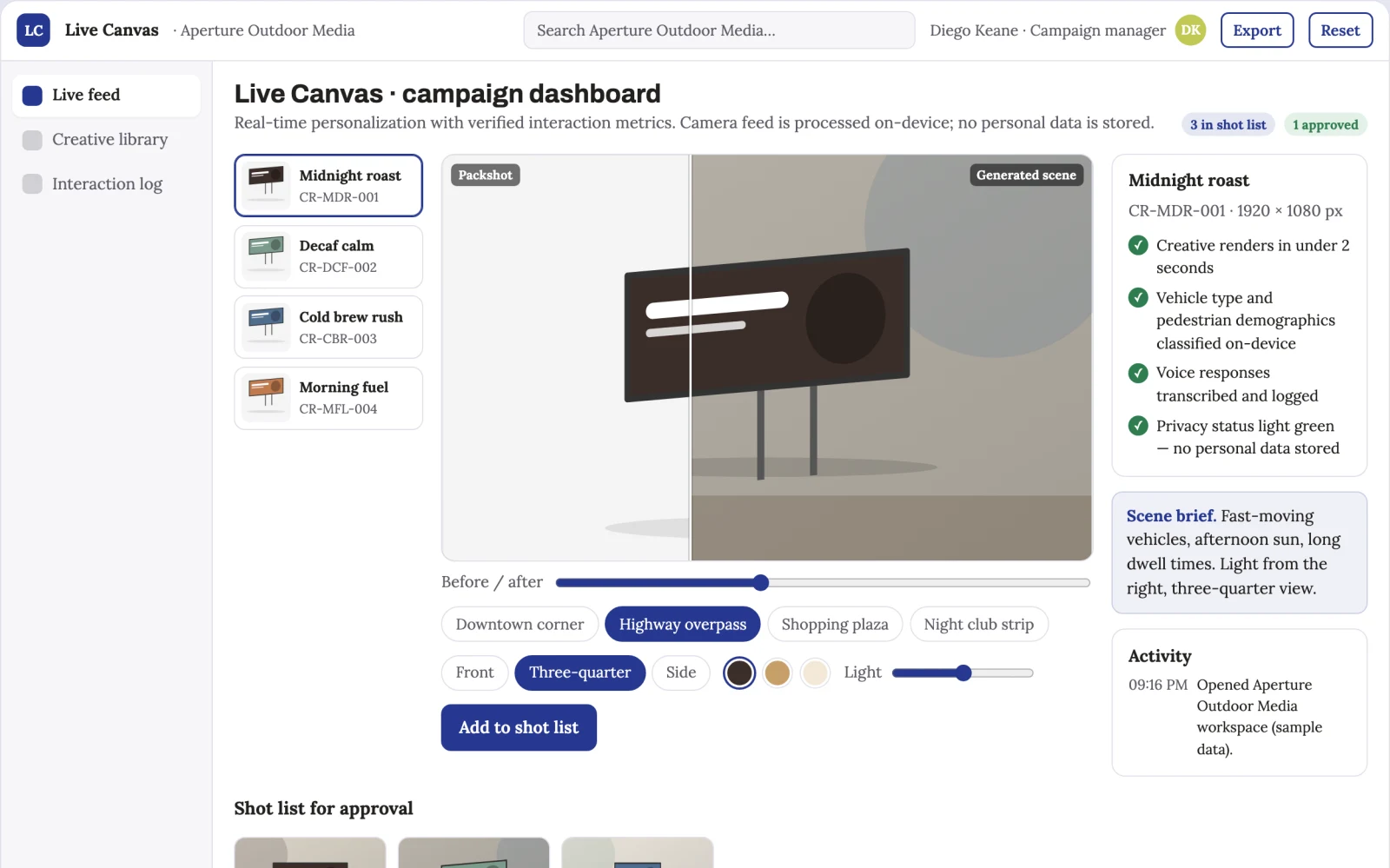
Key screens: Live feed dashboard, creative library, interaction log. Use a live feed dashboard for real-time monitoring, a creative library for managing variants, and an interaction log for tracking dwell time and voice responses. Show alerts for high engagement and a status light for privacy assurance. In this product, the first view is live feed dashboard, followed by creative library and interaction log.
Accounts and administration
User roles (admin, editor, viewer), permission-based access, creative version control, approval workflow for new creatives, audit trail of all interactions and changes, and data retention policy ensuring no personal data is stored.
Integrations and data access
Camera hardware, digital screen APIs, weather and local data feeds, and ad management platforms for creative uploads.
How we build it
We build with our own AI software development factory, so most implementations take days to a few weeks of creation time, not months. You see working software at every step, and exact timing depends on availability.
- 1
Scoping call
Day 1Thirty minutes on your process, your data and how you want to run it: for your own team, or for your clients. You get a fixed scope and price for the MVP.
- 2
MVP
5 daysOne buyer segment, one recurring use case; first modules: live feed processing and creative selection. Manual review in the loop. Built by our AI software factory.
- 3
Paid pilot
6 daysAccounts, roles, review states, audit trail and the first integration, hardened for two to three paying pilot customers.
- 4
Full product
2 weeksSelf-serve onboarding, billing, monitoring and the wider integration set.
- 5
Run and improve
MonthlyWe host, monitor and improve it for a fixed monthly fee, or hand it over to your team. How the retainer works.
Why we start with an MVP
An MVP, or minimum viable product, is the smallest version that your users can actually work with. It is not a cheap version of the full solution. It is a test, built to answer the questions that decide whether the rest is worth building.
- Pick the riskiest assumption. Here: will marketing managers at outdoor advertising firms use it to solve "static billboards waste impressions on uninterested audiences and fail to prove engagement"?
- Build only what tests it. One team, one use case, a few core modules. People do the rest by hand for now.
- Run a paid pilot. Run a 30-day pilot on one screen with two advertisers.
- Measure, then decide. Track average view time per person and interaction rate (voice responses or dwell >5 seconds). Then expand, change course or stop, with evidence instead of opinions.
MVP scope for this solution. One buyer: an outdoor advertising firm. One use case: a single screen with 10 creatives for two local advertisers. First two modules: live feed processing and creative selection. Manual review of interaction logs and weekly reports.
After the MVP. After pilot, automate creative selection based on historical performance data, integrate with ad exchange platforms for real-time bidding, and add predictive analytics for optimal placement times.
What the build depends on. Reliable power and internet at screen locations, edge AI models for vision and NLP, and a library of creatives with targeting rules.
Investment
A planning range to start the conversation, not a quote. You pay per phase, so you can stop after the MVP.
- Phase 1
MVP
One buyer segment, one recurring use case; first modules: live feed processing and creative selection. Manual review in the loop.
- Phase 2
Paid pilot
Accounts, roles, review states, audit trail and the first integration, hardened for two to three paying pilot customers.
- Phase 3
Full product
Self-serve onboarding, billing, monitoring and the wider integration set.
Indicative total, MVP to full product$38,000about 5 weeks of creation time · start with the MVP from $9,500
Running costs per month
A rough indication of monthly hosting and AI model costs once it is live, not tested. Real costs depend on usage, file sizes and the models chosen.
| Stage | Hosting and infrastructure | AI usage | Total per month |
|---|---|---|---|
| MVP and paid pilotabout 3 customers | $40–$80 | $150–$310 | $190–$390 |
| Full productabout 50 customers | $160–$320 | $2,100–$4,200 | $2,260–$4,520 |
Run it or resell it
For your own team
Marketing managers at outdoor advertising firms run it inside the business: live camera feed, creative library, contextual data (e.g., pollen count, sports scores) in, dynamic ad creatives, verified interaction metrics, weekly performance reports out, reviewed by your people.
As part of your offer
Agencies, consultancies and software companies can offer it to their own clients under their brand. We build and maintain it; you sell and deliver it.
Your brand, or this one
Run it under your own brand, or start from this concept style.
- primary
#273891 - accent
#c1c954 - surface
#e4e7f1 - ink
#22201e
- Headings
- Archivo
- Text
- Lora
- Voice
- Energetic, specific, results-minded
Selling it to your own clients: the go-to-market playbook
Pricing to test
Test pricing: $500/month per screen for the edge kit and software, plus $0.50 per verified interaction or $100 per 1000 impressions with engagement.
Message to test
Turn every passerby into a customer with ads that adapt in real time.
Where to find buyers
Industry conferences, digital advertising forums, direct sales to outdoor media owners, and partnerships with screen manufacturers.
Lead magnet
Free demo showing a simulated screen with live interaction metrics.
The first 30 days
- Week 1: Finalize hardware specs and AI model selection.
- Week 2: Build edge processing prototype.
- Week 3: Develop creative library and targeting rules.
- Week 4: Deploy on one screen and test with local advertisers.
Paid pilot
Run a 30-day pilot on one screen with two advertisers. Baseline: current average view time and interaction rate. Decision: proceed if interaction rate exceeds 5% and dwell time increases by 20%.
Success metrics
Average view time per person, interaction rate (voice responses or dwell >5 seconds).
Retention and expansion
Recurring monthly fee for software and analytics, plus per-interaction charges, creating ongoing revenue. Regular updates and new features keep clients engaged.
Why clients would pick it
Network effects from accumulated interaction data improve targeting accuracy over time, while proprietary edge AI models and partnerships with screen owners create high switching costs.
Alternatives and positioning
Static billboards, digital signage with scheduled content, or basic sensors without AI. This differs by offering dynamic personalization and measurable engagement, unlike traditional static ads.
Main delivery costs
Edge hardware ($200/unit), software development, cloud storage for reports, and maintenance support.
Safeguards
Local processing only, no cloud upload of raw video, automatic pixel deletion, visible privacy light, and strict access controls. Must not store any facial recognition data or personally identifiable information.