Local model runtime and admin console
Run AI models locally on your own device instead of in the cloud.
- For
- IT teams and developers running AI models on their own devices
- Solves
- Cloud AI sends sensitive data off-device and adds recurring per-seat costs, while local runtimes are scattered across tools with different formats, hardware support and APIs.
- Delivers
- A source-linked local runtime and administrator console
- Built in
- about 4 weeks of creation time, MVP in 5 days
- Investment
- $13,000 for the MVP, $44,000 for the full product
- Run it
- Inside your business, or as part of your offer to clients
What it does
Run AI models locally on your own device instead of in the cloud.
- Run AI models directly on the user's device without sending data to the cloud.
- Use both CPU and GPU hardware to run models locally.
- Provide source code that anyone can inspect, modify, and contribute to.
- Handle text, vision, and audio inputs and outputs in one system.
- Run models that can understand and process images.
- Manage memory efficiently to run large models on local hardware.
- Work with multiple model file formats for flexibility.
- Offer an API that simplifies adding local AI to existing applications.
- Support streaming responses and function calls for interactive or production use.
- Provide compressed models that use less memory and storage.
- Include models tailored for specific tasks like survey generation and tool integration.
- Use a custom CUDA framework to optimize deployment on compatible hardware.
- Keep the application small for quick installation and low disk usage.
- Use neural processing units for local acceleration on supported devices.
- Plan to run on more devices like smartphones and single-board computers.
- Plan to add support for speech, image generation, and video.
Everything these tools do, in one app
- Local model execution Runs AI models directly on the user's device without sending data to the cloud.Found in Kolosal AI, Ollama v0.7, Nexa SDK and 1 more
- CPU and GPU support Uses both CPU and GPU hardware to run models locally.Found in Kolosal AI, Nexa SDK
- Open-source platform Provides source code that anyone can inspect, modify, and contribute to.Found in Kolosal AI, Nexa SDK, MiniCPM 4.0
- Multimodal capabilities Handles text, vision, and audio inputs and outputs in one system.Found in Nexa SDK
- Vision model support Runs models that can understand and process images.Found in Ollama v0.7
- Memory management Efficiently manages memory to run large models on local hardware.Found in Ollama v0.7
- Model format compatibility Works with multiple model file formats for flexibility.Found in Nexa SDK
- API integration Offers an API that simplifies adding local AI to existing applications.Found in Nexa SDK
- Streaming and function calling Supports streaming responses and function calls for interactive or production use.Found in Nexa SDK
- Quantized model versions Provides compressed models that use less memory and storage.Found in MiniCPM 4.0
- Specialized agent models Includes models tailored for specific tasks like survey generation and tool integration.Found in MiniCPM 4.0
- Custom inference framework Uses a custom CUDA framework to optimize deployment on compatible hardware.Found in MiniCPM 4.0
- Lightweight application size Keeps the application small for quick installation and low disk usage.Found in Kolosal AI
- NPU backend support Uses neural processing units for local acceleration on supported devices.Found in Nexa SDK
- Planned wider device support Aims to run on more devices like smartphones and single-board computers.Found in Kolosal AI
- Future modality support Plans to add support for speech, image generation, and video.Found in Ollama v0.7
What goes in, what comes out
- Owned hardware
- Approved model files
- Application requirements

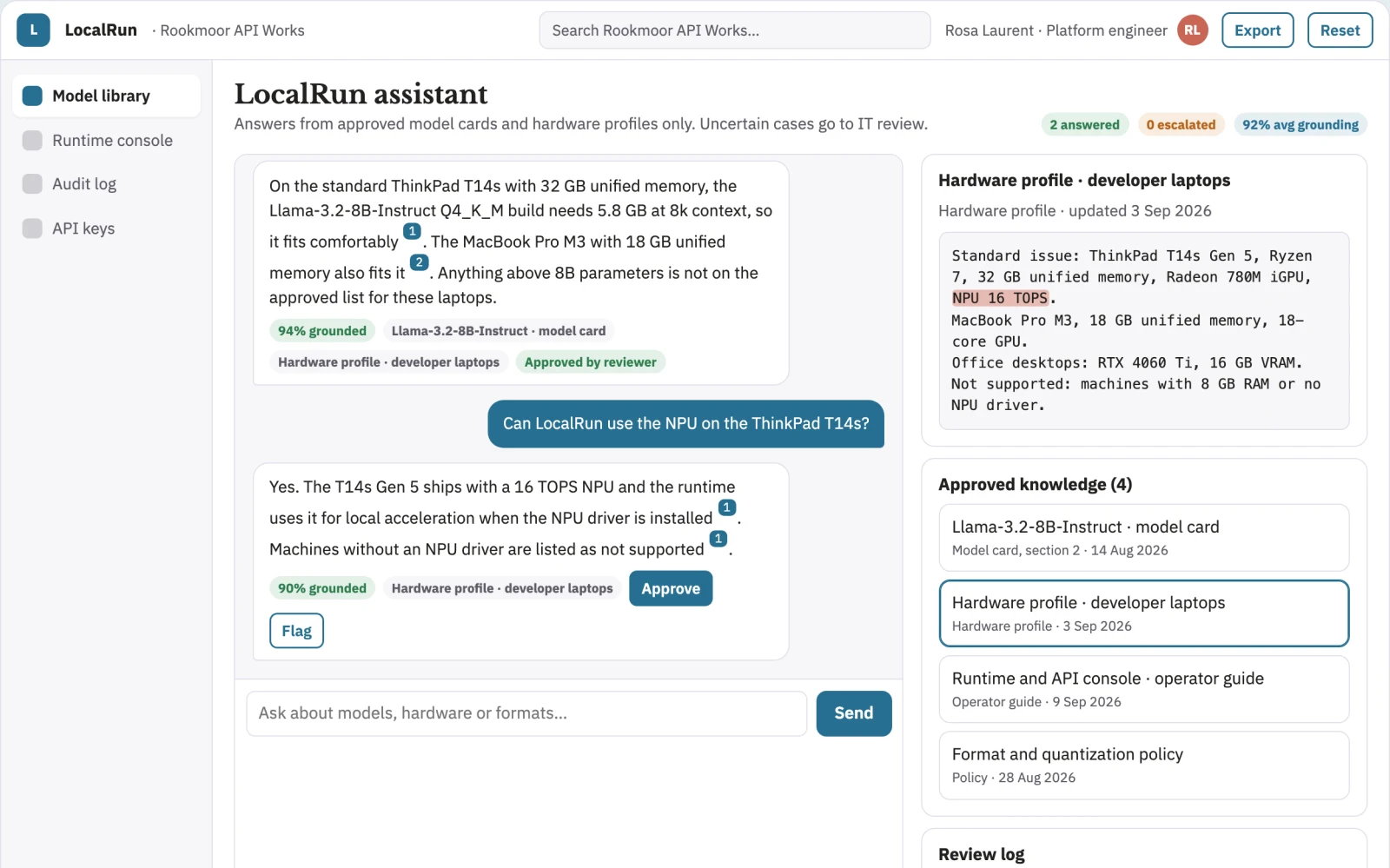
AI drafts, people review. Source-linked assistant and administrator console.
- A source-linked local runtime
- Administrator console
How it works
The workflow
- InStart with
Owned hardware, approved model files and application requirements
- 1
Confirm the buyer's problem and scope
- 2
Collect owned hardware
- 3
Approved model files and application requirements
- 4
Then follow this sequence: 1
- OutFinish with
A source-linked local runtime and administrator console
AI does the heavy lifting, people stay in charge
Use AI to interpret permitted inputs, suggest structured mappings and generate candidate outputs for the three stated task modules. Use deterministic code for arithmetic, schema validation, hard constraints and reproducible tests. Review source-linked explanations and uncertainty before accepting results. One fixed hardware profile and approved model set; final security and compliance checks remain with the buyer's IT. A model suggestion is never a verified fact, professional decision or authorization to act.
What your team sees
Primary screens: Model library and hardware profile, Runtime and API console, Admin and audit log. Use a thumbnail gallery for installed models, a large central run and chat canvas, and a right-hand panel for hardware, memory and format constraints. Let users compare model versions side by side. Display draft, running and approved states. Provide an API key view with request logs anchored to the relevant model and device. Make the task-specific outcome a source-linked local runtime and administrator console visible beside its evidence, review state and value baseline.
Accounts and administration
Project ownership, model versions, device profiles, API keys, approval states, usage allowances, request limits, download history and a rights record for supplied material. Add organization access boundaries, named reviewers, usage caps, data retention controls, export logs and explicit approval for external actions.
Integrations and data access
Buyer-owned hardware, approved model repositories and permitted application sources. Cloud asset storage, design-file import/export and publishing destinations. Start with file exchange and validate destination specifications before promising direct publishing. Start with authorized file exchange. Validate current provider access, usage rights and schema behavior before promising a connector.
How we build it
We build with our own AI software development factory, so most implementations take days to a few weeks of creation time, not months. You see working software at every step, and exact timing depends on availability.
- 1
Scoping call
Day 1Thirty minutes on your process, your data and how you want to run it: for your own team, or for your clients. You get a fixed scope and price for the MVP.
- 2
MVP
5 daysOne buyer segment, one recurring use case; first modules: run AI models directly on the user's device without sending data to the cloud; use both CPU and GPU hardware to run models locally. Manual review in the loop. Built by our AI software factory.
- 3
Paid pilot
6 daysAccounts, roles, review states, audit trail and the first integration, hardened for two to three paying pilot customers.
- 4
Full product
2 weeksSelf-serve onboarding, billing, monitoring and the wider integration set.
- 5
Run and improve
MonthlyWe host, monitor and improve it for a fixed monthly fee, or hand it over to your team. How the retainer works.
Why we start with an MVP
An MVP, or minimum viable product, is the smallest version that your users can actually work with. It is not a cheap version of the full solution. It is a test, built to answer the questions that decide whether the rest is worth building.
- Pick the riskiest assumption. Here: will IT teams and developers running AI models on their own devices use it to solve "cloud AI sends sensitive data off-device and adds recurring per-seat costs, while local runtimes are scattered across tools with different formats, hardware support and APIs"?
- Build only what tests it. One team, one use case, a few core modules. People do the rest by hand for now.
- Run a paid pilot. Agree quality and outcome thresholds before the pilot using this measure: Tokens per second on target hardware and data kept on-device.
- Measure, then decide. Track tokens per second on target hardware and data kept on-device; accepted-output rate; material error rate; reviewer correction time; actual repeat purchase. Then expand, change course or stop, with evidence instead of opinions.
MVP scope for this solution. Pilot scope: One fixed hardware profile and approved model set; final security and compliance checks remain with the buyer's IT. Implement one approved input format, a bounded representative case set and the first two task modules: run AI models directly on the user's device without sending data to the cloud; use both CPU and GPU hardware to run models locally. Support the third module with operator review: provide source code that anyone can inspect, modify, and contribute to. Include source references, corrections, basic organization access, approval states, export and value measurement. Use managed operator assistance for unresolved exceptions. The cost estimate covers this narrow prototype, not unrestricted multi-tenant scale, complex production integrations, specialist certification or physical operations.
After the MVP. Once paid pilots prove usefulness, automate repeatable reviewed steps and add one verified source integration. Expand supported inputs and case volume only after new evaluation cases pass. Build reusable customer configurations and recurring value reports around a source-linked local runtime and administrator console. Retain the explicit scope boundary: One fixed hardware profile and approved model set; final security and compliance checks remain with the buyer's IT.
What the build depends on. Model upload and preview, asynchronous generation jobs, editable version history, reviewer access and tested export formats. High-fidelity production requires specialist IT QA. Obtain representative authorized cases, baseline measurements, qualified reviewers and a buyer-side decision owner. Specific limitation: One fixed hardware profile and approved model set; final security and compliance checks remain with the buyer's IT.
Investment
A planning range to start the conversation, not a quote. You pay per phase, so you can stop after the MVP.
- Phase 1
MVP
One buyer segment, one recurring use case; first modules: run AI models directly on the user's device without sending data to the cloud; use both CPU and GPU hardware to run models locally. Manual review in the loop.
- Phase 2
Paid pilot
Accounts, roles, review states, audit trail and the first integration, hardened for two to three paying pilot customers.
- Phase 3
Full product
Self-serve onboarding, billing, monitoring and the wider integration set.
Indicative total, MVP to full product$44,000about 4 weeks of creation time · start with the MVP from $13,000
Running costs per month
A rough indication of monthly hosting and AI model costs once it is live, not tested. Real costs depend on usage, file sizes and the models chosen.
| Stage | Hosting and infrastructure | AI usage | Total per month |
|---|---|---|---|
| MVP and paid pilotabout 3 customers | $30–$60 | $60–$120 | $90–$180 |
| Full productabout 50 customers | $110–$210 | $530–$1,050 | $640–$1,260 |
Run it or resell it
For your own team
IT teams and developers running AI models on their own devices run it inside the business: owned hardware, approved model files and application requirements in, a source-linked local runtime and administrator console out, reviewed by your people.
As part of your offer
Agencies, consultancies and software companies can offer it to their own clients under their brand. We build and maintain it; you sell and deliver it.
Your brand, or this one
Run it under your own brand, or start from this concept style.
- primary
#276f91 - accent
#c96654 - surface
#e4edf1 - ink
#22201e
- Headings
- Libre Baskerville
- Text
- IBM Plex Sans
- Voice
- Technical, direct, no hype
Selling it to your own clients: the go-to-market playbook
Pricing to test
Test a USD 300-1,500 fixed pilot for one defined device and model package. Offer a monthly production allowance after repeat demand. Quote complex multi-device or specialist integration separately. These are test prices, not market benchmarks. Package the initial sale as one bounded source-linked local runtime and administrator console. Recurring fees must specify volume, review depth and integration support. For exchanges, test a disclosed coordination or successful-service fee rather than holding customer funds. Reprice only after measuring real delivery labor; platform-build cost is separate from a commercial pilot fee.
Message to test
Run AI models locally on your own device instead of in the cloud. Demonstrate a concrete source-linked local runtime and administrator console using the buyer's approved example and show the baseline, corrections and actual delivery effort.
Where to find buyers
IT teams and developers running AI models on their own devices professional communities; specialist consultants serving this buyer; permissioned partner introductions; practical demonstrations at relevant trade or practitioner events.
Lead magnet
A reviewed sample source-linked local runtime and administrator console from a small authorized input set, with a transparent calculation of tokens per second on target hardware and data kept on-device and no promised savings.
The first 30 days
- Week 1: interview five IT teams and developers running AI models on their own devices and inspect a recent example of cloud AI sending sensitive data off-device and adding recurring per-seat costs, while local runtimes are scattered across tools with different formats, hardware support and APIs.
- Week 2: prepare a consented or synthetic demonstration of the three task modules.
- Week 3: seek one bounded paid pilot with agreed baseline and acceptance criteria.
- Week 4: measure tokens per second on target hardware and data kept on-device, reviewer effort and repeat-purchase interest. This is a demand-validation plan, not a thirty-day full-product delivery promise.
Paid pilot
Agree quality and outcome thresholds before the pilot using this measure: Tokens per second on target hardware and data kept on-device. Continue only if the buyer accepts the actual output, the intended job outcome improves without unacceptable errors, and measured delivery cost fits willingness to pay. Revise or stop if access is unavailable, qualified review cannot be provided, or apparent savings disappear after corrections and support. Use held-out cases when comparing model quality; use a properly reviewed comparison design before making causal claims. Record missing cases and negative results alongside successful outputs.
Success metrics
Tokens per second on target hardware and data kept on-device; accepted-output rate; material error rate; reviewer correction time; actual repeat purchase.
Retention and expansion
Repeat the workflow when the buyer again needs a source-linked local runtime and administrator console. Retain permissioned settings and reviewed examples, report realized value honestly, and sell increased volume or adjacent approved workflows only after contribution margin and quality remain acceptable.
Why clients would pick it
A reusable library of approved hardware profiles, model formats and review examples, together with reliable delivery for a narrow IT niche. Build a permissioned library of representative task cases, reviewer corrections and verified operating constraints for IT teams and developers running AI models on their own devices. Repeatable delivery and useful integrations matter more than access to a base model.
Alternatives and positioning
Kolosal AI, Ollama v0.7, Nexa SDK and MiniCPM 4.0, plus cloud AI subscriptions. Compare this product with the buyer's present method on tokens per second on target hardware and data kept on-device. Offer a bounded paid workflow instead of claiming broad autonomous expertise. Market uniqueness and competitor coverage are not verified.
Main delivery costs
Model download and storage, GPU or NPU test hardware, reviewer hours, client revision rounds and licensed source assets. Additional initial validation requires representative authorized sample preparation, buyer interviews, buyer-side evaluation and bounded validation of a source-linked local runtime and administrator console. Track cost per accepted output, including correction work, unsuccessful cases and support.
Safeguards
Preserve data ownership, source attribution, model licensing and usage permissions. IT approves substantive changes and deployment scope. One fixed hardware profile and approved model set; final security and compliance checks remain with the buyer's IT. Keep all consequential actions under authorized human control and do not fabricate missing inputs, permissions, professional judgments or market evidence.