Multi-model AI request routing control plane
Reduce model spend and manual routing while keeping a single policy across tools.
- For
- Platform and engineering teams running several AI models across internal tools
- Solves
- Requests are sent to one default model, so cost, latency and quality vary without a central routing policy.
- Delivers
- Reviewed routing policy and per-request decision log
- Built in
- about 5 weeks of creation time, MVP in 6 days
- Investment
- $14,500 for the MVP, $49,500 for the full product
- Run it
- Inside your business, or as part of your offer to clients
What it does
Reduce model spend and manual routing while keeping a single policy across tools.
- Route each request to the most suitable model by task type.
- Apply user-defined routing rules by query type, context or cost.
- Connect and route across multiple AI providers from one interface.
- Decide routing in real time for speed and relevance.
- Show a dashboard of routing performance and usage.
- Mix several top-tier models to improve accuracy.
- Adapt reasoning settings to business or technical needs.
- Support flexible hosting for security and compliance.
- Stay compatible with the OpenAI ecosystem.
- Score task complexity and route by difficulty.
- Track cache state per provider and switch only when savings exceed rebuild cost.
- Route models from one subscription inside another tool by complexity, cost or quota.
- Show per-turn quota savings for each request.
- Let users pick the model pool and set cost-versus-speed preference.
- Use tiered decision paths for obvious, ambiguous and complex calls.
- Integrate with Codex hooks to route or re-plan before execution.
- Expose routing through MCP for other compatible systems.
- Work as a standalone layer without framework lock-in.
- Provide the full codebase for inspection and self-hosting.
- Accept per-tool API keys with centralized policy.
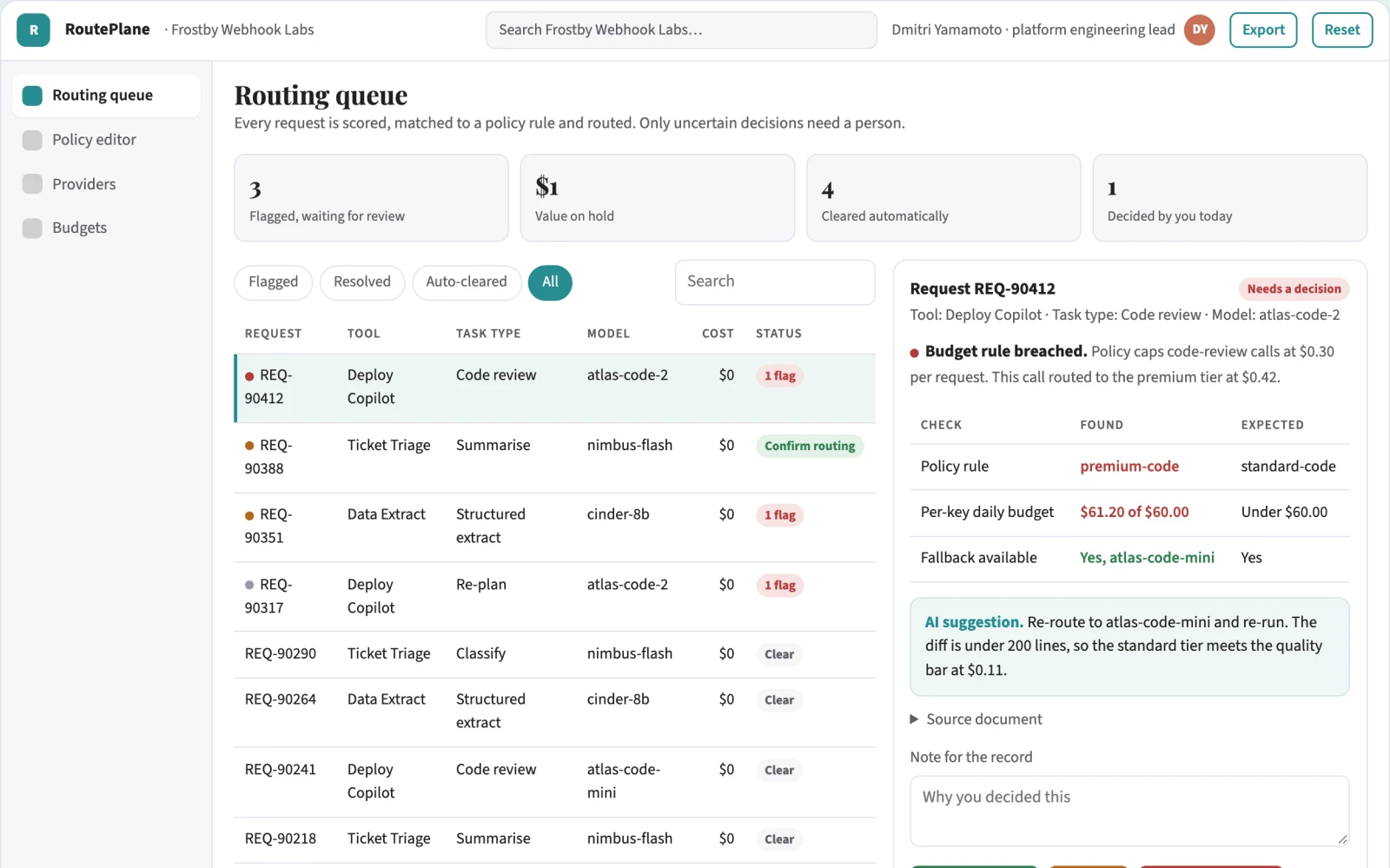
- Enforce per-key daily budgets at request time.
- Fall back automatically on errors, rate limits or timeouts.
- Display remaining quota and reset dates across accounts.
- Allow bring-your-own provider credentials.
Everything these tools do, in one app
- Automatic model routing Automatically selects and sends each request to the most suitable AI model based on the task.Found in GPT Router, Humiris AI, Weave Router 2.0 and 2 more
- Customizable routing rules Lets users define rules or preferences for how requests are routed, such as by query type, context, or cost.Found in GPT Router, Humiris AI, Weave Router 2.0
- Multi-model integration Connects to and routes across multiple AI engines or providers from a single interface.Found in GPT Router, Humiris AI, Weave Router 2.0 and 1 more
- Real-time routing decisions Makes routing decisions on the fly to optimize response speed and relevance.Found in GPT Router
- Monitoring dashboard Provides a dashboard to monitor and manage routing performance and usage.Found in GPT Router
- Model mixing Combines multiple top-tier models to improve accuracy and performance.Found in Humiris AI
- Customizable reasoning Adapts the AI's reasoning processes to meet specific business or technical needs.Found in Humiris AI
- Flexible deployment Offers various hosting solutions to address security and compliance requirements.Found in Humiris AI
- OpenAI ecosystem integration Fully compatible with the OpenAI ecosystem for easy incorporation into existing architectures.Found in Humiris AI, Zerg Router
- Complexity-scored routing Routes requests based on task difficulty using a classifier trained on agentic coding sessions.Found in Weave Router 2.0
- Cache-aware switching Tracks cache state per provider and session, switching models only when savings exceed cache rebuild costs.Found in Weave Router 2.0
- Multi-subscription routing Allows running models from one subscription inside another tool, routing by complexity, cost, or remaining quota.Found in Weave Router 2.0
- Per-turn savings visibility Shows how much quota each request saves on every turn.Found in Weave Router 2.0
- Configurable model pool Lets users select which models the router picks from and set cost-versus-speed preferences.Found in Weave Router 2.0
- Tiered decision paths Uses a fast path for obvious tool calls, Jev for ambiguous cases, and bounded MCTS for complex multi-step decisions.Found in Harness Router
- Codex hook integration Integrates with Codex via SessionStart and PreToolUse hooks to route or re-plan calls transparently before execution.Found in Harness Router, Zerg Router
- MCP exposure Exposes the routing layer through the Model Context Protocol for other MCP-compatible systems to query.Found in Harness Router
- Framework-agnostic design Works as a standalone routing layer without locking users into a specific agent framework.Found in Harness Router
- Open source Provides the full codebase for inspection, modification, and self-hosting.Found in Harness Router
- Scoped API keys Accepts per-tool API keys to keep routing policy centralized in the account.Found in Zerg Router
- Per-key daily budgets Enforces daily spending limits at request time, stopping keys when they hit their limit.Found in Zerg Router
- Automatic fallback chains Automatically tries the next model in sequence when a provider returns errors, rate limits, or timeouts.Found in Zerg Router
- Quota visibility Displays remaining weekly quota and reset dates across connected accounts.Found in Zerg Router
- Bring your own keys Allows users to use their own provider credentials instead of the router's paid usage.Found in Zerg Router
What goes in, what comes out
- Provider credentials
- Routing rules
- Task metadata
- Budget limits

AI drafts, people review. Operational coordination portal.
- Reviewed routing policy
- Per-request decision log
How it works
The workflow
- InStart with
Provider credentials, routing rules, task metadata and budget limits
- 1
Confirm the buyer's problem and scope
- 2
Collect provider credentials
- 3
Routing rules
- 4
Task metadata and budget limits
- 5
Then follow this sequence: 1
- OutFinish with
Reviewed routing policy and per-request decision log
AI does the heavy lifting, people stay in charge
Use AI to interpret permitted inputs, suggest structured mappings and generate candidate outputs for the three stated task modules. Use deterministic code for arithmetic, schema validation, hard constraints and reproducible tests. Review source-linked explanations and uncertainty before accepting results. One fixed provider set and approved hosting region; final policy and budget changes remain human. A model suggestion is never a verified fact, professional decision or authorization to act.
What your team sees
Primary screens: Routing policy editor, Live request monitor, Provider and budget console. Use a table of connected models with health and quota, a central rule canvas, and a right-hand panel for request traces and cost. Let users compare routing paths side by side. Display active, degraded and blocked states. Provide a per-request trace link with the selected model, reason and fallback history. Make the task-specific outcome reviewed routing policy and per-request decision log visible beside its evidence, review state and value baseline.
Accounts and administration
Project ownership, provider credentials, routing rule versions, API key scopes, budget limits, fallback chains, quota records and a rights record for supplied material. Add organization access boundaries, named reviewers, usage caps, data retention controls, export logs and explicit approval for external actions.
Integrations and data access
Customer-owned provider accounts, internal tools and approved model endpoints. Cloud secret storage, CI/CD pipelines and observability destinations. Start with file exchange and validate destination specifications before promising direct publishing. Start with authorized file exchange. Validate current provider access, usage rights and schema behavior before promising a connector.
How we build it
We build with our own AI software development factory, so most implementations take days to a few weeks of creation time, not months. You see working software at every step, and exact timing depends on availability.
- 1
Scoping call
Day 1Thirty minutes on your process, your data and how you want to run it: for your own team, or for your clients. You get a fixed scope and price for the MVP.
- 2
MVP
6 daysOne buyer segment, one recurring use case; first modules: route each request to the most suitable model by task type; apply user-defined routing rules by query type, context or cost. Manual review in the loop. Built by our AI software factory.
- 3
Paid pilot
7 daysAccounts, roles, review states, audit trail and the first integration, hardened for two to three paying pilot customers.
- 4
Full product
2 weeksSelf-serve onboarding, billing, monitoring and the wider integration set.
- 5
Run and improve
MonthlyWe host, monitor and improve it for a fixed monthly fee, or hand it over to your team. How the retainer works.
Why we start with an MVP
An MVP, or minimum viable product, is the smallest version that your users can actually work with. It is not a cheap version of the full solution. It is a test, built to answer the questions that decide whether the rest is worth building.
- Pick the riskiest assumption. Here: will platform and engineering teams running several AI models across internal tools use it to solve "requests are sent to one default model, so cost, latency and quality vary without a central routing policy"?
- Build only what tests it. One team, one use case, a few core modules. People do the rest by hand for now.
- Run a paid pilot. Agree quality and outcome thresholds before the pilot using this measure: Cost per accepted request and routing decision accuracy.
- Measure, then decide. Track cost per accepted request and routing decision accuracy; accepted-output rate; material error rate; reviewer correction time; actual repeat purchase. Then expand, change course or stop, with evidence instead of opinions.
MVP scope for this solution. Pilot scope: One fixed provider set and approved hosting region; final policy and budget changes remain human. Implement one approved input format, a bounded representative case set and the first two task modules: route each request to the most suitable model by task type; apply user-defined routing rules by query type, context or cost. Support the third module with operator review: connect and route across multiple AI providers from one interface. Include source references, corrections, basic organization access, approval states, export and value measurement. Use managed operator assistance for unresolved exceptions. The cost estimate covers this narrow prototype, not unrestricted multi-tenant scale, complex production integrations, specialist certification or physical operations.
After the MVP. Once paid pilots prove usefulness, automate repeatable reviewed steps and add one verified source integration. Expand supported inputs and case volume only after new evaluation cases pass. Build reusable customer configurations and recurring value reports around reviewed routing policy and per-request decision log. Retain the explicit scope boundary: One fixed provider set and approved hosting region; final policy and budget changes remain human.
What the build depends on. Credential storage, request tracing, editable rule history, reviewer access and tested export formats. High-fidelity production requires specialist engineering QA. Obtain representative authorized cases, baseline measurements, qualified reviewers and a buyer-side decision owner. Specific limitation: One fixed provider set and approved hosting region; final policy and budget changes remain human.
Investment
A planning range to start the conversation, not a quote. You pay per phase, so you can stop after the MVP.
- Phase 1
MVP
One buyer segment, one recurring use case; first modules: route each request to the most suitable model by task type; apply user-defined routing rules by query type, context or cost. Manual review in the loop.
- Phase 2
Paid pilot
Accounts, roles, review states, audit trail and the first integration, hardened for two to three paying pilot customers.
- Phase 3
Full product
Self-serve onboarding, billing, monitoring and the wider integration set.
Indicative total, MVP to full product$49,500about 5 weeks of creation time · start with the MVP from $14,500
Running costs per month
A rough indication of monthly hosting and AI model costs once it is live, not tested. Real costs depend on usage, file sizes and the models chosen.
| Stage | Hosting and infrastructure | AI usage | Total per month |
|---|---|---|---|
| MVP and paid pilotabout 3 customers | $30–$60 | $40–$90 | $70–$150 |
| Full productabout 50 customers | $110–$210 | $280–$560 | $390–$770 |
Run it or resell it
For your own team
Platform and engineering teams running several AI models across internal tools run it inside the business: provider credentials, routing rules, task metadata and budget limits in, reviewed routing policy and per-request decision log out, reviewed by your people.
As part of your offer
Agencies, consultancies and software companies can offer it to their own clients under their brand. We build and maintain it; you sell and deliver it.
Your brand, or this one
Run it under your own brand, or start from this concept style.
- primary
#278c91 - accent
#c97054 - surface
#e4f0f1 - ink
#22201e
- Headings
- Playfair Display
- Text
- Source Sans 3
- Voice
- Technical, direct, no hype
Selling it to your own clients: the go-to-market playbook
Pricing to test
Test a USD 300-1,500 fixed pilot for one defined routing package. Offer a monthly production allowance after repeat demand. Quote complex multi-tenant or compliance work separately. These are test prices, not market benchmarks. Package the initial sale as one bounded reviewed routing policy and per-request decision log. Recurring fees must specify volume, review depth and integration support. For exchanges, test a disclosed coordination or successful-service fee rather than holding customer funds. Reprice only after measuring real delivery labor; platform-build cost is separate from a commercial pilot fee.
Message to test
Reduce model spend and manual routing while keeping a single policy across tools. Demonstrate a concrete reviewed routing policy and per-request decision log using the buyer's approved example and show the baseline, corrections and actual delivery effort.
Where to find buyers
Platform and engineering teams running several AI models across internal tools professional communities; specialist consultants serving this buyer; permissioned partner introductions; practical demonstrations at relevant trade or practitioner events.
Lead magnet
A reviewed sample reviewed routing policy and per-request decision log from a small authorized input set, with a transparent calculation of cost per accepted request and routing decision accuracy and no promised savings.
The first 30 days
- Week 1: interview five platform and engineering teams running several AI models across internal tools and inspect a recent example of requests sent to one default model, so cost, latency and quality vary without a central routing policy.
- Week 2: prepare a consented or synthetic demonstration of the three task modules.
- Week 3: seek one bounded paid pilot with agreed baseline and acceptance criteria.
- Week 4: measure cost per accepted request and routing decision accuracy, reviewer effort and repeat-purchase interest. This is a demand-validation plan, not a thirty-day full-product delivery promise.
Paid pilot
Agree quality and outcome thresholds before the pilot using this measure: Cost per accepted request and routing decision accuracy. Continue only if the buyer accepts the actual output, the intended job outcome improves without unacceptable errors, and measured delivery cost fits willingness to pay. Revise or stop if access is unavailable, qualified review cannot be provided, or apparent savings disappear after corrections and support. Use held-out cases when comparing model quality; use a properly reviewed comparison design before making causal claims. Record missing cases and negative results alongside successful outputs.
Success metrics
Cost per accepted request and routing decision accuracy; accepted-output rate; material error rate; reviewer correction time; actual repeat purchase.
Retention and expansion
Repeat the workflow when the buyer again needs reviewed routing policy and per-request decision log. Retain permissioned settings and reviewed examples, report realized value honestly, and sell increased volume or adjacent approved workflows only after contribution margin and quality remain acceptable.
Why clients would pick it
A reusable library of approved routing rules, provider constraints and review examples, together with reliable delivery for a narrow engineering niche. Build a permissioned library of representative task cases, reviewer corrections and verified operating constraints for platform and engineering teams running several AI models across internal tools. Repeatable delivery and useful integrations matter more than access to a base model.
Alternatives and positioning
GPT Router, Humiris AI, Weave Router 2.0, Harness Router and Zerg Router. Compare this product with the buyer's present method on cost per accepted request and routing decision accuracy. Offer a bounded paid workflow instead of claiming broad autonomous expertise. Market uniqueness and competitor coverage are not verified.
Main delivery costs
Provider usage, routing compute, storage, reviewer hours, client revision rounds and licensed source assets. Additional initial validation requires representative authorized sample preparation, buyer interviews, buyer-side evaluation and bounded validation of reviewed routing policy and per-request decision log. Track cost per accepted output, including correction work, unsuccessful cases and support.
Safeguards
Preserve provider credentials, request privacy, source attribution and usage permissions. Named owners approve policy and budget changes and external routing scope. One fixed provider set and approved hosting region; final policy and budget changes remain human. Keep all consequential actions under authorized human control and do not fabricate missing inputs, permissions, professional judgments or market evidence.