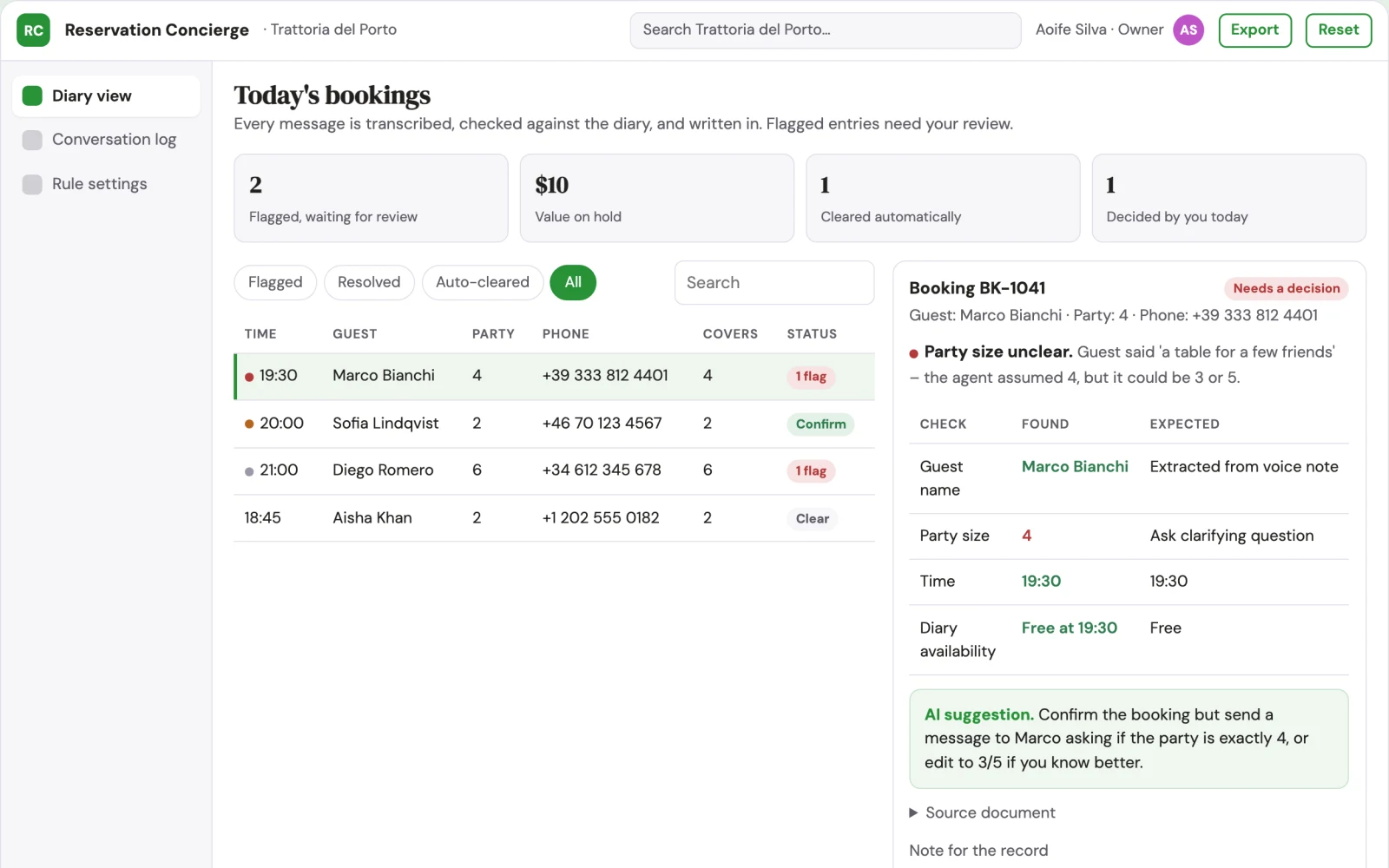
Reservation Concierge Agent
The agent reads and writes directly to the restaurant's real diary and sounds warm enough for regulars, trained on the owner's own voice rules.
- For
- Owner-operators of small restaurants and trattorias
- Solves
- Restaurants still take most bookings by phone or WhatsApp, forcing staff to interrupt prep, write on paper and double book when the diary is not checked.
- Delivers
- Confirmed diary entries, calendar invites and reminders
- Built in
- 10 days of creation time, MVP in 2 days
- Investment
- $5,000 for the MVP, $16,000 for the full product
- Run it
- Inside your business, or as part of your offer to clients
What it does
For owner-operators of small restaurants and trattorias, turn casual voice notes and text messages into confirmed diary entries with reminders and calendar invites.
- Transcribe and detect language from voice notes and text.
- Cross check availability against the diary.
- Ask one clarifying question when the request is ambiguous.
- Write the booking with guest name, party size and phone number.
- Send a calendar invite and a four hour reminder.
- Log every conversation for review.
What goes in, what comes out
- Voice notes
- Text messages from diners
- Plus the restaurant's booking diary

AI drafts, people review. Operational coordination portal.
- Confirmed diary entries
- Calendar invites
- Reminders
How it works
The workflow
- InStart with
Voice notes and text messages from diners, plus the restaurant's booking diary
- 1
Receive message
- 2
Transcribe and detect language
- 3
Check diary
- 4
Ask for missing details
- 5
Confirm and write entry
- 6
Send invite and reminder
- 7
Log the conversation
- OutFinish with
Confirmed diary entries, calendar invites and reminders
AI does the heavy lifting, people stay in charge
Use speech recognition and language models to interpret casual multi language requests and hold a short conversation. Keep the diary as structured data. A human owner reviews the conversation log and can override any booking before it is used.
What your team sees
Key screens: Diary view, conversation log, rule settings. Use a calendar grid as the main screen, with a side panel showing the latest conversation transcript and a status badge for each booking. Let the owner edit a booking directly or add blocked days. Show a weekly summary of covers handled. In this product, the first view is diary view, followed by conversation log and rule settings.
Accounts and administration
Owner account per venue, conversation logs, booking versions, override permissions, blocked day rules, and an audit trail of every change.
Integrations and data access
WhatsApp Business API, Google Calendar, a simple spreadsheet, and later a web grid and POS systems.
How we build it
We build with our own AI software development factory, so most implementations take days to a few weeks of creation time, not months. You see working software at every step, and exact timing depends on availability.
- 1
Scoping call
Day 1Thirty minutes on your process, your data and how you want to run it: for your own team, or for your clients. You get a fixed scope and price for the MVP.
- 2
MVP
2 daysOne buyer segment, one recurring use case. Manual review in the loop. Built by our AI software factory.
- 3
Paid pilot
3 daysAccounts, roles, review states, audit trail and the first integration, hardened for two to three paying pilot customers.
- 4
Full product
5 daysSelf-serve onboarding, billing, monitoring and the wider integration set.
- 5
Run and improve
MonthlyWe host, monitor and improve it for a fixed monthly fee, or hand it over to your team. How the retainer works.
Why we start with an MVP
An MVP, or minimum viable product, is the smallest version that your users can actually work with. It is not a cheap version of the full solution. It is a test, built to answer the questions that decide whether the rest is worth building.
- Pick the riskiest assumption. Here: will owner-operators of small restaurants and trattorias use it to solve "restaurants still take most bookings by phone or WhatsApp, forcing staff to interrupt prep, write on paper and double book when the diary is not checked"?
- Build only what tests it. One team, one use case, a few core modules. People do the rest by hand for now.
- Run a paid pilot. Five restaurants run the agent for two weekends.
- Measure, then decide. Track two measurable outcomes: reduction in missed calls and double bookings and and increase in confirmed bookings with reminders sent. Then expand, change course or stop, with evidence instead of opinions.
MVP scope for this solution. One city, five restaurants, one shared Google Calendar, two languages. The agent handles text and voice notes; the owner reviews the log daily. First two modules are booking confirmation and reminder sending, with manual review of ambiguous requests.
After the MVP. After the paid pilot, automate waitlist filling, birthday follow ups, weekly occupancy summaries, and learning the owner's rules from the conversation log without a setup call.
What the build depends on. Reliable speech recognition in noisy environments, WhatsApp Business API access, and a language model that can hold a short conversation and ask for missing details.
Investment
A planning range to start the conversation, not a quote. You pay per phase, so you can stop after the MVP.
- Phase 1
MVP
One buyer segment, one recurring use case. Manual review in the loop.
- Phase 2
Paid pilot
Accounts, roles, review states, audit trail and the first integration, hardened for two to three paying pilot customers.
- Phase 3
Full product
Self-serve onboarding, billing, monitoring and the wider integration set.
Indicative total, MVP to full product$16,00010 days of creation time · start with the MVP from $5,000
Running costs per month
A rough indication of monthly hosting and AI model costs once it is live, not tested. Real costs depend on usage, file sizes and the models chosen.
| Stage | Hosting and infrastructure | AI usage | Total per month |
|---|---|---|---|
| MVP and paid pilotabout 3 customers | $30–$60 | $40–$90 | $70–$150 |
| Full productabout 50 customers | $110–$210 | $280–$560 | $390–$770 |
Run it or resell it
For your own team
Owner-operators of small restaurants and trattorias run it inside the business: voice notes and text messages from diners, plus the restaurant's booking diary in, confirmed diary entries, calendar invites and reminders out, reviewed by your people.
As part of your offer
Agencies, consultancies and software companies can offer it to their own clients under their brand. We build and maintain it; you sell and deliver it.
Your brand, or this one
Run it under your own brand, or start from this concept style.
- primary
#279137 - accent
#bf54c9 - surface
#e4f1e6 - ink
#22201e
- Headings
- DM Serif Display
- Text
- DM Sans
- Voice
- Welcoming, lively, attentive
Selling it to your own clients: the go-to-market playbook
Pricing to test
Test three tiers: USD 99, 199 and 349 per month based on monthly covers handled, not features. Base tier includes the agent and calendar.
Message to test
Let the phone answer itself and never double book again.
Where to find buyers
Local restaurant associations, WhatsApp groups for hospitality owners, and direct outreach to neighbourhood bistros.
Lead magnet
A free two week trial on the owner's own phone with their own voice rules.
The first 30 days
- Week 1: Build the WhatsApp agent connected to a shared Google Calendar in two languages.
- Week 2: Onboard five restaurants and run the first weekend.
- Week 3: Measure booking count and missed call reduction.
- Week 4: Refine the clarifying question flow and present results to the pilot group.
Paid pilot
Five restaurants run the agent for two weekends. Baseline is current missed calls and double bookings. The pilot proves value if booking count holds or rises and no double bookings occur, with the owner deciding to continue after seeing the conversation log.
Success metrics
Two measurable outcomes: reduction in missed calls and double bookings, and increase in confirmed bookings with reminders sent.
Retention and expansion
The agent keeps earning a monthly fee by handling every booking and reminder; the owner stays because the phone is quieter and no shows drop.
Why clients would pick it
The more conversations the agent handles, the better it learns each venue's rules, table layouts and regulars' preferences, making it harder for a competitor to match that local knowledge.
Alternatives and positioning
Paper diaries, shared spreadsheets, or staff answering calls and WhatsApp manually. This differs by removing the need for any app, portal or POS integration and by logging every conversation.
Main delivery costs
WhatsApp Business API fees, speech recognition and language model usage per message, and a setup call with each venue.
Safeguards
The agent must not accept bookings outside opening hours or for blocked days, must never cancel a booking without owner approval, and must log every conversation for the owner to review. It must not sound pushy or robotic with regulars.