Research survey branch tester
Deterministic survey flow checks before recruitment.
- For
- Survey research teams
- Solves
- Questionnaire branches hide unreachable or contradictory paths.
- Delivers
- Researcher-reviewed routing test pack
- Built in
- about 5 weeks of creation time, MVP in 6 days
- Investment
- $18,000 for the MVP, $50,000 for the full product
- Run it
- Inside your business, or as part of your offer to clients
What it does
For survey research teams, turn approved questionnaires and routing rules into researcher-reviewed routing test pack.
- Map response branches.
- Generate synthetic paths.
- Flag logic conflicts.
- Link proposed outputs to original source records.
- Capture reviewer corrections and approval.
- Export a versioned researcher-reviewed routing test pack.
What goes in, what comes out
- Approved questionnaires
- Routing rules

AI drafts, people review. Technical delivery workspace with managed implementation.
- Researcher-reviewed routing test pack
How it works
The workflow
- InStart with
Approved questionnaires and routing rules
- 1
The buyer creates a project
- 2
Supplies approved questionnaires and routing rules
- 3
Confirms scope and access
- OutFinish with
Researcher-reviewed routing test pack
AI does the heavy lifting, people stay in charge
AI assists these bounded tasks: map response branches; generate synthetic paths; flag logic conflicts. Use only approved questionnaires and routing rules and preserve uncertainty in researcher-reviewed routing test pack. Keep model suggestions separate from verified facts. Link factual outputs to authorized input evidence and show missing information explicitly. Use deterministic checks for counts, dates, identifiers and arithmetic where applicable. A designated reviewer validates consequential outputs and signs off the delivered result.
What your team sees
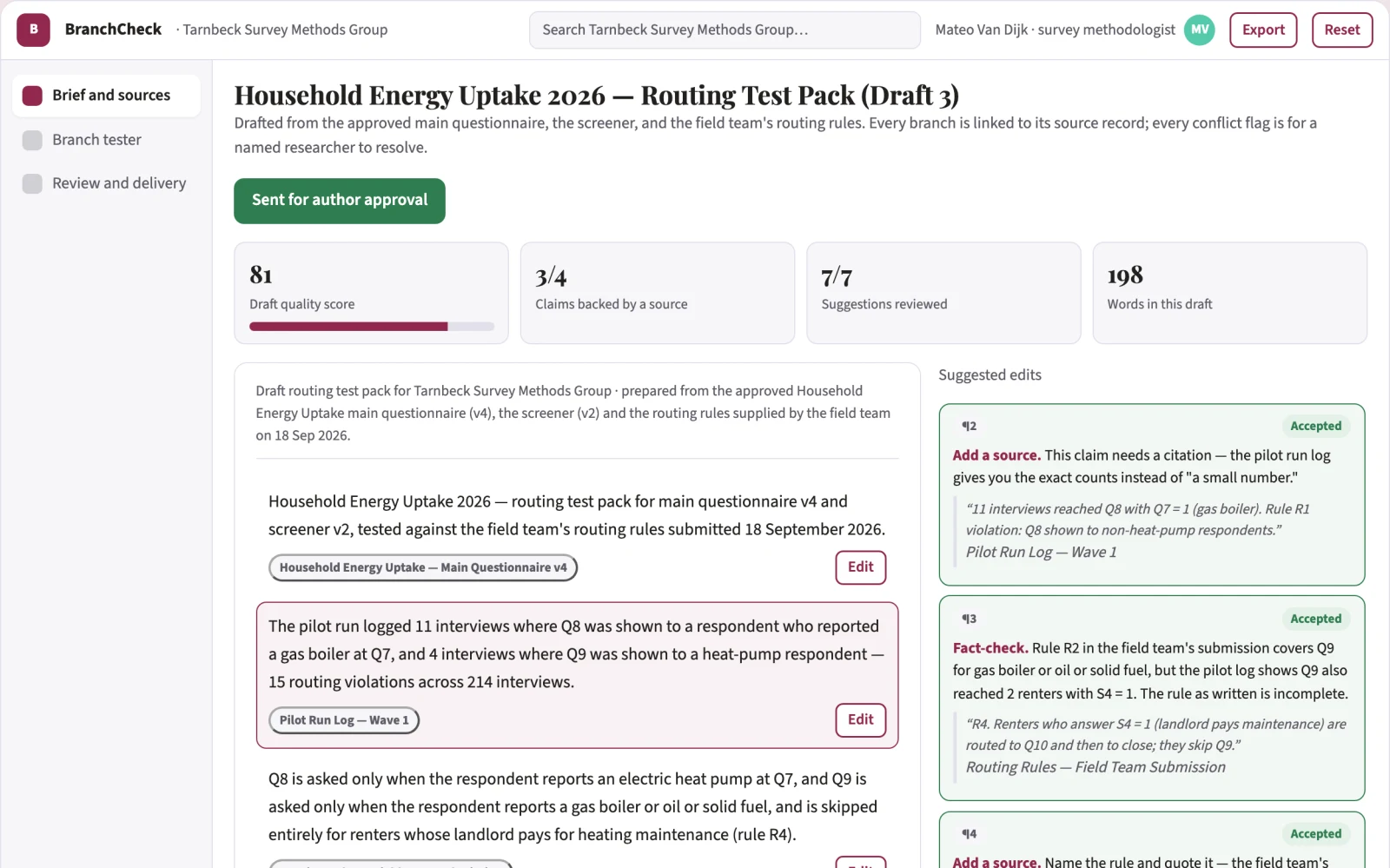
Key screens: Brief and sources, Research survey branch tester, Review and delivery. Show a work backlog, proposed changes and verification results. Link each item to its source configuration, code or data mapping. Provide execution logs and an owner-facing health view. Keep environments and approval states clearly separated so a draft cannot be mistaken for a live change. Open with brief and sources; move into research survey branch tester for the detailed task; finish in review and delivery for review and handoff. Show the source record, uncertainty and approval status beside each proposed output.
Accounts and administration
Project access, environment separation, versioned changes, test evidence, owner approvals, execution logs, rollback instructions and incident handling. Include organization-scoped access, named project owners, review queues, usage limits, export history and retention settings. Never reuse private customer material for other accounts without permission.
Integrations and data access
Authorized datasets, papers, protocols, code and research records. Approved repositories, application APIs, execution platforms and monitoring systems. Validate current API access and behavior during discovery before promising compatibility. Begin with uploads and exports of approved questionnaires and routing rules. Any named system or connector is a candidate requiring current access and compatibility checks; no live connection is included by default.
How we build it
We build with our own AI software development factory, so most implementations take days to a few weeks of creation time, not months. You see working software at every step, and exact timing depends on availability.
- 1
Scoping call
Day 1Thirty minutes on your process, your data and how you want to run it: for your own team, or for your clients. You get a fixed scope and price for the MVP.
- 2
MVP
6 daysOne buyer segment, one recurring use case; first modules: map response branches; generate synthetic paths. Manual review in the loop. Built by our AI software factory.
- 3
Paid pilot
7 daysAccounts, roles, review states, audit trail and the first integration, hardened for two to three paying pilot customers.
- 4
Full product
3 weeksSelf-serve onboarding, billing, monitoring and the wider integration set.
- 5
Run and improve
MonthlyWe host, monitor and improve it for a fixed monthly fee, or hand it over to your team. How the retainer works.
Why we start with an MVP
An MVP, or minimum viable product, is the smallest version that your users can actually work with. It is not a cheap version of the full solution. It is a test, built to answer the questions that decide whether the rest is worth building.
- Pick the riskiest assumption. Here: will survey research teams use it to solve "questionnaire branches hide unreachable or contradictory paths"?
- Build only what tests it. One team, one use case, a few core modules. People do the rest by hand for now.
- Run a paid pilot. Agree the acceptance criteria, input limits and reviewer responsibilities before starting.
- Measure, then decide. Track broken routing paths; reviewer correction minutes; buyer acceptance and repeat purchase. Then expand, change course or stop, with evidence instead of opinions.
MVP scope for this solution. Costed pilot: One organization, one defined input format and one representative pilot batch using approved questionnaires and routing rules. Professional judgment, physical inspections, live external actions and production certification remain outside this prototype. Start with one buyer organization and a bounded set of representative inputs. Implement the first two modules: map response branches; generate synthetic paths. Support the third task through an assisted review queue: flag logic conflicts. Handle the remaining required functions manually until validated. Include input upload, source references, user correction, a reviewer approval step and export of researcher-reviewed routing test pack. Authentication, account isolation, deletion controls and basic operational logging are included. Specialized production certification, live write integrations and broader rollout are not included unless explicitly stated.
After the MVP. After paying customers repeatedly accept researcher-reviewed routing test pack, automate link proposed outputs to original source records; capture reviewer corrections and approval; export a versioned researcher-reviewed routing test pack. Add one tested read integration, reusable customer configuration and scheduled repeat delivery. Increase supported formats or teams only when evaluation cases and reviewer capacity cover the new scope. One organization, one defined input format and one representative pilot batch using approved questionnaires and routing rules. Professional judgment, physical inspections, live external actions and production certification remain outside this prototype.
What the build depends on. Authorized technical access, suitable test environments, documented APIs or schemas, secrets management, meaningful checks and recovery procedures. Obtain representative authorized inputs, an agreed review rubric and a buyer-side owner. Specific scope: One organization, one defined input format and one representative pilot batch using approved questionnaires and routing rules. Professional judgment, physical inspections, live external actions and production certification remain outside this prototype.
Investment
A planning range to start the conversation, not a quote. You pay per phase, so you can stop after the MVP.
- Phase 1
MVP
One buyer segment, one recurring use case; first modules: map response branches; generate synthetic paths. Manual review in the loop.
- Phase 2
Paid pilot
Accounts, roles, review states, audit trail and the first integration, hardened for two to three paying pilot customers.
- Phase 3
Full product
Self-serve onboarding, billing, monitoring and the wider integration set.
Indicative total, MVP to full product$50,000about 5 weeks of creation time · start with the MVP from $18,000
Running costs per month
A rough indication of monthly hosting and AI model costs once it is live, not tested. Real costs depend on usage, file sizes and the models chosen.
| Stage | Hosting and infrastructure | AI usage | Total per month |
|---|---|---|---|
| MVP and paid pilotabout 3 customers | $30–$60 | $60–$120 | $90–$180 |
| Full productabout 50 customers | $110–$210 | $530–$1,050 | $640–$1,260 |
Run it or resell it
For your own team
Survey research teams run it inside the business: approved questionnaires and routing rules in, researcher-reviewed routing test pack out, reviewed by your people.
As part of your offer
Agencies, consultancies and software companies can offer it to their own clients under their brand. We build and maintain it; you sell and deliver it.
Your brand, or this one
Run it under your own brand, or start from this concept style.
- primary
#91274e - accent
#54c9aa - surface
#f1e4e9 - ink
#22201e
- Headings
- Playfair Display
- Text
- Source Sans 3
- Voice
- Rigorous, transparent, cited
Selling it to your own clients: the go-to-market playbook
Pricing to test
Test USD 1,000-4,000 for one bounded implementation or technical review, then USD 200-1,000 monthly for defined maintenance. Hosting, vendor fees and major feature changes are separate. Prices are hypotheses. For this buyer, package the first sale around prepare a sample researcher-reviewed routing test pack from a small authorized set of approved questionnaires and routing rules and the defined researcher-reviewed routing test pack. Record actual review effort before offering a recurring allowance. The commercial pilot fee is distinct from the platform development budget.
Message to test
Deterministic survey flow checks before recruitment. Demonstrate the result with prepare a sample researcher-reviewed routing test pack from a small authorized set of approved questionnaires and routing rules for survey research teams. Use a concrete before-and-after example without promising unmeasured savings.
Where to find buyers
University research offices and scientific data communities
Lead magnet
Prepare a sample researcher-reviewed routing test pack from a small authorized set of approved questionnaires and routing rules
The first 30 days
- Week 1: interview five prospective buyers from survey research teams and inspect how they handle questionnaire branches hide unreachable or contradictory paths.
- Week 2: prepare prepare a sample researcher-reviewed routing test pack from a small authorized set of approved questionnaires and routing rules using authorized or synthetic material.
- Week 3: share the demonstration through university research offices and scientific data communities and seek one bounded paid pilot.
- Week 4: measure broken routing paths; reviewer correction minutes; buyer acceptance and repeat purchase, review delivery effort and ask for a repeat purchase. This is a validation schedule, not a promise that the full product can be built in thirty days.
Paid pilot
Agree the acceptance criteria, input limits and reviewer responsibilities before starting. Run prepare a sample researcher-reviewed routing test pack from a small authorized set of approved questionnaires and routing rules and deliver researcher-reviewed routing test pack. Compare broken routing paths; reviewer correction minutes; buyer acceptance and repeat purchase with the buyer's current process on comparable cases; include corrections, missed issues and reviewer time. Seek payment and repeat use. Stop or revise the scope if data access, accuracy or unit economics fail.
Success metrics
Broken routing paths; reviewer correction minutes; buyer acceptance and repeat purchase
Retention and expansion
Build repeat use around researcher-reviewed routing test pack. Save approved configurations and review decisions with permission, revisit unresolved exceptions and show progress on broken routing paths; reviewer correction minutes; buyer acceptance and repeat purchase. Offer a recurring volume allowance after repeat demand; expand to adjacent tasks only when the buyer asks and delivery quality remains acceptable.
Why clients would pick it
Reliable niche implementations, integration knowledge, representative tests and ongoing operational responsibility. For this concept, accumulate permissioned examples and reviewer corrections around deterministic survey flow checks before recruitment. The durable asset is reliable task-specific execution and trusted customer configuration, not access to a general-purpose AI model.
Alternatives and positioning
Developers, system integrators, existing automation products and internal engineering work. Position this concept around deterministic survey flow checks before recruitment. Compare it against the customer's current process on the same representative task. This is proposed differentiation; no exhaustive competitor study or uniqueness claim has been established.
Main delivery costs
Engineering, testing, cloud execution, third-party API fees, monitoring, incident response and vendor-change maintenance. Initial validation additionally budgets for representative sample preparation, interviews with survey research teams, and qualified domain review of researcher-reviewed routing test pack. Track model usage, storage, reviewer minutes, exception handling and customer support per accepted deliverable.
Safeguards
Preserve original data, methods, citations and research limitations. Use researcher review and document every substantive transformation. One organization, one defined input format and one representative pilot batch using approved questionnaires and routing rules. Professional judgment, physical inspections, live external actions and production certification remain outside this prototype. Require appropriate access and publication approval. Preserve source material, label AI drafts and make corrections traceable. Measure false positives and missed cases alongside speed.