Calendar-Aware Handbag Rotation
A service that reads your actual calendar and weather, not your stated preferences, and ships a bag two days before you need it.
- For
- Working women in management consulting, law and enterprise sales
- Solves
- Closets full of handbags still leave women grabbing the same tote for a client dinner, a rainy Thursday or a weekend trip.
- Delivers
- Pre-shipped handbag matched to event and weather, pre-paid return label, cleaning schedule and next reservation window
- Built in
- about 3 weeks of creation time, MVP in 3 days
- Investment
- $6,500 for the MVP, $22,500 for the full product
- Run it
- Inside your business, or as part of your offer to clients
What it does
For working women in management consulting, law and enterprise sales, turn calendar events, weather forecasts, outfit photos and rental history into a pre-shipped, event-matched handbag with a pre-paid return.
- Parse calendar event text for dress code and formality.
- Match local weather forecast to bag material and size.
- Score bag options against outfit photos and style preferences.
- Trigger shipment two days before the event.
- Generate pre-paid return labels with next reservation window.
- Track bag cleaning and queue for next member.
What goes in, what comes out
- Calendar access
- Weather forecast feed
- Outfit photos
- Style preferences
- Rental history

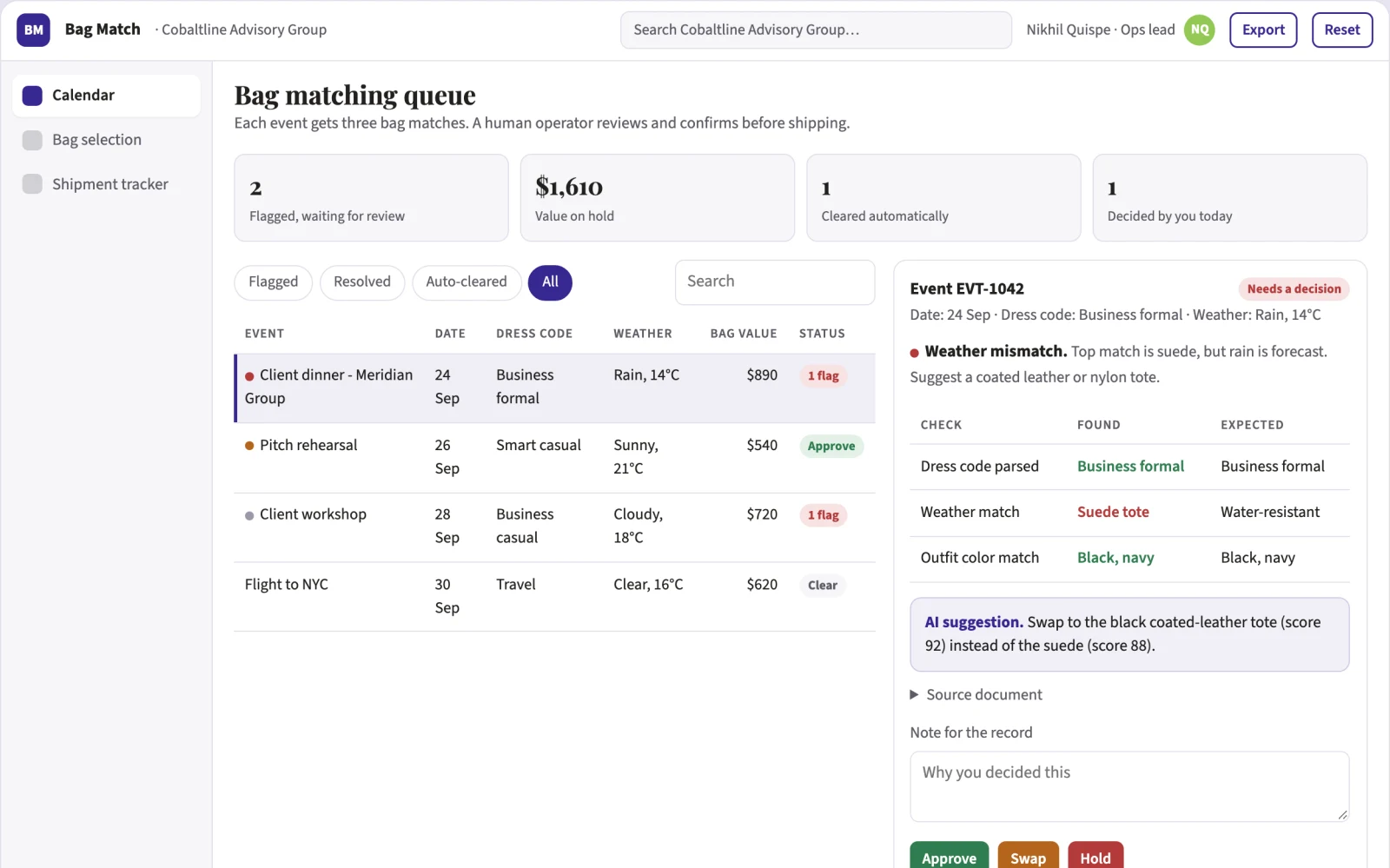
AI drafts, people review. Operational coordination portal.
- Pre-shipped handbag matched to event
- Weather
- Pre-paid return label
- Cleaning schedule
- Next reservation window
How it works
The workflow
- InStart with
Calendar access, weather forecast feed, outfit photos, style preferences, rental history
- 1
Connect calendar
- 2
Upload outfit photos
- 3
Review three matched bags
- 4
Approve or swap one
- 5
Receive shipment
- 6
Use the bag
- 7
Return in pre-paid mailer
- 8
Receive cleaning confirmation
- OutFinish with
Pre-shipped handbag matched to event and weather, pre-paid return label, cleaning schedule and next reservation window
AI does the heavy lifting, people stay in charge
Use language models to read calendar invite text for dress code and event type. Use vision models to analyse outfit photos for bag shape and colour. Use a rule-based scheduler to align shipment dates with weather and event timing. A human operator reviews all bag suggestions before shipment and confirms the final choice.
What your team sees
Key screens: Calendar view, bag selection, shipment tracker. Use a weekly calendar grid as the main view, with event cards showing dress code and weather. A bag carousel below each event shows three matched options with a swap button. Display approval state, shipment date and return window. Provide a history tab for past rentals and style feedback. In this product, the first view is calendar view, followed by bag selection and shipment tracker.
Accounts and administration
Member profiles, calendar permissions, bag inventory, reservation calendar, shipment history, return status, cleaning log, approval records and audit trail for every bag movement.
Integrations and data access
Google Calendar, Outlook, weather API, courier shipping API, payment processor, and a simple inventory database. Start with calendar and weather, add courier later.
How we build it
We build with our own AI software development factory, so most implementations take days to a few weeks of creation time, not months. You see working software at every step, and exact timing depends on availability.
- 1
Scoping call
Day 1Thirty minutes on your process, your data and how you want to run it: for your own team, or for your clients. You get a fixed scope and price for the MVP.
- 2
MVP
3 daysOne buyer segment, one recurring use case. Manual review in the loop. Built by our AI software factory.
- 3
Paid pilot
4 daysAccounts, roles, review states, audit trail and the first integration, hardened for two to three paying pilot customers.
- 4
Full product
7 daysSelf-serve onboarding, billing, monitoring and the wider integration set.
- 5
Run and improve
MonthlyWe host, monitor and improve it for a fixed monthly fee, or hand it over to your team. How the retainer works.
Why we start with an MVP
An MVP, or minimum viable product, is the smallest version that your users can actually work with. It is not a cheap version of the full solution. It is a test, built to answer the questions that decide whether the rest is worth building.
- Pick the riskiest assumption. Here: will working women in management consulting, law and enterprise sales use it to solve "closets full of handbags still leave women grabbing the same tote for a client dinner, a rainy Thursday or a weekend trip"?
- Build only what tests it. One team, one use case, a few core modules. People do the rest by hand for now.
- Run a paid pilot. Run a 6-week paid pilot with 20 consultants in one city.
- Measure, then decide. Track percentage of bags used for their matched event and and average time from calendar event to shipment confirmation. Then expand, change course or stop, with evidence instead of opinions.
MVP scope for this solution. One buyer type (consultants in one city), one use case (client dinners), first two modules (calendar parsing and bag matching), manual review by a human operator before every shipment.
After the MVP. Automate bag matching with vision models, auto-approve low-risk swaps, integrate with courier tracking and predictive demand forecasting from calendar patterns across the member base.
What the build depends on. Access to calendar APIs, a reliable weather forecast API, a vision model for outfit analysis, a bag inventory system, and a human operator workflow for approval.
Investment
A planning range to start the conversation, not a quote. You pay per phase, so you can stop after the MVP.
- Phase 1
MVP
One buyer segment, one recurring use case. Manual review in the loop.
- Phase 2
Paid pilot
Accounts, roles, review states, audit trail and the first integration, hardened for two to three paying pilot customers.
- Phase 3
Full product
Self-serve onboarding, billing, monitoring and the wider integration set.
Indicative total, MVP to full product$22,500about 3 weeks of creation time · start with the MVP from $6,500
Running costs per month
A rough indication of monthly hosting and AI model costs once it is live, not tested. Real costs depend on usage, file sizes and the models chosen.
| Stage | Hosting and infrastructure | AI usage | Total per month |
|---|---|---|---|
| MVP and paid pilotabout 3 customers | $30–$60 | $40–$90 | $70–$150 |
| Full productabout 50 customers | $110–$210 | $280–$560 | $390–$770 |
Run it or resell it
For your own team
Working women in management consulting, law and enterprise sales run it inside the business: calendar access, weather forecast feed, outfit photos, style preferences, rental history in, pre-shipped handbag matched to event and weather, pre-paid return label, cleaning schedule and next reservation window out, reviewed by your people.
As part of your offer
Agencies, consultancies and software companies can offer it to their own clients under their brand. We build and maintain it; you sell and deliver it.
Your brand, or this one
Run it under your own brand, or start from this concept style.
- primary
#372791 - accent
#93c954 - surface
#e6e4f1 - ink
#22201e
- Headings
- Playfair Display
- Text
- Source Sans 3
- Voice
- Calm, reliable, step-by-step
Selling it to your own clients: the go-to-market playbook
Pricing to test
Test pricing at $89 per month for a standard tier and $149 per month for a premium tier, with a $20 delivery fee per shipment. Hypothesis: consultants pay for time saved and relevance.
Message to test
Never stare at your closet again: get the right bag for every event, before you need it.
Where to find buyers
LinkedIn ads targeting consultants and lawyers, partnerships with executive women's networks, and referral incentives from existing members.
Lead magnet
A free one-week calendar and weather analysis showing which bags you would have been recommended for your upcoming events.
The first 30 days
- Week 1: Build calendar parsing and weather integration, recruit 20 pilot members.
- Week 2: Develop bag matching logic and outfit photo upload, train operator on manual review.
- Week 3: Ship first rotation to pilot members, collect feedback on relevance and timing.
- Week 4: Measure retention after two cycles, refine matching rules and plan the paid pilot.
Paid pilot
Run a 6-week paid pilot with 20 consultants in one city. Baseline: current time spent choosing a bag and number of unused bags per month. Decision: continue if retention after two cycles exceeds 70% and average time saved per event is over 15 minutes.
Success metrics
Percentage of bags used for their matched event, and average time from calendar event to shipment confirmation.
Retention and expansion
The service keeps earning through a monthly membership fee. After the first delivery, the agent learns from usage and feedback, improving matches, and the demand forecast increases inventory utilisation, making the service more valuable over time.
Why clients would pick it
The calendar and outfit data accumulates per member, making matching more accurate over time. The rental history and demand forecast across the member base optimises inventory utilisation, which competitors cannot replicate without the same data.
Alternatives and positioning
People use their own handbags, one-off rental sites like Rent the Runway, or subscription boxes that ship random luxury items. This differs by using calendar and weather context to select the bag, not a generic style quiz.
Main delivery costs
Bag inventory purchase or lease, cleaning and maintenance, shipping both ways, human operator time for review, and AI inference costs for calendar parsing and vision matching.
Safeguards
Members must approve every shipment before it is sent. The system must not access calendar events outside the member's explicit consent window. It must not share outfit photos or calendar data with third parties. It must not ship a bag without a confirmed return date. Human operator reviews all AI suggestions before any bag is dispatched.