FitCycle Underwear Service
A fit profile that improves with every pair, based on actual wear feedback, not just initial measurements.
- For
- Operations leads at direct-to-consumer underwear brands
- Solves
- Underwear fit is guessed, not measured, so returns and churn stay high.
- Delivers
- Personalised fit profile, approved design, auto-replenishment schedule
- Built in
- about 2 weeks of creation time, MVP in 2 days
- Investment
- $5,500 for the MVP, $17,000 for the full product
- Run it
- Inside your business, or as part of your offer to clients
What it does
For operations leads at direct-to-consumer underwear brands, turn customer photos, style preferences and wear feedback into a personalised fit profile and auto-replenishment schedule.
- Estimate body measurements from two photos.
- Map measurements to size and cut.
- Generate pattern and colour options.
- Capture voice feedback on fit.
- Predict replacement date from wear cycle.
- Adjust next order based on feedback.
What goes in, what comes out
- Customer photos (front
- Side)
- Style preferences
- Voice feedback on fit

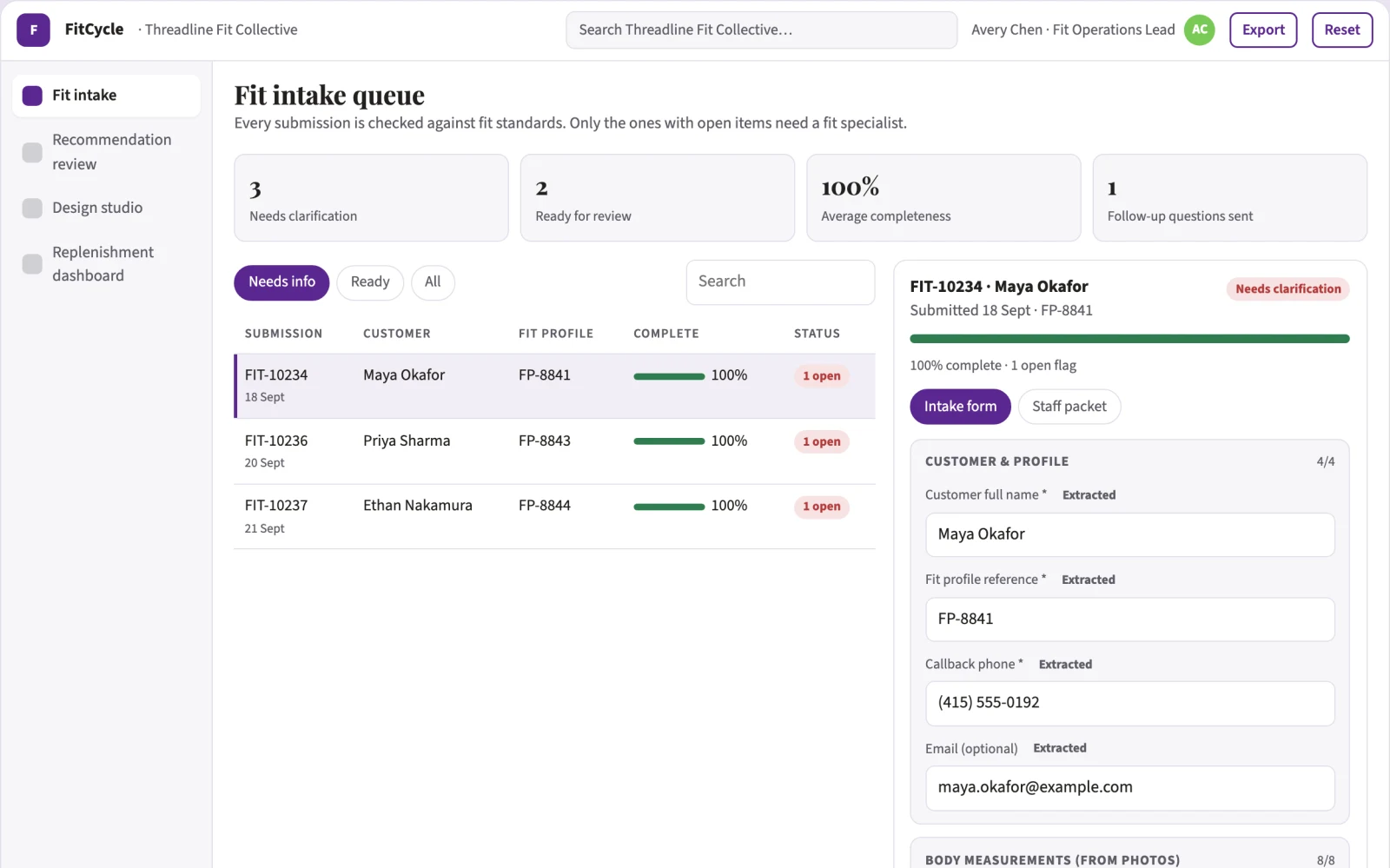
AI drafts, people review. Client intake portal and staff exception queue.
- Personalised fit profile
- Approved design
- Auto-replenishment schedule
How it works
The workflow
- InStart with
Customer photos (front and side), style preferences, voice feedback on fit
- 1
Upload photos
- 2
Consent to processing
- 3
Receive fit recommendation
- 4
Approve or tweak design
- 5
Receive first pair
- 6
Give voice feedback
- 7
Receive auto-replenished pairs
- OutFinish with
Personalised fit profile, approved design, auto-replenishment schedule
AI does the heavy lifting, people stay in charge
Use a vision model to estimate measurements from photos and a generative model to create designs. Keep size and cut decisions in structured fields. A human fit specialist reviews borderline cases and confirms design quality before production.
What your team sees
Key screens: Photo intake, fit recommendation, design studio, replenishment dashboard. Use a guided upload flow with privacy consent, a recommendation card showing size and cut, a design canvas for pattern and colour tweaks, and a calendar view of predicted replacement dates. Show fit confidence and allow voice feedback on each pair. In this product, the first view is photo intake, followed by fit recommendation, design studio and replenishment dashboard.
Accounts and administration
Customer consent records, photo deletion logs, fit profile versions, order history, feedback transcripts, subscription states and audit trail for all AI decisions.
Integrations and data access
E-commerce platform (Shopify), print-on-demand API, customer support ticketing, and payment provider.
How we build it
We build with our own AI software development factory, so most implementations take days to a few weeks of creation time, not months. You see working software at every step, and exact timing depends on availability.
- 1
Scoping call
Day 1Thirty minutes on your process, your data and how you want to run it: for your own team, or for your clients. You get a fixed scope and price for the MVP.
- 2
MVP
2 daysOne buyer segment, one recurring use case; first modules: photo intake and fit recommendation. Manual review in the loop. Built by our AI software factory.
- 3
Paid pilot
3 daysAccounts, roles, review states, audit trail and the first integration, hardened for two to three paying pilot customers.
- 4
Full product
6 daysSelf-serve onboarding, billing, monitoring and the wider integration set.
- 5
Run and improve
MonthlyWe host, monitor and improve it for a fixed monthly fee, or hand it over to your team. How the retainer works.
Why we start with an MVP
An MVP, or minimum viable product, is the smallest version that your users can actually work with. It is not a cheap version of the full solution. It is a test, built to answer the questions that decide whether the rest is worth building.
- Pick the riskiest assumption. Here: will operations leads at direct-to-consumer underwear brands use it to solve "underwear fit is guessed, not measured, so returns and churn stay high"?
- Build only what tests it. One team, one use case, a few core modules. People do the rest by hand for now.
- Run a paid pilot. A paid pilot with 50 subscribers proves it by measuring return rate and subscription renewal at 90 days.
- Measure, then decide. Track return rate below 10% and subscription renewal rate above 80% at 90 days. Then expand, change course or stop, with evidence instead of opinions.
MVP scope for this solution. One buyer, one use case: photo-based sizing for a single underwear line. First two modules: photo intake and fit recommendation. Manual review of all borderline fits. No generative design yet.
After the MVP. Automate design generation, voice feedback parsing, and replacement timing after the paid pilot. Add fabric recommendations and multi-brand catalogues.
What the build depends on. Accurate vision model for body measurement, secure image handling, and a reliable print-on-demand partner.
Investment
A planning range to start the conversation, not a quote. You pay per phase, so you can stop after the MVP.
- Phase 1
MVP
One buyer segment, one recurring use case; first modules: photo intake and fit recommendation. Manual review in the loop.
- Phase 2
Paid pilot
Accounts, roles, review states, audit trail and the first integration, hardened for two to three paying pilot customers.
- Phase 3
Full product
Self-serve onboarding, billing, monitoring and the wider integration set.
Indicative total, MVP to full product$17,000about 2 weeks of creation time · start with the MVP from $5,500
Running costs per month
A rough indication of monthly hosting and AI model costs once it is live, not tested. Real costs depend on usage, file sizes and the models chosen.
| Stage | Hosting and infrastructure | AI usage | Total per month |
|---|---|---|---|
| MVP and paid pilotabout 3 customers | $30–$60 | $40–$90 | $70–$150 |
| Full productabout 50 customers | $110–$210 | $280–$560 | $390–$770 |
Run it or resell it
For your own team
Operations leads at direct-to-consumer underwear brands run it inside the business: customer photos (front and side), style preferences, voice feedback on fit in, personalised fit profile, approved design, auto-replenishment schedule out, reviewed by your people.
As part of your offer
Agencies, consultancies and software companies can offer it to their own clients under their brand. We build and maintain it; you sell and deliver it.
Your brand, or this one
Run it under your own brand, or start from this concept style.
- primary
#5a2791 - accent
#79c954 - surface
#eae4f1 - ink
#22201e
- Headings
- Playfair Display
- Text
- Source Sans 3
- Voice
- Calm, reliable, step-by-step
Selling it to your own clients: the go-to-market playbook
Pricing to test
Test pricing at $24 per pair per month, with a $10 premium for fully custom AI-generated designs.
Message to test
Never guess your size again: get a perfect fit and automatic replacements before you run out.
Where to find buyers
Instagram ads, underwear review blogs, and subscription box comparison sites.
Lead magnet
Free fit report from two photos, with no purchase required.
The first 30 days
- Week 1: Build photo intake and consent flow.
- Week 2: Integrate vision model and size mapping.
- Week 3: Set up print-on-demand and first orders.
- Week 4: Test with 20 users and collect feedback.
Paid pilot
A paid pilot with 50 subscribers proves it by measuring return rate and subscription renewal at 90 days. Baseline is current industry return rate of 30% and renewal of 60%. Decision point: if returns drop below 10% and renewals exceed 80%, expand to full launch.
Success metrics
Return rate below 10% and subscription renewal rate above 80% at 90 days.
Retention and expansion
The service keeps earning through monthly subscriptions and premium design fees, with reorder accuracy improving as feedback accumulates.
Why clients would pick it
Each customer's feedback history and fit corrections create a proprietary dataset that makes recommendations more accurate over time, which competitors cannot replicate without the same feedback loop.
Alternatives and positioning
People today buy multi-packs blindly or use standard subscription boxes with fixed sizes. This differs by using photos for initial fit and voice feedback for continuous refinement.
Main delivery costs
Vision model inference, print-on-demand manufacturing, customer support, and cloud storage for temporary images.
Safeguards
Photo deletion after measurement, explicit consent before processing, no storage of raw images, human review of borderline fits, and a hard stop on using photos for any purpose other than sizing.