Living Story Walk
A story that remembers each guest and rebuilds itself in real time, turning any physical space into a living, personalized attraction.
- For
- Operations directors at family entertainment centers and regional theme parks
- Solves
- Static physical attractions cannot match the novelty of digital worlds, so repeat visits decline.
- Delivers
- Personalized story walk with branching narrative and memory file
- Built in
- 10 days of creation time, MVP in 2 days
- Investment
- $5,000 for the MVP, $16,000 for the full product
- Run it
- Inside your business, or as part of your offer to clients
What it does
For operations directors at family entertainment centers and regional theme parks, turn guest profiles, physical space markers, and narrative libraries into a personalized, branching story walk that changes each visit.
- Generate a unique story seed from guest history and current mood.
- Trigger scenes based on physical markers and movement.
- Adapt dialogue and atmosphere in real time.
- Save memory files for future visits.
- Review session logs for quality and safety.
- Export story variants for operator approval.
What goes in, what comes out
- Guest profiles
- Physical space markers
- Narrative libraries

AI drafts, people review. Source-based content workspace with editorial delivery.
- Personalized story walk with branching narrative
- Memory file
How it works
The workflow
- InStart with
Guest profiles, physical space markers, narrative libraries
- 1
Create a guest profile
- 2
Choose a theme
- 3
Generate a story seed
- 4
Walk the physical space
- 5
Trigger scenes
- 6
Adapt narrative based on interactions
- 7
Save a memory file
- OutFinish with
Personalized story walk with branching narrative and memory file
AI does the heavy lifting, people stay in charge
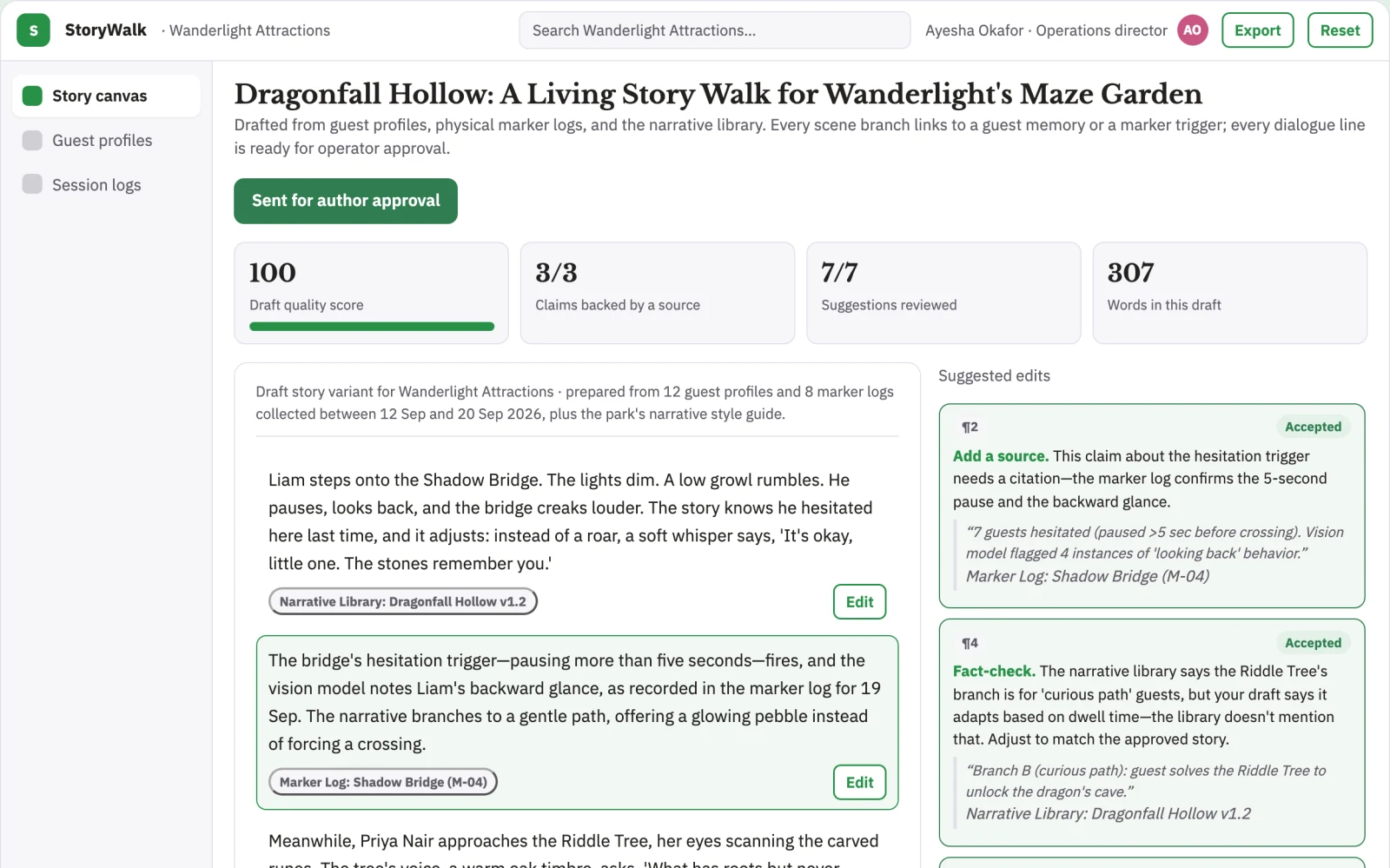
Use language models to generate dialogue and narrative branches, and vision models to track guest attention and hesitation. Keep safety and content filters in place. A human operator reviews session logs and approves story variants before public use.
What your team sees
Key screens: Guest profile, story canvas, live session view. Use a dashboard for active sessions, a central story canvas showing the current branch and triggers, and a right-hand panel for guest history and mood. Let operators monitor progress and intervene if needed. Display session logs and memory files. Provide a replay interface for post-visit review. In this product, the first view is guest profile, followed by story canvas and live session view.
Accounts and administration
Operator accounts, story versions, guest consent records, session logs, approval states, content filters, and audit trail for all generated narratives.
Integrations and data access
Guest management systems, beacon or QR infrastructure, and payment platforms.
How we build it
We build with our own AI software development factory, so most implementations take days to a few weeks of creation time, not months. You see working software at every step, and exact timing depends on availability.
- 1
Scoping call
Day 1Thirty minutes on your process, your data and how you want to run it: for your own team, or for your clients. You get a fixed scope and price for the MVP.
- 2
MVP
2 daysOne buyer segment, one recurring use case; first modules: story generation and session tracking. Manual review in the loop. Built by our AI software factory.
- 3
Paid pilot
3 daysAccounts, roles, review states, audit trail and the first integration, hardened for two to three paying pilot customers.
- 4
Full product
5 daysSelf-serve onboarding, billing, monitoring and the wider integration set.
- 5
Run and improve
MonthlyWe host, monitor and improve it for a fixed monthly fee, or hand it over to your team. How the retainer works.
Why we start with an MVP
An MVP, or minimum viable product, is the smallest version that your users can actually work with. It is not a cheap version of the full solution. It is a test, built to answer the questions that decide whether the rest is worth building.
- Pick the riskiest assumption. Here: will operations directors at family entertainment centers and regional theme parks use it to solve "static physical attractions cannot match the novelty of digital worlds, so repeat visits decline"?
- Build only what tests it. One team, one use case, a few core modules. People do the rest by hand for now.
- Run a paid pilot. Run a paid pilot at one regional park with a baseline of repeat visits and session length.
- Measure, then decide. Track repeat visit rate within 30 days and average session duration. Then expand, change course or stop, with evidence instead of opinions.
MVP scope for this solution. One buyer: a single regional park. One use case: a 15-minute haunted manor walk. First two modules: story generation and session tracking. Manual review of all generated content before use.
After the MVP. Automate story variant testing and content moderation after the paid pilot, using feedback loops to improve narrative quality.
What the build depends on. Real-time generative AI models, low-latency voice synthesis, and reliable marker detection on standard phones.
Investment
A planning range to start the conversation, not a quote. You pay per phase, so you can stop after the MVP.
- Phase 1
MVP
One buyer segment, one recurring use case; first modules: story generation and session tracking. Manual review in the loop.
- Phase 2
Paid pilot
Accounts, roles, review states, audit trail and the first integration, hardened for two to three paying pilot customers.
- Phase 3
Full product
Self-serve onboarding, billing, monitoring and the wider integration set.
Indicative total, MVP to full product$16,00010 days of creation time · start with the MVP from $5,000
Running costs per month
A rough indication of monthly hosting and AI model costs once it is live, not tested. Real costs depend on usage, file sizes and the models chosen.
| Stage | Hosting and infrastructure | AI usage | Total per month |
|---|---|---|---|
| MVP and paid pilotabout 3 customers | $30–$60 | $70–$140 | $100–$200 |
| Full productabout 50 customers | $110–$210 | $700–$1,400 | $810–$1,610 |
Run it or resell it
For your own team
Operations directors at family entertainment centers and regional theme parks run it inside the business: guest profiles, physical space markers, narrative libraries in, personalized story walk with branching narrative and memory file out, reviewed by your people.
As part of your offer
Agencies, consultancies and software companies can offer it to their own clients under their brand. We build and maintain it; you sell and deliver it.
Your brand, or this one
Run it under your own brand, or start from this concept style.
- primary
#279147 - accent
#c95483 - surface
#e4f1e8 - ink
#22201e
- Headings
- Libre Baskerville
- Text
- IBM Plex Sans
- Voice
- Welcoming, lively, attentive
Selling it to your own clients: the go-to-market playbook
Pricing to test
Test a flat monthly license fee of $2,000 per venue, plus a $1 per session revenue share for pop-up installations.
Message to test
Turn any space into a story that never repeats, and every guest into the hero of their own adventure.
Where to find buyers
Industry trade shows, direct outreach to park operators, and partnerships with immersive theater networks.
Lead magnet
Offer a free demo walk in a rented room, showing how a single physical set becomes a hundred storylines.
The first 30 days
- Week 1: Build a prototype story generator for a single theme.
- Week 2: Integrate voice and marker triggers.
- Week 3: Test with 10 users and refine branches.
- Week 4: Package as a demo for one partner venue.
Paid pilot
Run a paid pilot at one regional park with a baseline of repeat visits and session length. Measure the change in repeat visits and guest satisfaction over one month, and decide whether to expand based on a 20% improvement.
Success metrics
Repeat visit rate within 30 days and average session duration.
Retention and expansion
Ongoing license fees and revenue share, plus upsell of new story themes and memory-based personalization features.
Why clients would pick it
The accumulated memory files and narrative preferences create a proprietary guest history that is hard to replicate, and the story library grows with each session, making the system more valuable over time.
Alternatives and positioning
Static rides and scripted shows; this differs by offering infinite narrative variety and personalization without new construction.
Main delivery costs
Cloud inference for generative models, voice synthesis, and storage for session logs and memory files.
Safeguards
Content filters for appropriate language, guest consent for data storage, session limits, and a human operator override for any generated narrative. It must not collect data without consent or generate harmful content.