Adaptive Brand Showrooms
A showroom that rebuilds itself in seconds based on what each visitor looks at and asks, guided by a voice agent that knows the full range.
- For
- Sales and marketing leads at furniture and electronics brands selling high-consideration goods online
- Solves
- Static product demos ignore who is visiting and what they need, so customers leave without a reason to buy.
- Delivers
- Personalised 3D showrooms with a voice agent that adapts to each visitor
- Built in
- about 3 weeks of creation time, MVP in 4 days
- Investment
- $7,500 for the MVP, $27,000 for the full product
- Run it
- Inside your business, or as part of your offer to clients
What it does
For sales and marketing leads at furniture and electronics brands selling high-consideration goods online, turn product images, dimensions and brand guidelines into personalised 3D showrooms with a voice agent that adapts to each visitor.
- Upload product images and dimensions in bulk.
- Generate a 3D room from a brand brief.
- Configure a voice agent with product knowledge.
- Track visitor gaze and movement in session.
- Pull related items forward based on interest.
- Export session summaries and cart actions.
What goes in, what comes out
- Product images
- Dimensions
- Brand guidelines

AI drafts, people review. Visual production platform with managed creative review.
- Personalised 3D showrooms with a voice agent that adapts to each visitor
How it works
The workflow
- InStart with
Product images, dimensions and brand guidelines
- 1
Upload product assets
- 2
Set brand guidelines
- 3
Generate the room
- 4
Configure the voice agent
- 5
Review the experience
- 6
Publish a shareable link
- 7
Monitor live sessions
- OutFinish with
Personalised 3D showrooms with a voice agent that adapts to each visitor
AI does the heavy lifting, people stay in charge
Use generative models to build 3D scenes from product photos and brand briefs, and language models to power the voice agent. Keep product specifications in structured fields. Validate room dimensions and object placement through deterministic checks. A human reviewer confirms visual quality and agent accuracy before publishing.
What your team sees
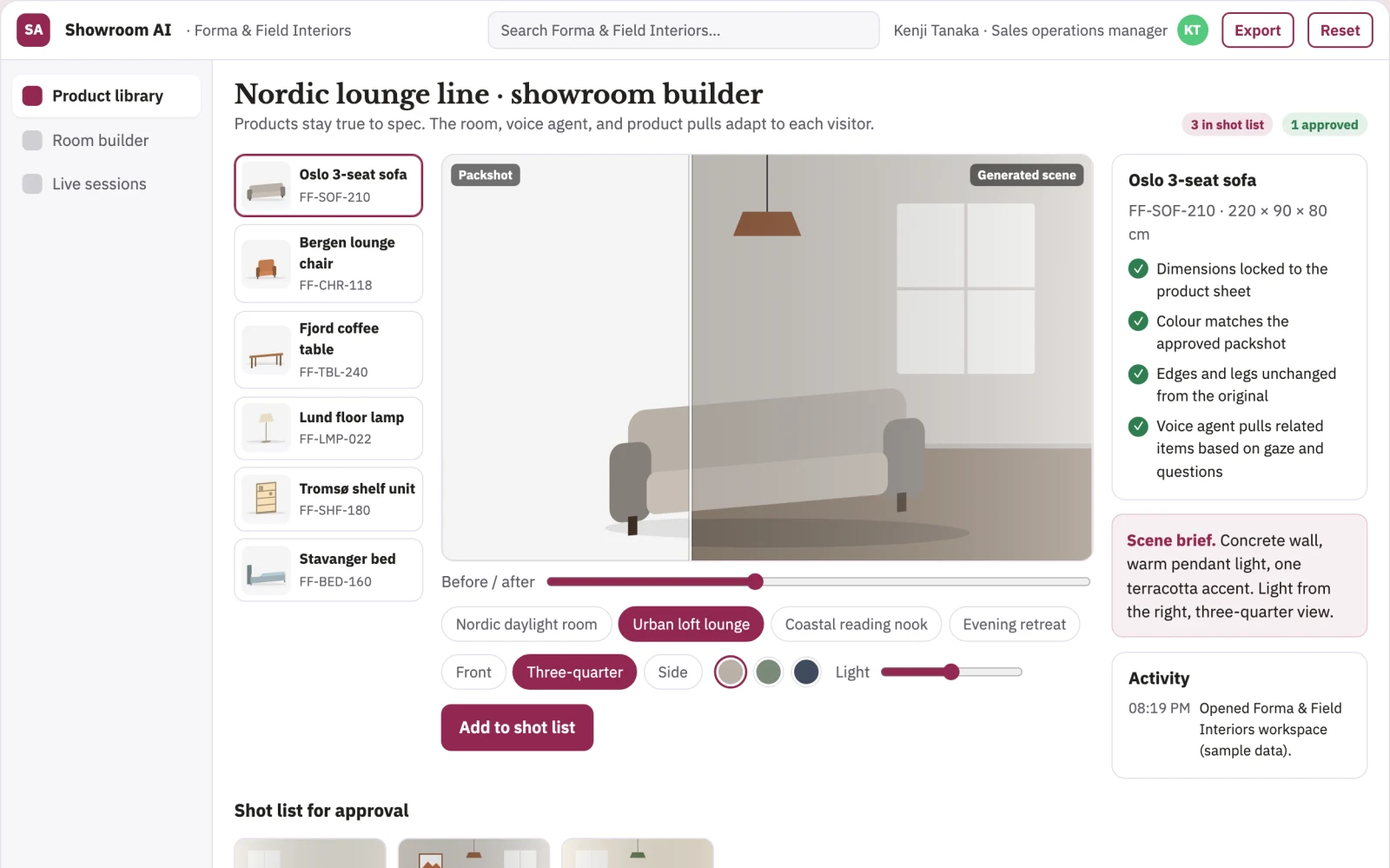
Key screens: Product library, room builder, live session view. Use a thumbnail gallery for product uploads, a central room canvas for layout and styling, and a live session panel showing visitor behaviour and agent dialogue. Let operators monitor sessions in real time. Display active, ended and queued session states. Provide a session replay link with flagged interest moments. In this product, the first view is product library, followed by room builder and live session view.
Accounts and administration
Room ownership, session logs, agent script versions, approval states, visitor consent records, usage allowances, replay history and a rights record for supplied product assets.
Integrations and data access
E-commerce platforms for cart and checkout, CRM for lead capture, and video conferencing tools for booking calls. Start with a web link and manual export.
How we build it
We build with our own AI software development factory, so most implementations take days to a few weeks of creation time, not months. You see working software at every step, and exact timing depends on availability.
- 1
Scoping call
Day 1Thirty minutes on your process, your data and how you want to run it: for your own team, or for your clients. You get a fixed scope and price for the MVP.
- 2
MVP
4 daysOne buyer segment, one recurring use case; first modules: room generator and voice agent. Manual review in the loop. Built by our AI software factory.
- 3
Paid pilot
5 daysAccounts, roles, review states, audit trail and the first integration, hardened for two to three paying pilot customers.
- 4
Full product
8 daysSelf-serve onboarding, billing, monitoring and the wider integration set.
- 5
Run and improve
MonthlyWe host, monitor and improve it for a fixed monthly fee, or hand it over to your team. How the retainer works.
Why we start with an MVP
An MVP, or minimum viable product, is the smallest version that your users can actually work with. It is not a cheap version of the full solution. It is a test, built to answer the questions that decide whether the rest is worth building.
- Pick the riskiest assumption. Here: will sales and marketing leads at furniture and electronics brands selling high-consideration goods online use it to solve "static product demos ignore who is visiting and what they need, so customers leave without a reason to buy"?
- Build only what tests it. One team, one use case, a few core modules. People do the rest by hand for now.
- Run a paid pilot. Run a paid pilot with one furniture brand.
- Measure, then decide. Track two measurable outcomes: session completion rate and cart add rate per visitor. Then expand, change course or stop, with evidence instead of opinions.
MVP scope for this solution. One buyer: sales leads at furniture brands. One use case: single product walkthrough in a browser. First two modules: room generator and voice agent. Manual review of generated rooms and agent answers before publishing.
After the MVP. Automate room regeneration based on real-time visitor behaviour, add cart and booking integrations, and scale to multi-product catalogues with self-service onboarding.
What the build depends on. Reliable 3D generation models, low-latency voice agent APIs, and a browser-based renderer that works on mobile devices.
Investment
A planning range to start the conversation, not a quote. You pay per phase, so you can stop after the MVP.
- Phase 1
MVP
One buyer segment, one recurring use case; first modules: room generator and voice agent. Manual review in the loop.
- Phase 2
Paid pilot
Accounts, roles, review states, audit trail and the first integration, hardened for two to three paying pilot customers.
- Phase 3
Full product
Self-serve onboarding, billing, monitoring and the wider integration set.
Indicative total, MVP to full product$27,000about 3 weeks of creation time · start with the MVP from $7,500
Running costs per month
A rough indication of monthly hosting and AI model costs once it is live, not tested. Real costs depend on usage, file sizes and the models chosen.
| Stage | Hosting and infrastructure | AI usage | Total per month |
|---|---|---|---|
| MVP and paid pilotabout 3 customers | $40–$80 | $150–$310 | $190–$390 |
| Full productabout 50 customers | $160–$320 | $2,100–$4,200 | $2,260–$4,520 |
Run it or resell it
For your own team
Sales and marketing leads at furniture and electronics brands selling high-consideration goods online run it inside the business: product images, dimensions and brand guidelines in, personalised 3D showrooms with a voice agent that adapts to each visitor out, reviewed by your people.
As part of your offer
Agencies, consultancies and software companies can offer it to their own clients under their brand. We build and maintain it; you sell and deliver it.
Your brand, or this one
Run it under your own brand, or start from this concept style.
- primary
#912751 - accent
#54c97d - surface
#f1e4e9 - ink
#22201e
- Headings
- Libre Baskerville
- Text
- IBM Plex Sans
- Voice
- Direct, upbeat, outcome-focused
Selling it to your own clients: the go-to-market playbook
Pricing to test
Test pricing at USD 500 per month per brand for up to 10 active rooms, plus USD 0.50 per adaptive session. No setup fee.
Message to test
Give every customer their own product demo space, built by AI in seconds and guided by voice.
Where to find buyers
Furniture and electronics trade shows, LinkedIn outreach to sales and marketing leads, and partnerships with e-commerce platforms.
Lead magnet
A free single-product showroom demo for one month, with a live session review.
The first 30 days
- Week 1: Build product upload and room generator.
- Week 2: Integrate voice agent with pre-loaded questions.
- Week 3: Test browser rendering and session tracking.
- Week 4: Run a pilot with one brand and collect feedback.
Paid pilot
Run a paid pilot with one furniture brand. Baseline: current demo conversion rate. Decision: proceed if adaptive showrooms lift session completion or cart adds by 20 percent.
Success metrics
Two measurable outcomes: session completion rate and cart add rate per visitor.
Retention and expansion
Monthly subscription continues as brands add new products and rooms; adaptive session fees grow with usage, and behavioural data improves results over time.
Why clients would pick it
Each session generates behavioural data that improves room relevance and agent responses, making the system harder to replicate as the dataset grows.
Alternatives and positioning
Static 3D tours, pre-recorded videos and standard product pages. This differs by generating a unique, conversational experience per visitor without studio production.
Main delivery costs
Cloud GPU for 3D generation, voice agent inference, storage for room assets and session logs, and human review time.
Safeguards
Limit room generation to approved product assets, restrict agent answers to verified specifications, require human approval before publishing, and block collection of personal data beyond session behaviour. Must not generate rooms for unapproved products or make claims about product features.