Nomad Field Guide
A community-maintained library whose guides re-verify themselves weekly against scanned sources, rather than articles that rot after publication.
- For
- Community leads at remote-work platforms
- Solves
- Practical nomad knowledge sits in group chats and blogs that go stale within weeks.
- Delivers
- Curated topic guides, maintained cost-of-living tables, structured field notes and subscriber update alerts
- Built in
- about 3 weeks of creation time, MVP in 4 days
- Investment
- $7,000 for the MVP, $26,000 for the full product
- Run it
- Inside your business, or as part of your offer to clients
What it does
For community leads at remote-work platforms, turn spoken field notes, member submissions and tracked nomad blogs into a maintained topic library with curated guides and live cost-of-living tables.
- Dictate field notes and return structured drafts.
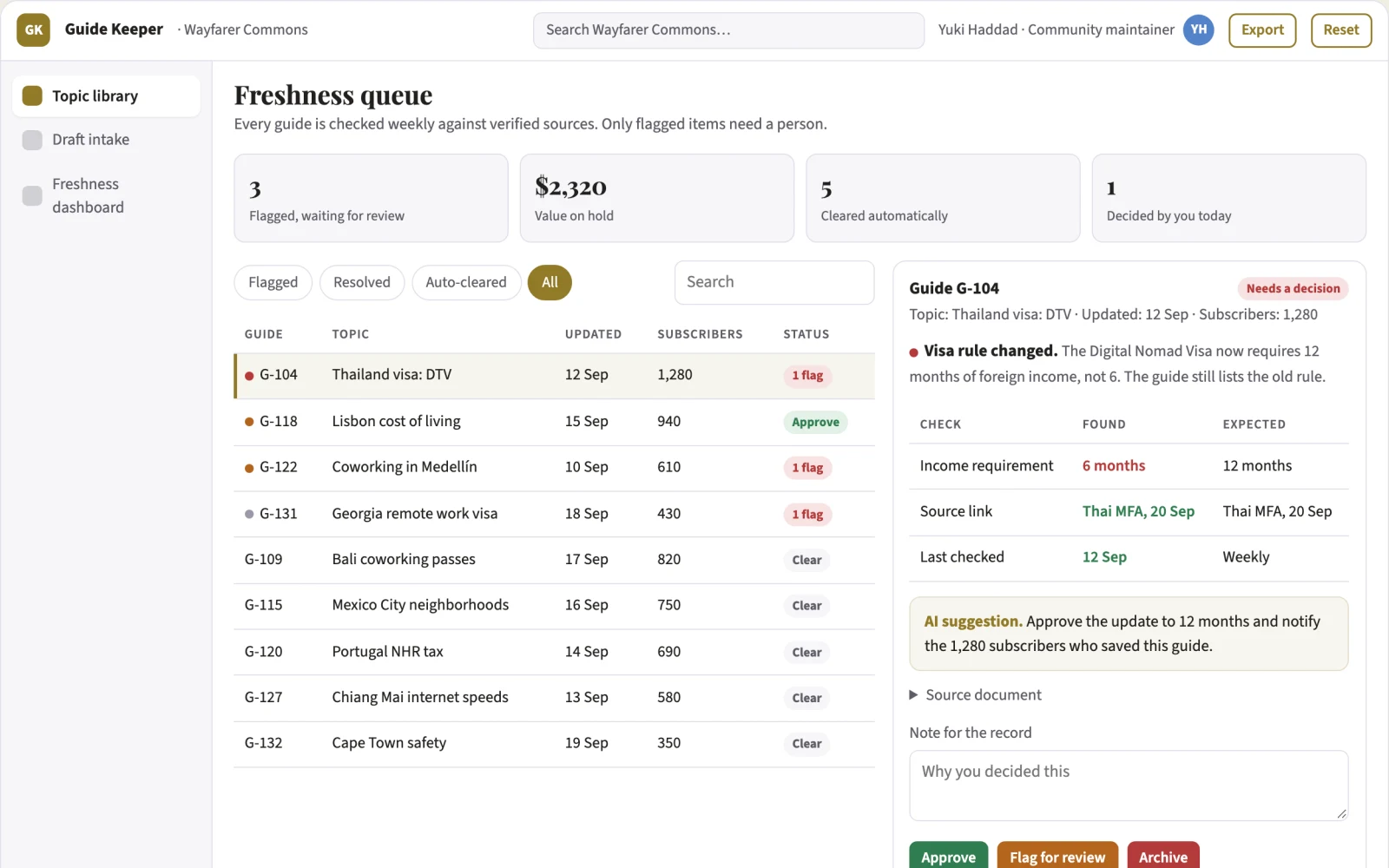
- Flag outdated visa rules, dead links and price shifts.
- Summarise tracked nomad blogs into linked topic pages.
- Maintain cost-of-living tables from photo and source checks.
- Alert subscribers when a saved guide changes.
- Export offline guide packs for paid readers.
What goes in, what comes out
- Dictated field notes
- Member draft submissions
- Contributor maintenance notes
- A tracked list of nomad blogs
- Newsletters

AI drafts, people review. Searchable structured library and data stewardship console.
- Curated topic guides
- Maintained cost-of-living tables
- Structured field notes
- Subscriber update alerts
How it works
The workflow
- InStart with
Dictated field notes, member draft submissions, contributor maintenance notes and a tracked list of nomad blogs and newsletters
- 1
Submit a note or draft
- 2
Run speech structuring and fact checks
- 3
Review flagged claims
- 4
Refine and approve the piece
- 5
Schedule freshness scans
- 6
Publish the updated guide
- 7
Notify affected subscribers
- OutFinish with
Curated topic guides, maintained cost-of-living tables, structured field notes and subscriber update alerts
AI does the heavy lifting, people stay in charge
Speech-to-text turns dictated anecdotes into structured drafts, language models summarise recurring advice from tracked blogs, and agents check visa requirements, city names and pricing against verified sources, scanning weekly for policy and cost changes. A community maintainer confirms every flagged claim, approves each published piece and arbitrates contradictions before anything enters the library.
What your team sees
Key screens: Topic library, draft intake, freshness dashboard. Use a searchable topic tree on the left, a central article view with source links and flagged claims, and a right-hand panel for review states, contributor notes and change history. Show dated cost tables with an update log beside each figure. Display draft, flagged, approved and needs-refresh states. In this product, the first view is topic library, followed by draft intake and freshness dashboard.
Accounts and administration
Contributor and maintainer roles, draft versions, flagged claim records, approval states, weekly freshness logs, source attribution, subscriber entitlements and an audit trail of every automated change.
Integrations and data access
Start simple: speech-to-text API, a tracked feed list, an internal topic store and email alerts. Later add Slack or community webhooks, insurance and visa service affiliate feeds and subscriber billing.
How we build it
We build with our own AI software development factory, so most implementations take days to a few weeks of creation time, not months. You see working software at every step, and exact timing depends on availability.
- 1
Scoping call
Day 1Thirty minutes on your process, your data and how you want to run it: for your own team, or for your clients. You get a fixed scope and price for the MVP.
- 2
MVP
4 daysOne buyer segment, one recurring use case. Manual review in the loop. Built by our AI software factory.
- 3
Paid pilot
5 daysAccounts, roles, review states, audit trail and the first integration, hardened for two to three paying pilot customers.
- 4
Full product
8 daysSelf-serve onboarding, billing, monitoring and the wider integration set.
- 5
Run and improve
MonthlyWe host, monitor and improve it for a fixed monthly fee, or hand it over to your team. How the retainer works.
Why we start with an MVP
An MVP, or minimum viable product, is the smallest version that your users can actually work with. It is not a cheap version of the full solution. It is a test, built to answer the questions that decide whether the rest is worth building.
- Pick the riskiest assumption. Here: will community leads at remote-work platforms use it to solve "practical nomad knowledge sits in group chats and blogs that go stale within weeks"?
- Build only what tests it. One team, one use case, a few core modules. People do the rest by hand for now.
- Run a paid pilot. Run an eight-week paid pilot with one platform, baseline current guide freshness measured by weeks-since-last-verified and member question volume in group chats, and decide to expand if agent scans cut verification lag in half while maintainers approve outputs at under thirty minutes per week.
- Measure, then decide. Track median days since last verified update per guide and and reduction in member questions redirected to the library per month. Then expand, change course or stop, with evidence instead of opinions.
MVP scope for this solution. One community lead at a single remote-work platform, one use case: visa-run guides for Southeast Asia. Ship draft intake with speech-to-text structuring plus a weekly freshness scan, with a maintainer reviewing and approving every published update by hand.
After the MVP. After the paid pilot, automate blog summarisation into topic pages, photo-based cost table updates, subscriber alerting and offline guide export, while keeping human approval for all rule-heavy content.
What the build depends on. Speech-to-text, retrieval over verified sources and contributor notes, summarisation, structured data tables for prices and rules, and a review queue with role-based permissions.
Investment
A planning range to start the conversation, not a quote. You pay per phase, so you can stop after the MVP.
- Phase 1
MVP
One buyer segment, one recurring use case. Manual review in the loop.
- Phase 2
Paid pilot
Accounts, roles, review states, audit trail and the first integration, hardened for two to three paying pilot customers.
- Phase 3
Full product
Self-serve onboarding, billing, monitoring and the wider integration set.
Indicative total, MVP to full product$26,000about 3 weeks of creation time · start with the MVP from $7,000
Running costs per month
A rough indication of monthly hosting and AI model costs once it is live, not tested. Real costs depend on usage, file sizes and the models chosen.
| Stage | Hosting and infrastructure | AI usage | Total per month |
|---|---|---|---|
| MVP and paid pilotabout 3 customers | $30–$60 | $50–$100 | $80–$160 |
| Full productabout 50 customers | $110–$210 | $350–$700 | $460–$910 |
Run it or resell it
For your own team
Community leads at remote-work platforms run it inside the business: dictated field notes, member draft submissions, contributor maintenance notes and a tracked list of nomad blogs and newsletters in, curated topic guides, maintained cost-of-living tables, structured field notes and subscriber update alerts out, reviewed by your people.
As part of your offer
Agencies, consultancies and software companies can offer it to their own clients under their brand. We build and maintain it; you sell and deliver it.
Your brand, or this one
Run it under your own brand, or start from this concept style.
- primary
#917a27 - accent
#5483c9 - surface
#f1eee4 - ink
#22201e
- Headings
- Playfair Display
- Text
- Source Sans 3
- Voice
- Encouraging, patient, precise
Selling it to your own clients: the go-to-market playbook
Pricing to test
Free reading with a subscriber tier at 9 USD per month for offline guides and update alerts; a platform licence at 400 USD per month as the initial hypothesis.
Message to test
Field notes from people who crossed the border last month, kept fresh by agents and vouched for by maintainers.
Where to find buyers
Remote-work and digital nomad communities on Slack and Discord, coworking space networks, nomad newsletters and partner distributions from remote-work platforms.
Lead magnet
A free maintained guide on visa runs in Southeast Asia, refreshed weekly, with a sample update alert.
The first 30 days
- Week 1: ship draft intake with speech-to-text structuring and the visa-run guide seeded from existing community notes.
- Week 2: onboard thirty contributing nomads and start the weekly freshness scan with manual maintainer review.
- Week 3: add the cost-of-living table with dated entries and the blog summarisation feed linking back to sources.
- Week 4: launch the pilot licence with update alerts and measure guide accuracy and maintainer load.
Paid pilot
Run an eight-week paid pilot with one platform, baseline current guide freshness measured by weeks-since-last-verified and member question volume in group chats, and decide to expand if agent scans cut verification lag in half while maintainers approve outputs at under thirty minutes per week.
Success metrics
Median days since last verified update per guide, and reduction in member questions redirected to the library per month.
Retention and expansion
Subscribers renew for update alerts on saved guides, maintainers renew for the freshness engine their community cannot staff, and affiliate partners renew where maintainers vouch for them.
Why clients would pick it
Accumulated contributor ground truth and a change history per topic make the library harder to match, since freshness agents degrade without maintained community notes.
Alternatives and positioning
Readers today comb Facebook groups, Slack channels and personal blogs, finding advice of unknown age. This differs by structuring contributions into dated, source-linked guides that agents keep current and maintainers vouch for.
Main delivery costs
Transcription and summarisation usage, weekly retrieval scans across tracked sources, review and moderation staffing, and platform hosting.
Safeguards
Maintainer approval gates all published claims, only vetted contributors may submit, automated edits are limited to flagged freshness changes and never rewrite approved guidance, medical and legal topics are blocked from agent-generated advice, and every automated change is logged with its source for audit.