Automated Process Correction Agent
A single agent reads every signal and drafts the exact fix, removing the need for a committee and weekly meetings
- For
- Operations leads at direct-to-consumer brands
- Solves
- Customer complaints land in support tickets and surveys but fixes are delayed by weekly meetings and roadmaps causing repeated friction.
- Delivers
- Implemented process corrections, updated knowledge base articles, automated workflow triggers, daily digest of resolved issues
- Built in
- about 3 weeks of creation time, MVP in 3 days
- Investment
- $6,000 for the MVP, $19,500 for the full product
- Run it
- Inside your business, or as part of your offer to clients
What it does
For operations leads at direct-to-consumer brands, turn unstructured feedback into process corrections and knowledge base updates.
- Aggregate unstructured feedback from multiple sources.
- Identify root causes rather than keywords.
- Draft backend configuration changes.
- Generate knowledge base articles.
- Trigger automated workflows like refunds.
- Manage approval requests for changes.
What goes in, what comes out
- Unstructured text
- Images
- Voice transcripts
- Existing helpdesk
- CRM data

AI drafts, people review. Operational coordination portal.
- Implemented process corrections
- Updated knowledge base articles
- Automated workflow triggers
- Daily digest of resolved issues
How it works
The workflow
- InStart with
Unstructured text, images, voice transcripts, existing helpdesk and CRM data
- 1
Connect data sources
- 2
Ingest feedback
- 3
Group by root cause
- 4
Draft the fix
- 5
Request approval
- 6
Implement change
- 7
Log resolution
- OutFinish with
Implemented process corrections, updated knowledge base articles, automated workflow triggers, daily digest of resolved issues
AI does the heavy lifting, people stay in charge
Use NLP to read text, images and voice transcripts. Identify intent and root cause. Draft code or configuration changes. A human checks the logic and safety of the draft before execution.
What your team sees
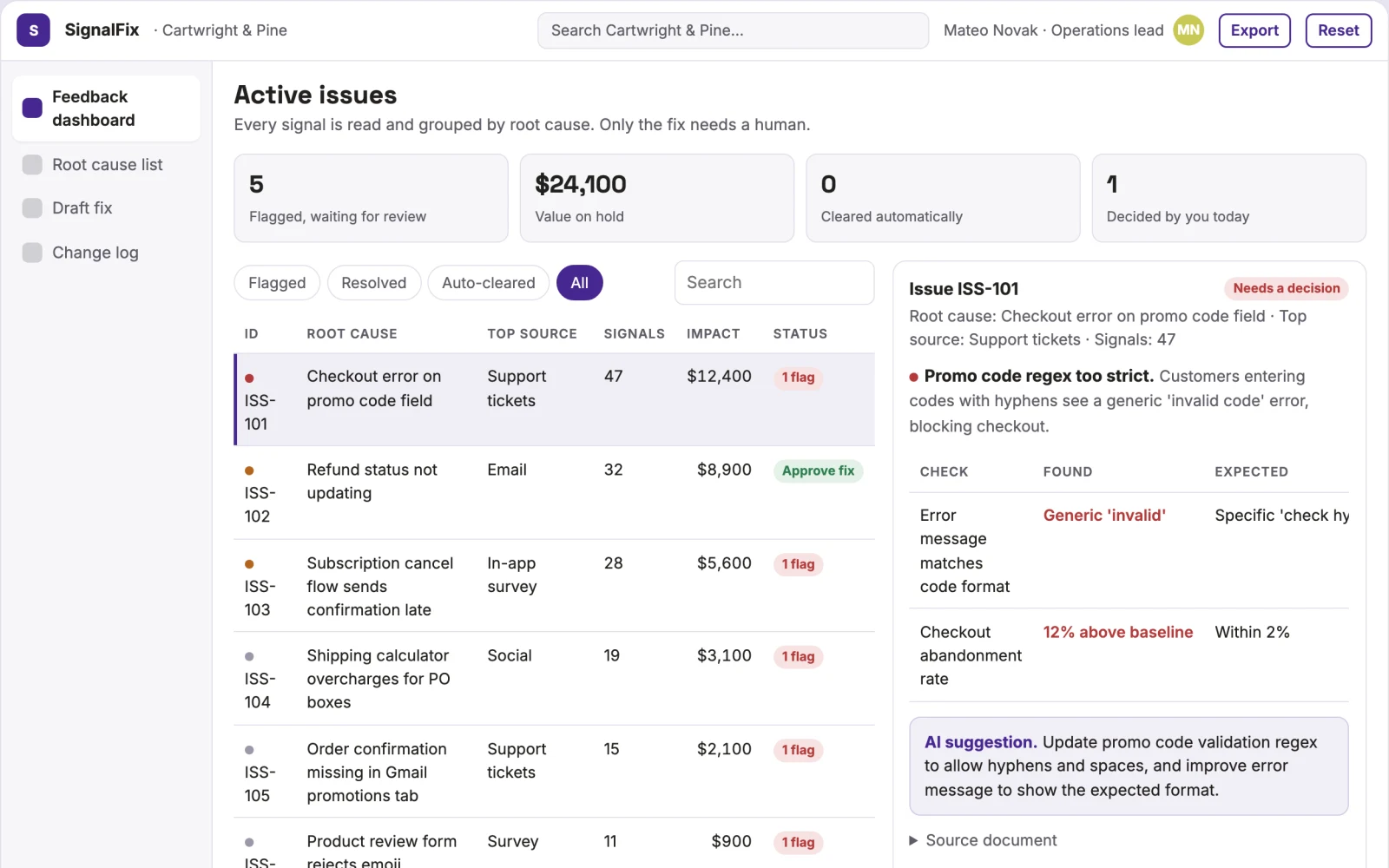
Key screens: Feedback dashboard, root cause analysis, approval workflow, change log. Use a dashboard to aggregate signals, a list view to group by root cause, a form to draft the fix, and a history log. The first view is the feedback dashboard showing active issues.
Accounts and administration
User roles for approvers, version history of changes, audit trail of AI actions, approval states, integration credentials
Integrations and data access
Helpdesk software, CRM, Order Management System, Knowledge Base
How we build it
We build with our own AI software development factory, so most implementations take days to a few weeks of creation time, not months. You see working software at every step, and exact timing depends on availability.
- 1
Scoping call
Day 1Thirty minutes on your process, your data and how you want to run it: for your own team, or for your clients. You get a fixed scope and price for the MVP.
- 2
MVP
3 daysOne buyer segment, one recurring use case. Manual review in the loop. Built by our AI software factory.
- 3
Paid pilot
4 daysAccounts, roles, review states, audit trail and the first integration, hardened for two to three paying pilot customers.
- 4
Full product
6 daysSelf-serve onboarding, billing, monitoring and the wider integration set.
- 5
Run and improve
MonthlyWe host, monitor and improve it for a fixed monthly fee, or hand it over to your team. How the retainer works.
Why we start with an MVP
An MVP, or minimum viable product, is the smallest version that your users can actually work with. It is not a cheap version of the full solution. It is a test, built to answer the questions that decide whether the rest is worth building.
- Pick the riskiest assumption. Here: will operations leads at direct-to-consumer brands use it to solve "customer complaints land in support tickets and surveys but fixes are delayed by weekly meetings and roadmaps causing repeated friction"?
- Build only what tests it. One team, one use case, a few core modules. People do the rest by hand for now.
- Run a paid pilot. Run for 30 days on one complaint type.
- Measure, then decide. Track reduction in repeat tickets for the specific issue and time saved on weekly meetings. Then expand, change course or stop, with evidence instead of opinions.
MVP scope for this solution. Connect to one helpdesk and one order system. Focus on one high-volume complaint type like wrong delivery addresses. Read tickets, group them, draft the backend rule change, and send a daily digest with one approval button.
After the MVP. Automate the approval process, expand to other complaint types, integrate with more backend systems, generate proactive alerts for emerging trends
What the build depends on. Stable APIs from the client's existing systems, sufficient volume of data to train the root cause analysis
Investment
A planning range to start the conversation, not a quote. You pay per phase, so you can stop after the MVP.
- Phase 1
MVP
One buyer segment, one recurring use case. Manual review in the loop.
- Phase 2
Paid pilot
Accounts, roles, review states, audit trail and the first integration, hardened for two to three paying pilot customers.
- Phase 3
Full product
Self-serve onboarding, billing, monitoring and the wider integration set.
Indicative total, MVP to full product$19,500about 3 weeks of creation time · start with the MVP from $6,000
Running costs per month
A rough indication of monthly hosting and AI model costs once it is live, not tested. Real costs depend on usage, file sizes and the models chosen.
| Stage | Hosting and infrastructure | AI usage | Total per month |
|---|---|---|---|
| MVP and paid pilotabout 3 customers | $30–$60 | $40–$90 | $70–$150 |
| Full productabout 50 customers | $110–$210 | $280–$560 | $390–$770 |
Run it or resell it
For your own team
Operations leads at direct-to-consumer brands run it inside the business: unstructured text, images, voice transcripts, existing helpdesk and CRM data in, implemented process corrections, updated knowledge base articles, automated workflow triggers, daily digest of resolved issues out, reviewed by your people.
As part of your offer
Agencies, consultancies and software companies can offer it to their own clients under their brand. We build and maintain it; you sell and deliver it.
Your brand, or this one
Run it under your own brand, or start from this concept style.
- primary
#472791 - accent
#c9c954 - surface
#e8e4f1 - ink
#22201e
- Headings
- Space Grotesk
- Text
- Inter
- Voice
- Calm, reliable, step-by-step
Selling it to your own clients: the go-to-market playbook
Pricing to test
Test pricing at 0.05 USD per interaction read and 50 USD per action taken
Message to test
One agent reads your feedback and fixes the process, so you never need a committee again
Where to find buyers
LinkedIn, industry forums, direct outreach to operations leads
Lead magnet
A free audit of current support ticket patterns
The first 30 days
- Week 1: Connect to helpdesk and ingest data.
- Week 2: Train the agent on one complaint type.
- Week 3: Test the drafting and approval workflow.
- Week 4: Launch pilot with daily digest.
Paid pilot
Run for 30 days on one complaint type. Establish a baseline of repeat tickets. Measure the reduction in repeat tickets after the agent implements fixes.
Success metrics
Reduction in repeat tickets for the specific issue, time saved on weekly meetings
Retention and expansion
Earn recurring fees based on the volume of interactions processed and the number of successful fixes implemented
Why clients would pick it
The value comes from the specific domain knowledge of the client's business logic and the quality of the root cause analysis, which requires fine-tuning on their specific data
Alternatives and positioning
Manual ticket triage, weekly operations meetings, quarterly roadmap planning, generic chatbots
Main delivery costs
API costs for data ingestion, compute costs for NLP processing, and developer time for initial setup and fine-tuning
Safeguards
Limits on the types of changes the agent can make, mandatory human approval for financial actions, audit logs to track AI decisions