Predictive Appliance Care
Appliances are replaced before they fail, so customers get uninterrupted use instead of emergency repairs.
- For
- Property managers with rental units
- Solves
- Appliances break unexpectedly causing operational disruption and repair costs.
- Delivers
- Automated maintenance schedules, replacement orders, technician bookings
- Built in
- about 3 weeks of creation time, MVP in 3 days
- Investment
- $6,000 for the MVP, $19,500 for the full product
- Run it
- Inside your business, or as part of your offer to clients
What it does
For property managers, turn appliance telemetry and usage data into automated maintenance schedules and replacement orders.
- Monitor sensor telemetry and usage patterns.
- Cross-reference anomalies with technical manuals.
- Check parts availability and service history.
- Book technician slots automatically.
- Order replacement parts.
- Dispatch replacement units.
What goes in, what comes out
- Appliance telemetry
- Usage patterns
- Manufacturer manuals
- Parts databases

AI drafts, people review. Operational coordination portal.
- Automated maintenance schedules
- Replacement orders
- Technician bookings
How it works
The workflow
- InStart with
Appliance telemetry, usage patterns, manufacturer manuals, parts databases
- 1
Connect sensors
- 2
Ingest data
- 3
Detect anomaly
- 4
Check history
- 5
Book repair
- 6
Order parts
- 7
Notify customer
- OutFinish with
Automated maintenance schedules, replacement orders, technician bookings
AI does the heavy lifting, people stay in charge
Use machine learning models to analyse sensor data against normal operating patterns. Cross-reference anomalies with technical manuals and parts databases. Use vision models to interpret customer photos of faults. A human supervisor confirms critical actions before execution.
What your team sees
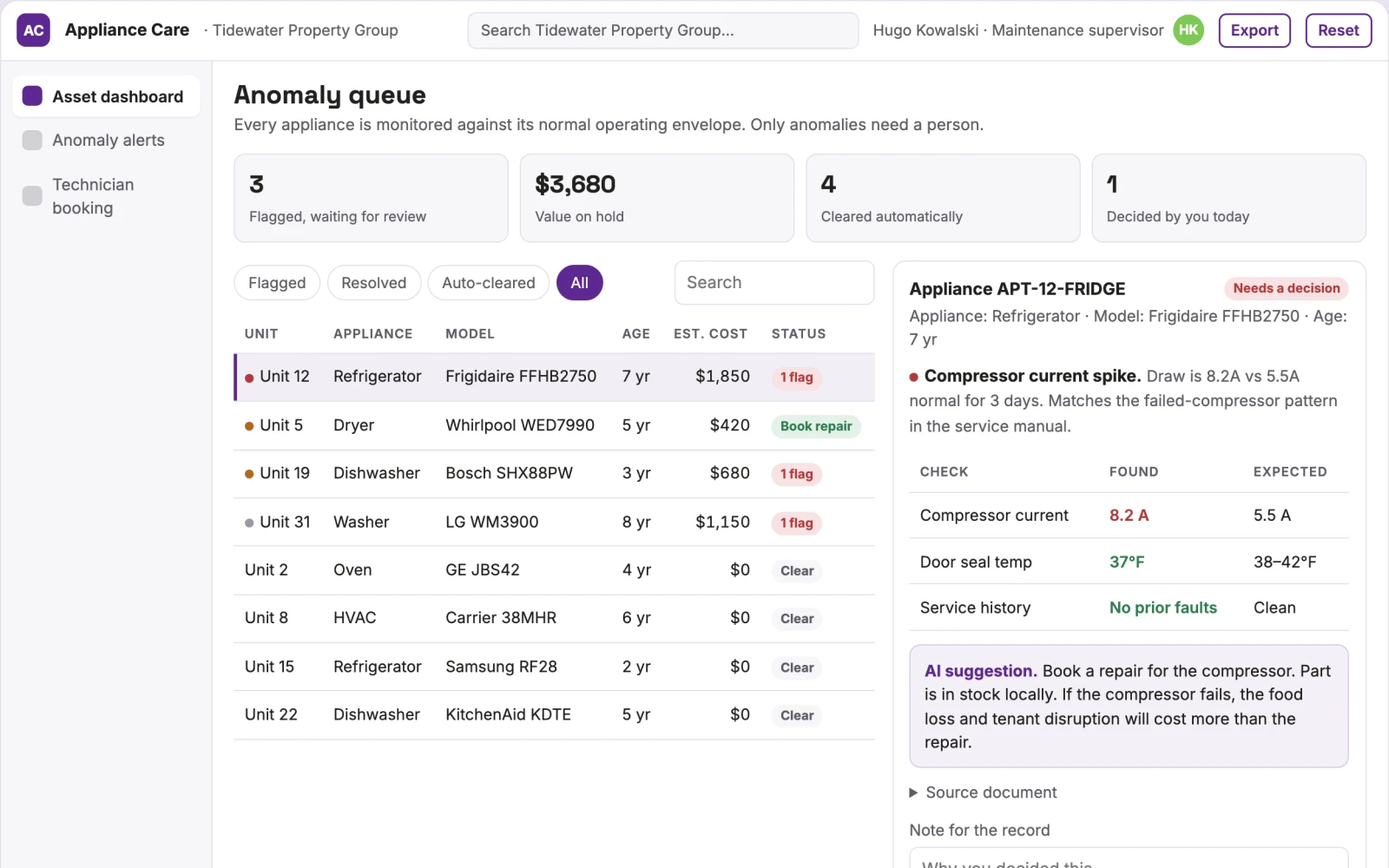
Key screens: Asset dashboard, anomaly alert, technician booking. Use a central dashboard for all connected units, a detailed alert view for specific faults, and a booking interface for service scheduling. Display real-time sensor data and historical trends. In this product, the first view is the asset dashboard, followed by anomaly alert and technician booking.
Accounts and administration
Asset ownership, sensor status, maintenance history, booking confirmations, audit trail, approval states, version control for maintenance logs.
Integrations and data access
IoT device APIs, parts supplier databases, technician scheduling software.
How we build it
We build with our own AI software development factory, so most implementations take days to a few weeks of creation time, not months. You see working software at every step, and exact timing depends on availability.
- 1
Scoping call
Day 1Thirty minutes on your process, your data and how you want to run it: for your own team, or for your clients. You get a fixed scope and price for the MVP.
- 2
MVP
3 daysOne buyer segment, one recurring use case. Manual review in the loop. Built by our AI software factory.
- 3
Paid pilot
4 daysAccounts, roles, review states, audit trail and the first integration, hardened for two to three paying pilot customers.
- 4
Full product
6 daysSelf-serve onboarding, billing, monitoring and the wider integration set.
- 5
Run and improve
MonthlyWe host, monitor and improve it for a fixed monthly fee, or hand it over to your team. How the retainer works.
Why we start with an MVP
An MVP, or minimum viable product, is the smallest version that your users can actually work with. It is not a cheap version of the full solution. It is a test, built to answer the questions that decide whether the rest is worth building.
- Pick the riskiest assumption. Here: will property managers with rental units use it to solve "appliances break unexpectedly causing operational disruption and repair costs"?
- Build only what tests it. One team, one use case, a few core modules. People do the rest by hand for now.
- Run a paid pilot. Prove it by comparing the monthly cost of this service against the historical cost of emergency repairs for a set of 50 units.
- Measure, then decide. Track reduction in emergency repair calls and reduction in tenant complaints. Then expand, change course or stop, with evidence instead of opinions.
MVP scope for this solution. First cut: one buyer (property managers), one use case (washing machines), first two modules (monitoring and anomaly detection), manual review of alerts.
After the MVP. Automated parts ordering, voice agent customer notifications, vision model integration for customer-reported faults.
What the build depends on. Connected appliance hardware with telemetry capabilities.
Investment
A planning range to start the conversation, not a quote. You pay per phase, so you can stop after the MVP.
- Phase 1
MVP
One buyer segment, one recurring use case. Manual review in the loop.
- Phase 2
Paid pilot
Accounts, roles, review states, audit trail and the first integration, hardened for two to three paying pilot customers.
- Phase 3
Full product
Self-serve onboarding, billing, monitoring and the wider integration set.
Indicative total, MVP to full product$19,500about 3 weeks of creation time · start with the MVP from $6,000
Running costs per month
A rough indication of monthly hosting and AI model costs once it is live, not tested. Real costs depend on usage, file sizes and the models chosen.
| Stage | Hosting and infrastructure | AI usage | Total per month |
|---|---|---|---|
| MVP and paid pilotabout 3 customers | $30–$60 | $40–$90 | $70–$150 |
| Full productabout 50 customers | $110–$210 | $280–$560 | $390–$770 |
Run it or resell it
For your own team
Property managers with rental units run it inside the business: appliance telemetry, usage patterns, manufacturer manuals, parts databases in, automated maintenance schedules, replacement orders, technician bookings out, reviewed by your people.
As part of your offer
Agencies, consultancies and software companies can offer it to their own clients under their brand. We build and maintain it; you sell and deliver it.
Your brand, or this one
Run it under your own brand, or start from this concept style.
- primary
#5c2791 - accent
#7dc954 - surface
#ebe4f1 - ink
#22201e
- Headings
- Space Grotesk
- Text
- Inter
- Voice
- Calm, reliable, step-by-step
Selling it to your own clients: the go-to-market playbook
Pricing to test
$50 per appliance per month
Message to test
Stop paying for emergency repairs and start paying for predictable appliance uptime.
Where to find buyers
Property management software forums, real estate trade shows, commercial cleaning suppliers.
Lead magnet
Free 30-day trial of the monitoring dashboard for one property.
The first 30 days
- Week 1: Install sensors on a small batch of washing machines.
- Week 2: Train the model on normal usage patterns.
- Week 3: Review flagged anomalies with a human operator.
- Week 4: Confirm the system can predict failures.
Paid pilot
Prove it by comparing the monthly cost of this service against the historical cost of emergency repairs for a set of 50 units. The decision is whether the savings outweigh the subscription fee.
Success metrics
Reduction in emergency repair calls, reduction in tenant complaints.
Retention and expansion
Renew monthly subscription based on continued uptime and satisfaction.
Why clients would pick it
Accumulated data on appliance failure patterns creates a proprietary model that improves accuracy over time.
Alternatives and positioning
Manual inspection, reactive repair calls, standard warranties.
Main delivery costs
Sensor hardware costs, technician dispatch fees, parts inventory holding.
Safeguards
Limit automated spending to pre-approved budgets, require human approval for part orders over a certain value.