Ambient Clinical Note Assistant
Clinical notes drafted from the consultation on the device, so patient data never leaves the room until the clinician approves it.
- For
- Clinicians at small GP practices
- Solves
- Documentation burdens consume evenings and reduce time with patients.
- Delivers
- Structured clinical notes, draft records, audit trail of the consultation
- Built in
- about 4 weeks of creation time, MVP in 4 days
- Investment
- $7,500 for the MVP, $28,000 for the full product
- Run it
- Inside your business, or as part of your offer to clients
What it does
For clinicians at small GP practices, turn consultation audio and dialogue into structured clinical notes and draft records, and the problem it addresses is evenings spent typing notes from memory or shorthand.
- Capture audio in real time.
- Distinguish speaker roles.
- Transcribe dialogue to text.
- Map text to structured templates.
- Provide secure review and approval.
- Export to EHR systems.
What goes in, what comes out
- Consultation audio
- Patient dialogue
- Clinical note templates

AI drafts, people review. Source-linked assistant and administrator console.
- Structured clinical notes
- Draft records
- Audit trail of the consultation
How it works
The workflow
- InStart with
Consultation audio, patient dialogue, clinical note templates
- 1
Start consultation
- 2
Capture audio
- 3
Generate draft
- 4
Review and edit
- 5
Approve note
- 6
Save to EHR
- OutFinish with
Structured clinical notes, draft records, audit trail of the consultation
AI does the heavy lifting, people stay in charge
Use speech-to-text and language models to structure dialogue into clinical templates. Detect speaker intent and context. A clinician reviews the draft for clinical accuracy and privacy compliance before saving.
What your team sees
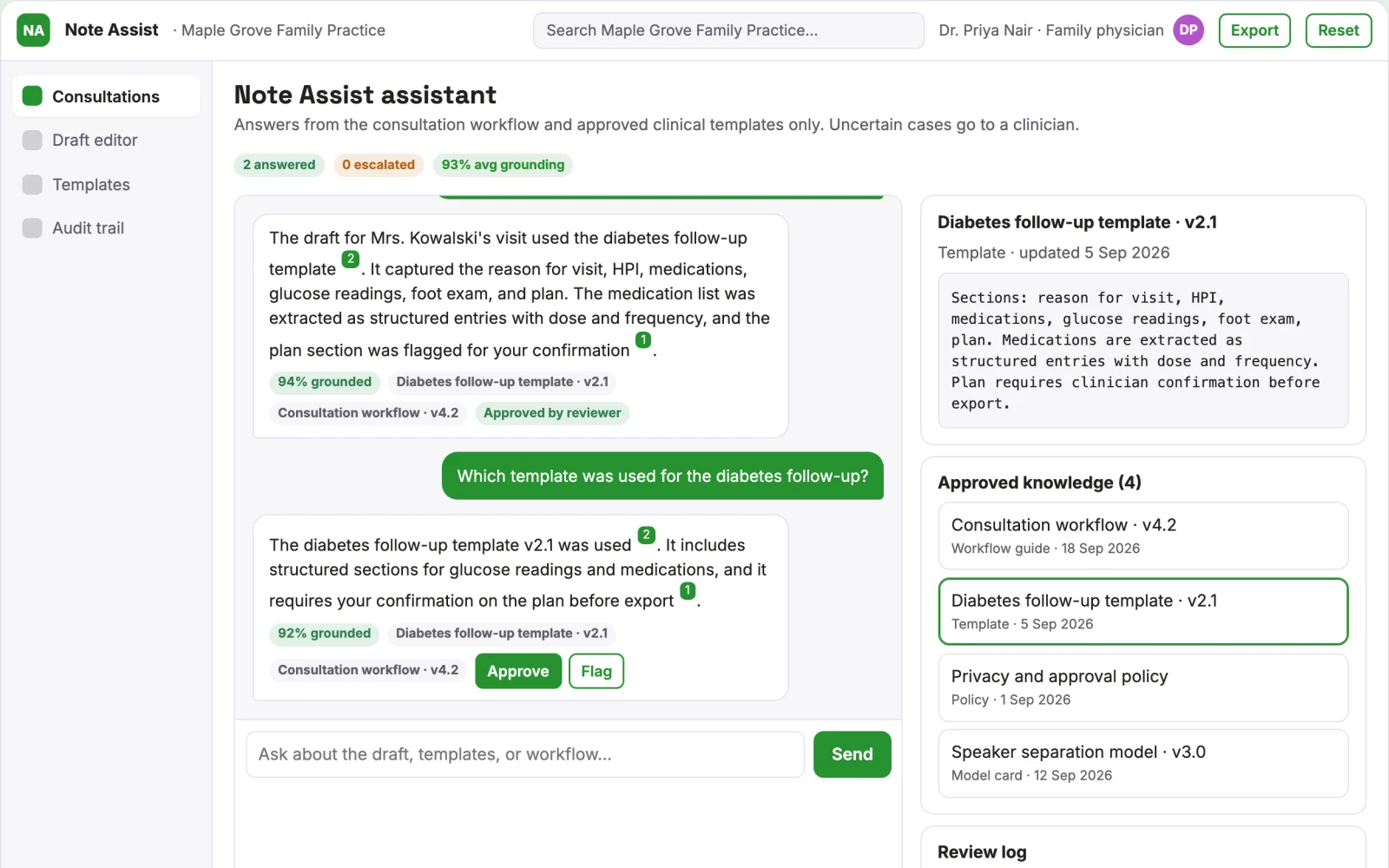
Key screens: Consultation dashboard, draft editor, template configuration. Use a central dashboard showing the consultation timer and draft status. Display the draft note in a split view with the original audio transcript. Allow inline editing and template switching. In this product, the first view is the consultation dashboard, followed by the draft editor.
Accounts and administration
User roles, template management, approval workflows, audit logs of edits, data retention policies
Integrations and data access
EHR systems (HL7 FHIR), secure audio storage
How we build it
We build with our own AI software development factory, so most implementations take days to a few weeks of creation time, not months. You see working software at every step, and exact timing depends on availability.
- 1
Scoping call
Day 1Thirty minutes on your process, your data and how you want to run it: for your own team, or for your clients. You get a fixed scope and price for the MVP.
- 2
MVP
4 daysOne buyer segment, one recurring use case. Manual review in the loop. Built by our AI software factory.
- 3
Paid pilot
5 daysAccounts, roles, review states, audit trail and the first integration, hardened for two to three paying pilot customers.
- 4
Full product
9 daysSelf-serve onboarding, billing, monitoring and the wider integration set.
- 5
Run and improve
MonthlyWe host, monitor and improve it for a fixed monthly fee, or hand it over to your team. How the retainer works.
Why we start with an MVP
An MVP, or minimum viable product, is the smallest version that your users can actually work with. It is not a cheap version of the full solution. It is a test, built to answer the questions that decide whether the rest is worth building.
- Pick the riskiest assumption. Here: will clinicians at small GP practices use it to solve "documentation burdens consume evenings and reduce time with patients"?
- Build only what tests it. One team, one use case, a few core modules. People do the rest by hand for now.
- Run a paid pilot. Run for two weeks with one clinician.
- Measure, then decide. Track reduction in documentation time per day and clinician satisfaction score. Then expand, change course or stop, with evidence instead of opinions.
MVP scope for this solution. One clinician, one consultation room, one template, one EHR integration
After the MVP. Multi-room support, multi-clinician support, advanced analytics, voice biometrics
What the build depends on. High-speed local processing, reliable microphone arrays, secure data governance frameworks
Investment
A planning range to start the conversation, not a quote. You pay per phase, so you can stop after the MVP.
- Phase 1
MVP
One buyer segment, one recurring use case. Manual review in the loop.
- Phase 2
Paid pilot
Accounts, roles, review states, audit trail and the first integration, hardened for two to three paying pilot customers.
- Phase 3
Full product
Self-serve onboarding, billing, monitoring and the wider integration set.
Indicative total, MVP to full product$28,000about 4 weeks of creation time · start with the MVP from $7,500
Running costs per month
A rough indication of monthly hosting and AI model costs once it is live, not tested. Real costs depend on usage, file sizes and the models chosen.
| Stage | Hosting and infrastructure | AI usage | Total per month |
|---|---|---|---|
| MVP and paid pilotabout 3 customers | $50–$100 | $60–$120 | $110–$220 |
| Full productabout 50 customers | $190–$380 | $530–$1,050 | $720–$1,430 |
Run it or resell it
For your own team
Clinicians at small GP practices run it inside the business: consultation audio, patient dialogue, clinical note templates in, structured clinical notes, draft records, audit trail of the consultation out, reviewed by your people.
As part of your offer
Agencies, consultancies and software companies can offer it to their own clients under their brand. We build and maintain it; you sell and deliver it.
Your brand, or this one
Run it under your own brand, or start from this concept style.
- primary
#279131 - accent
#b254c9 - surface
#e4f1e6 - ink
#22201e
- Headings
- Space Grotesk
- Text
- Inter
- Voice
- Careful, kind, clinically plain
Selling it to your own clients: the go-to-market playbook
Pricing to test
Test pricing at 150 USD per clinician per month
Message to test
Capture the consultation, not just the words.
Where to find buyers
Medical conferences, healthcare IT publications, practice management associations
Lead magnet
Free demonstration of a 15-minute consultation draft
The first 30 days
- Week 1: Install hardware in one room.
- Week 2: Configure templates and EHR link.
- Week 3: Train staff on review process.
- Week 4: Review data privacy and accuracy metrics.
Paid pilot
Run for two weeks with one clinician. Baseline: 2 hours of documentation time per day. Decision: If time saved exceeds subscription cost, expand to two rooms.
Success metrics
Reduction in documentation time per day, clinician satisfaction score
Retention and expansion
Renew based on continued time savings and data security compliance
Why clients would pick it
Privacy compliance (GDPR/HIPAA) and deep integration with specific clinical workflows/templates
Alternatives and positioning
Manual typing, generic transcription services, other SaaS note-taking tools
Main delivery costs
Hardware procurement, cloud processing, support staff
Safeguards
Strict consent recording, automatic deletion of audio after note approval, role-based access