Nightshift Storefront Agent
The whole shop floor becomes an online storefront from nothing but a phone video, with no manual listing at any point.
- For
- Owners of independent boutiques and market stalls with no online presence
- Solves
- Shop stock sits invisible online because listing, pricing and answering buyers is a second job nobody has time for.
- Delivers
- Live marketplace or Shopify listings, handled buyer conversations, closed sales and a daily pick list with prepaid shipping labels
- Built in
- about 3 weeks of creation time, MVP in 3 days
- Investment
- $6,000 for the MVP, $20,000 for the full product
- Run it
- Inside your business, or as part of your offer to clients
What it does
For owners of independent boutiques and market stalls, turn a weekly smartphone video walkthrough of stock into live marketplace listings, negotiated sales and morning pick lists.
- Identify items from a video walkthrough.
- Draft listings with measurements and condition notes.
- Suggest prices the owner can override.
- Answer buyer questions and send extra photos.
- Accept or decline offers within margin rules.
- Generate pick lists and prepaid shipping labels on sale.
What goes in, what comes out
- A weekly smartphone video walkthrough of the shop floor
- Stockroom
- Price floors
- Margin rules
- Courier preferences

AI drafts, people review. Operational coordination portal.
- Live marketplace or Shopify listings
- Handled buyer conversations
- Closed sales
- A daily pick list with prepaid shipping labels
How it works
The workflow
- InStart with
A weekly smartphone video walkthrough of the shop floor and stockroom, price floors, margin rules and courier preferences
- 1
Film a walkthrough
- 2
Upload the video
- 3
Review and approve drafted listings
- 4
Set price floors and margin rules
- 5
Let the agent handle buyer conversations
- 6
Approve exceptions
- 7
Pack from the morning pick list
- OutFinish with
Live marketplace or Shopify listings, handled buyer conversations, closed sales and a daily pick list with prepaid shipping labels
AI does the heavy lifting, people stay in charge
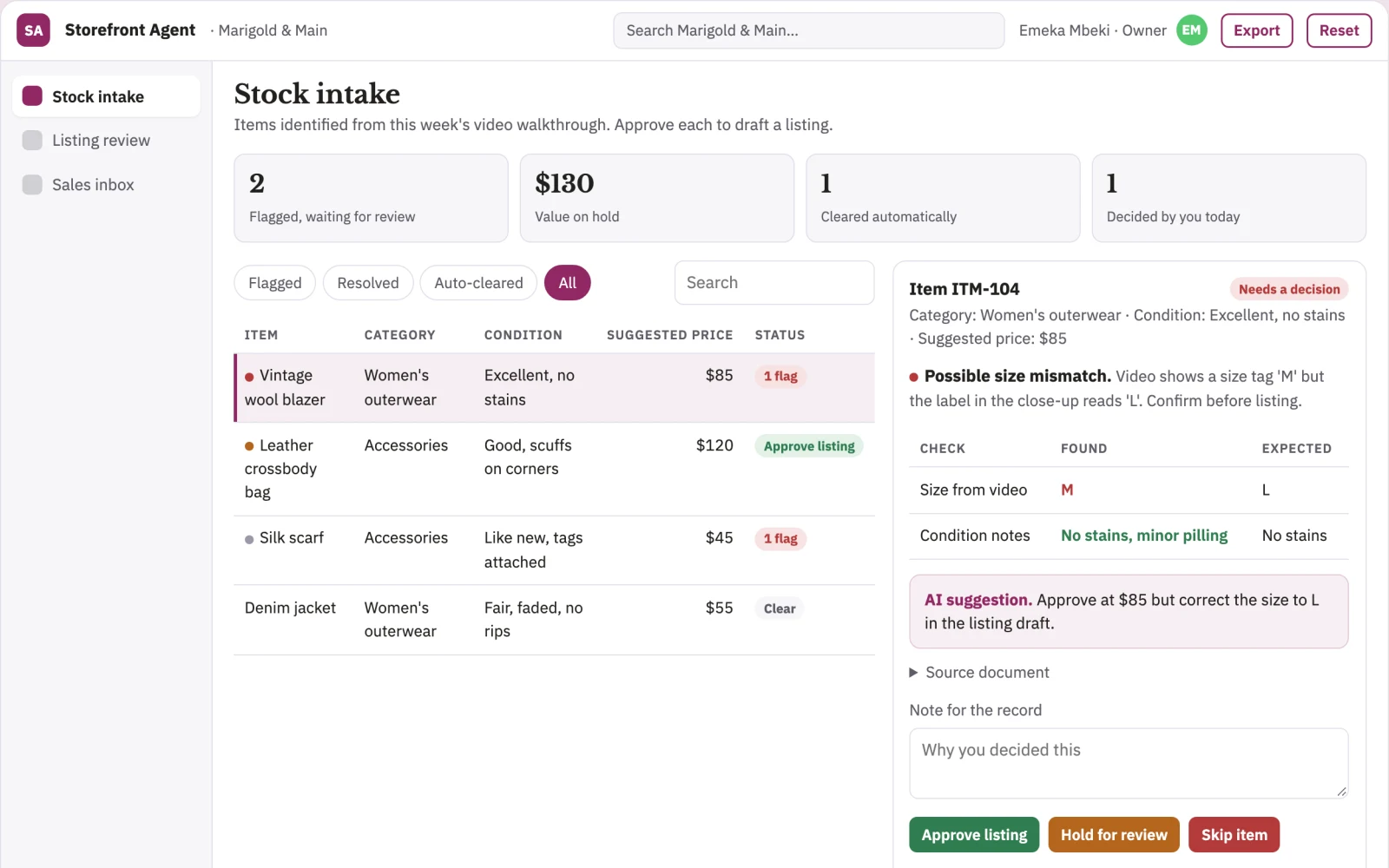
Use vision models to identify items and extract condition details from video, and language models to write listings and hold multi-turn buyer conversations grounded in a structured stock record so it never sells stock that does not exist. The owner approves each listing and any offer outside set margin rules before it is sent.
What your team sees
Key screens: Stock intake, listing review, sales inbox. Use a video-derived item grid for stock intake, a listing editor with photos, measurements and price override, and a threaded buyer conversation view with offer rules. Show draft, live and sold states, and a daily pick list with shipping labels. In this product, the first view is stock intake, followed by listing review and sales inbox.
Accounts and administration
Owner account with staff access, stock record versions, listing approval states, offer rule settings, message logs, order history and an audit trail of agent decisions.
Integrations and data access
Start with eBay listing APIs and a courier label API, then Shopify, then Stripe for off-marketplace checkout.
How we build it
We build with our own AI software development factory, so most implementations take days to a few weeks of creation time, not months. You see working software at every step, and exact timing depends on availability.
- 1
Scoping call
Day 1Thirty minutes on your process, your data and how you want to run it: for your own team, or for your clients. You get a fixed scope and price for the MVP.
- 2
MVP
3 daysOne buyer segment, one recurring use case. Manual review in the loop. Built by our AI software factory.
- 3
Paid pilot
4 daysAccounts, roles, review states, audit trail and the first integration, hardened for two to three paying pilot customers.
- 4
Full product
6 daysSelf-serve onboarding, billing, monitoring and the wider integration set.
- 5
Run and improve
MonthlyWe host, monitor and improve it for a fixed monthly fee, or hand it over to your team. How the retainer works.
Why we start with an MVP
An MVP, or minimum viable product, is the smallest version that your users can actually work with. It is not a cheap version of the full solution. It is a test, built to answer the questions that decide whether the rest is worth building.
- Pick the riskiest assumption. Here: will owners of independent boutiques and market stalls with no online presence use it to solve "shop stock sits invisible online because listing, pricing and answering buyers is a second job nobody has time for"?
- Build only what tests it. One team, one use case, a few core modules. People do the rest by hand for now.
- Run a paid pilot. Run one trader for a month against a baseline of zero online sales.
- Measure, then decide. Track online orders closed per shop per month and and returns caused by inaccurate descriptions. Then expand, change course or stop, with evidence instead of opinions.
MVP scope for this solution. One indoor market trader, one use case: video to five live eBay listings with the owner approving everything. First two modules are stock intake from video and listing review, with a person manually handling buyer replies and pick lists for the first ten orders.
After the MVP. After the paid pilot, automate buyer messaging, offer negotiation within rules, shipping label generation and weekly re-pricing, then add Shopify and more marketplaces.
What the build depends on. Vision models reliable on consumer goods from casual video, a structured stock database the agent cannot contradict, marketplace APIs for listing and messaging, and carrier APIs for labels.
Investment
A planning range to start the conversation, not a quote. You pay per phase, so you can stop after the MVP.
- Phase 1
MVP
One buyer segment, one recurring use case. Manual review in the loop.
- Phase 2
Paid pilot
Accounts, roles, review states, audit trail and the first integration, hardened for two to three paying pilot customers.
- Phase 3
Full product
Self-serve onboarding, billing, monitoring and the wider integration set.
Indicative total, MVP to full product$20,000about 3 weeks of creation time · start with the MVP from $6,000
Running costs per month
A rough indication of monthly hosting and AI model costs once it is live, not tested. Real costs depend on usage, file sizes and the models chosen.
| Stage | Hosting and infrastructure | AI usage | Total per month |
|---|---|---|---|
| MVP and paid pilotabout 3 customers | $30–$60 | $40–$90 | $70–$150 |
| Full productabout 50 customers | $110–$210 | $280–$560 | $390–$770 |
Run it or resell it
For your own team
Owners of independent boutiques and market stalls with no online presence run it inside the business: a weekly smartphone video walkthrough of the shop floor and stockroom, price floors, margin rules and courier preferences in, live marketplace or Shopify listings, handled buyer conversations, closed sales and a daily pick list with prepaid shipping labels out, reviewed by your people.
As part of your offer
Agencies, consultancies and software companies can offer it to their own clients under their brand. We build and maintain it; you sell and deliver it.
Your brand, or this one
Run it under your own brand, or start from this concept style.
- primary
#912763 - accent
#54c970 - surface
#f1e4eb - ink
#22201e
- Headings
- Libre Baskerville
- Text
- IBM Plex Sans
- Voice
- Direct, upbeat, outcome-focused
Selling it to your own clients: the go-to-market playbook
Pricing to test
Hypothesis: 150 USD per month subscription plus 2 USD per order fulfilment fee, no setup charge.
Message to test
Film your shop once a week and wake up to live listings, handled buyers and a pick list waiting for the morning.
Where to find buyers
Indoor market trader associations, vintage clothing seller communities on Facebook and Reddit, local trade forums and shopkeeper WhatsApp groups.
Lead magnet
A free trial: send one video walkthrough and receive five ready-to-approve listings within 24 hours.
The first 30 days
- Week 1: build the WhatsApp video endpoint and item identification pipeline.
- Week 2: generate and publish the first five approved listings on eBay.
- Week 3: run ten orders with manual pick and pack to learn edge cases and returns.
- Week 4: add offer rules and the pick list screen, then sign the first paid trader.
Paid pilot
Run one trader for a month against a baseline of zero online sales. Measure listings live, orders closed and returns caused by description errors. Decision: if orders exceed returns losses and the trader renews, expand to three more traders.
Success metrics
Online orders closed per shop per month, and returns caused by inaccurate descriptions.
Retention and expansion
The weekly walkthrough becomes routine, the stock record and sale history live in the system, and repricing plus buyer messaging keep earning every month without extra work from the owner.
Why clients would pick it
Every walkthrough improves item recognition and condition detection for that shop's stock, and the accumulated listing, sale and returns history makes pricing and descriptions harder for a newcomer to match.
Alternatives and positioning
Owners today either list manually on eBay and Shopify in evenings, or pay listing services that still need typed descriptions and someone on message duty. This differs by generating everything from video and running the whole sale through to a pick list.
Main delivery costs
Vision and language model usage, marketplace and carrier API fees, hosting, and reviewer time for listing quality checks during the pilot.
Safeguards
The agent cannot sell items not in the approved stock record, cannot accept offers below the owner's floor, cannot send messages without a logged decision trail, and must flag suspected damage or missing measurements for human review rather than guess. Owners approve every first listing and can pause the agent at any time.