Adaptive Lesson Generator
Lessons that combine spoken interaction and automatic grading in one sequence, adapted to each pupil.
- For
- Curriculum leads at charter school networks
- Solves
- Teachers spend evenings and weekends building lesson plans that rarely adapt to student pace.
- Delivers
- Daily adaptive lessons, interactive quizzes, voice discussion prompts, student mastery reports, intervention plans
- Built in
- about 2 weeks of creation time, MVP in 2 days
- Investment
- $5,500 for the MVP, $17,000 for the full product
- Run it
- Inside your business, or as part of your offer to clients
What it does
For curriculum leads at charter school networks, turn textbooks, standards, and notes into adaptive daily lessons with voice interaction.
- Parse uploaded curriculum documents.
- Generate lesson sequences with clear objectives.
- Create video-like explanations.
- Generate practice problems and quizzes.
- Enable voice-based student interaction.
- Provide real-time remediation and weekly summaries.
What goes in, what comes out
- Textbooks
- State standards
- Teacher notes
- Pacing guides

AI drafts, people review. Interactive practice or facilitated workshop platform.
- Daily adaptive lessons
- Interactive quizzes
- Voice discussion prompts
- Student mastery reports
- Intervention plans
How it works
The workflow
- InStart with
Textbooks, state standards, teacher notes, pacing guides
- 1
Upload curriculum
- 2
Set pacing
- 3
Generate lessons
- 4
Run lessons
- 5
Monitor student progress
- 6
Receive weekly reports
- OutFinish with
Daily adaptive lessons, interactive quizzes, voice discussion prompts, student mastery reports, intervention plans
AI does the heavy lifting, people stay in charge
Use language models to interpret curriculum and generate explanations. Voice agents handle student interaction. Multimodal models grade math. The AI tracks mastery and prepares interventions. A human reviewer confirms pedagogical accuracy before delivery.
What your team sees
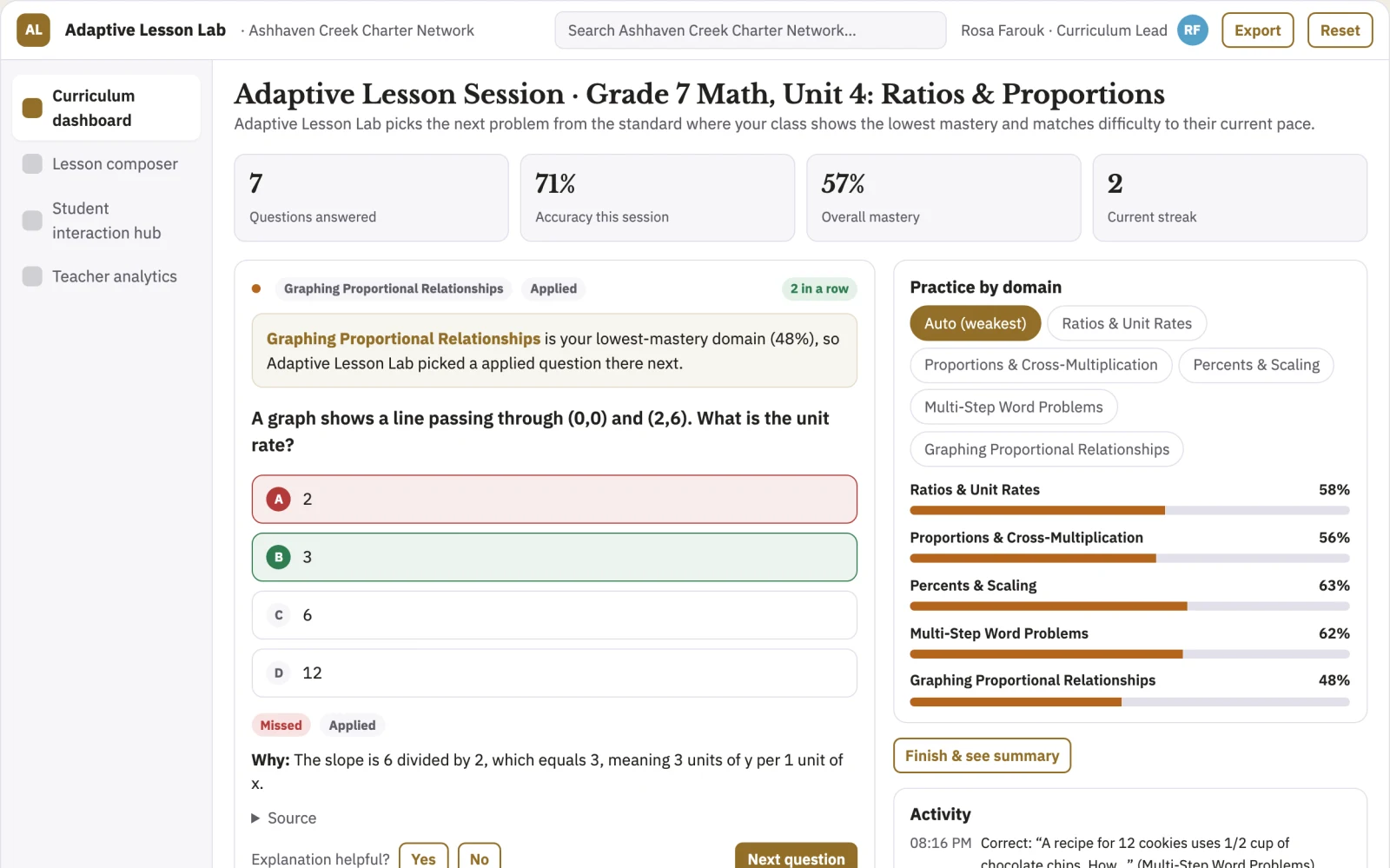
Key screens: Curriculum dashboard, lesson composer, student interaction hub, teacher analytics. Use a dashboard to view pacing and progress. The composer generates lesson content. The hub handles voice and video interaction. The analytics show gaps and strengths.
Accounts and administration
User roles, lesson versions, audit trail, permissions for curriculum access
Integrations and data access
Learning Management Systems, Student Information Systems, supplementary content libraries
How we build it
We build with our own AI software development factory, so most implementations take days to a few weeks of creation time, not months. You see working software at every step, and exact timing depends on availability.
- 1
Scoping call
Day 1Thirty minutes on your process, your data and how you want to run it: for your own team, or for your clients. You get a fixed scope and price for the MVP.
- 2
MVP
2 daysOne buyer segment, one recurring use case. Manual review in the loop. Built by our AI software factory.
- 3
Paid pilot
3 daysAccounts, roles, review states, audit trail and the first integration, hardened for two to three paying pilot customers.
- 4
Full product
6 daysSelf-serve onboarding, billing, monitoring and the wider integration set.
- 5
Run and improve
MonthlyWe host, monitor and improve it for a fixed monthly fee, or hand it over to your team. How the retainer works.
Why we start with an MVP
An MVP, or minimum viable product, is the smallest version that your users can actually work with. It is not a cheap version of the full solution. It is a test, built to answer the questions that decide whether the rest is worth building.
- Pick the riskiest assumption. Here: will curriculum leads at charter school networks use it to solve "teachers spend evenings and weekends building lesson plans that rarely adapt to student pace"?
- Build only what tests it. One team, one use case, a few core modules. People do the rest by hand for now.
- Run a paid pilot. Pilot proves value by comparing student progress in the AI-generated lessons versus traditional methods, establishing a baseline for engagement and mastery
- Measure, then decide. Track student engagement rates and reduction in teacher planning time. Then expand, change course or stop, with evidence instead of opinions.
MVP scope for this solution. First cut: Charter school math lead, single textbook chapter, week of adaptive practice, manual review of generated content
After the MVP. Automated grading for all subjects, parent portals, integration with LMS, mobile apps
What the build depends on. Large language models, speech-to-text models, multimodal vision models
Investment
A planning range to start the conversation, not a quote. You pay per phase, so you can stop after the MVP.
- Phase 1
MVP
One buyer segment, one recurring use case. Manual review in the loop.
- Phase 2
Paid pilot
Accounts, roles, review states, audit trail and the first integration, hardened for two to three paying pilot customers.
- Phase 3
Full product
Self-serve onboarding, billing, monitoring and the wider integration set.
Indicative total, MVP to full product$17,000about 2 weeks of creation time · start with the MVP from $5,500
Running costs per month
A rough indication of monthly hosting and AI model costs once it is live, not tested. Real costs depend on usage, file sizes and the models chosen.
| Stage | Hosting and infrastructure | AI usage | Total per month |
|---|---|---|---|
| MVP and paid pilotabout 3 customers | $30–$60 | $50–$110 | $80–$170 |
| Full productabout 50 customers | $110–$210 | $420–$840 | $530–$1,050 |
Run it or resell it
For your own team
Curriculum leads at charter school networks run it inside the business: textbooks, state standards, teacher notes, pacing guides in, daily adaptive lessons, interactive quizzes, voice discussion prompts, student mastery reports, intervention plans out, reviewed by your people.
As part of your offer
Agencies, consultancies and software companies can offer it to their own clients under their brand. We build and maintain it; you sell and deliver it.
Your brand, or this one
Run it under your own brand, or start from this concept style.
- primary
#916e27 - accent
#54a0c9 - surface
#f1ede4 - ink
#22201e
- Headings
- Libre Baskerville
- Text
- IBM Plex Sans
- Voice
- Encouraging, patient, precise
Selling it to your own clients: the go-to-market playbook
Pricing to test
Hypothesis: 5000 USD per school per year capped at 500 students
Message to test
Turn static textbooks into a living, voice-interactive daily lesson plan
Where to find buyers
EdTech conferences, charter school networks, direct sales to curriculum directors
Lead magnet
Free trial for one math unit
The first 30 days
- Week 1: Deploy MVP for math curriculum.
- Week 2: Gather feedback on voice interaction.
- Week 3: Refine remediation logic.
- Week 4: Prepare for pilot launch.
Paid pilot
Pilot proves value by comparing student progress in the AI-generated lessons versus traditional methods, establishing a baseline for engagement and mastery
Success metrics
Student engagement rates, reduction in teacher planning time
Retention and expansion
Annual subscriptions based on active student counts
Why clients would pick it
Rigorous testing of pedagogical sequences prevents hallucinations. Building a library of high-quality generated content over time
Alternatives and positioning
Traditional lesson planning software, static worksheets, generic AI chatbots
Main delivery costs
AI inference costs, development and maintenance
Safeguards
Strict guardrails on math answers, access controls for curriculum documents, audit logs for AI interactions