Brand Voice Content Engine
Content in your organisation's own voice, learned from your existing material rather than generic templates.
- For
- Marketing leads at B2B SaaS companies
- Solves
- Expert teams lack the hours to publish, resulting in empty calendars and disengaged audiences.
- Delivers
- Scheduled blog posts, social media threads, newsletters, performance reports
- Built in
- about 2 weeks of creation time, MVP in 2 days
- Investment
- $5,500 for the MVP, $17,500 for the full product
- Run it
- Inside your business, or as part of your offer to clients
What it does
For marketing leads at B2B SaaS companies, turn internal documents and call recordings into scheduled blog posts and social threads.
- Ingest and index brand assets.
- Analyse tone and key messages.
- Generate drafts for multiple channels.
- Schedule posts across platforms.
- Monitor engagement metrics.
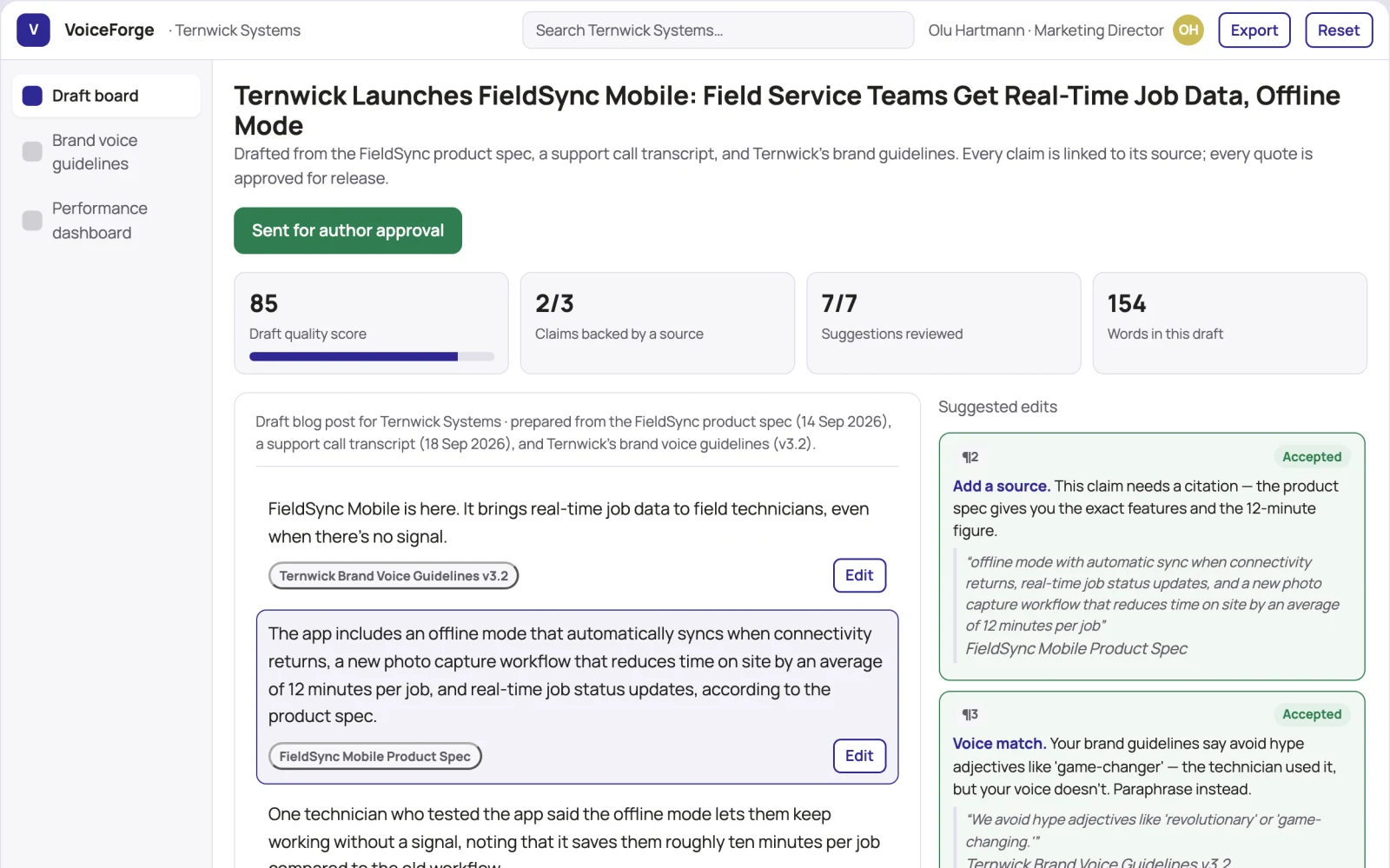
- Flag drafts for human review.
What goes in, what comes out
- Company documents
- Product pages
- Call recordings
- Past content
- Brand guidelines

AI drafts, people review. Source-based content workspace with editorial delivery.
- Scheduled blog posts
- Social media threads
- Newsletters
- Performance reports
How it works
The workflow
- InStart with
Company documents, product pages, call recordings, past content, brand guidelines
- 1
Upload brand assets
- 2
Define tone and channels
- 3
Review AI drafts
- 4
Approve or edit
- 5
Schedule publication
- 6
Analyse performance
- OutFinish with
Scheduled blog posts, social media threads, newsletters, performance reports
AI does the heavy lifting, people stay in charge
Use language models to synthesise information from documents and recordings, maintaining brand voice consistency. The AI drafts content and suggests scheduling based on engagement patterns. A human editor verifies factual accuracy and tone before publication.
What your team sees
Key screens: Knowledge ingestion, content draft board, performance dashboard. Use a central feed for drafts, a side panel for brand voice guidelines and source documents, and a performance graph for engagement metrics. Display approval status clearly. In this product, the first view is the ingestion dashboard, followed by the draft board and performance dashboard.
Accounts and administration
User roles, draft versions, approval workflows, audit logs, publishing permissions
Integrations and data access
CMS, social media platforms, email marketing tools
How we build it
We build with our own AI software development factory, so most implementations take days to a few weeks of creation time, not months. You see working software at every step, and exact timing depends on availability.
- 1
Scoping call
Day 1Thirty minutes on your process, your data and how you want to run it: for your own team, or for your clients. You get a fixed scope and price for the MVP.
- 2
MVP
2 daysOne buyer segment, one recurring use case. Manual review in the loop. Built by our AI software factory.
- 3
Paid pilot
3 daysAccounts, roles, review states, audit trail and the first integration, hardened for two to three paying pilot customers.
- 4
Full product
6 daysSelf-serve onboarding, billing, monitoring and the wider integration set.
- 5
Run and improve
MonthlyWe host, monitor and improve it for a fixed monthly fee, or hand it over to your team. How the retainer works.
Why we start with an MVP
An MVP, or minimum viable product, is the smallest version that your users can actually work with. It is not a cheap version of the full solution. It is a test, built to answer the questions that decide whether the rest is worth building.
- Pick the riskiest assumption. Here: will marketing leads at B2B SaaS companies use it to solve "expert teams lack the hours to publish, resulting in empty calendars and disengaged audiences"?
- Build only what tests it. One team, one use case, a few core modules. People do the rest by hand for now.
- Run a paid pilot. Compare output volume against manual production over 4 weeks to prove time savings.
- Measure, then decide. Track number of posts published and engagement rate increase. Then expand, change course or stop, with evidence instead of opinions.
MVP scope for this solution. One B2B SaaS client, focus on blog posts and LinkedIn updates, manual review of drafts, ingestion of website and 5 core PDFs
After the MVP. Automated scheduling, performance-based content adjustment, multi-language generation
What the build depends on. Large language models with long context windows
Investment
A planning range to start the conversation, not a quote. You pay per phase, so you can stop after the MVP.
- Phase 1
MVP
One buyer segment, one recurring use case. Manual review in the loop.
- Phase 2
Paid pilot
Accounts, roles, review states, audit trail and the first integration, hardened for two to three paying pilot customers.
- Phase 3
Full product
Self-serve onboarding, billing, monitoring and the wider integration set.
Indicative total, MVP to full product$17,500about 2 weeks of creation time · start with the MVP from $5,500
Running costs per month
A rough indication of monthly hosting and AI model costs once it is live, not tested. Real costs depend on usage, file sizes and the models chosen.
| Stage | Hosting and infrastructure | AI usage | Total per month |
|---|---|---|---|
| MVP and paid pilotabout 3 customers | $30–$60 | $70–$140 | $100–$200 |
| Full productabout 50 customers | $110–$210 | $700–$1,400 | $810–$1,610 |
Run it or resell it
For your own team
Marketing leads at B2B SaaS companies run it inside the business: company documents, product pages, call recordings, past content, brand guidelines in, scheduled blog posts, social media threads, newsletters, performance reports out, reviewed by your people.
As part of your offer
Agencies, consultancies and software companies can offer it to their own clients under their brand. We build and maintain it; you sell and deliver it.
Your brand, or this one
Run it under your own brand, or start from this concept style.
- primary
#2e2791 - accent
#c9ba54 - surface
#e5e4f1 - ink
#22201e
- Headings
- Manrope
- Text
- Manrope
- Voice
- Energetic, specific, results-minded
Selling it to your own clients: the go-to-market playbook
Pricing to test
$2,500 per month
Message to test
Turn your internal knowledge into a publishing machine
Where to find buyers
LinkedIn, industry forums, marketing conferences
Lead magnet
Free audit of current content backlog
The first 30 days
- Week 1: Ingest website and 5 core documents.
- Week 2: Generate 3 blog posts and 10 social updates.
- Week 3: Set up approval workflow.
- Week 4: Launch first scheduled posts.
Paid pilot
Compare output volume against manual production over 4 weeks to prove time savings.
Success metrics
Number of posts published, engagement rate increase
Retention and expansion
Monthly subscription for ongoing content generation and optimisation
Why clients would pick it
Accumulation of unique brand data and fine-tuned models makes it harder for competitors to replicate the specific output quality
Alternatives and positioning
Manual writing, generic AI copy tools, content agencies
Main delivery costs
AI inference costs, developer time for setup
Safeguards
Fact-checking against source documents, tone guardrails, human approval gate