Self Booking Trip Concierge
The agent does the elimination work first and hands over only a small set of calibrated choices, then books and monitors the whole trip, so the client approves a finished plan rather than assembling one.
- For
- Owner-managed travel agencies and concierge services serving time-poor families
- Solves
- Trip planning consumes three to fifteen hours of scattered research and still leaves clients unsure the pieces fit together.
- Delivers
- Three calibrated itinerary variants, a booked and versioned trip plan with confirmation references, a plain summary of cancellation terms and a monitored reservation record until departure
- Built in
- about 3 weeks of creation time, MVP in 4 days
- Investment
- $7,000 for the MVP, $26,000 for the full product
- Run it
- Inside your business, or as part of your offer to clients
What it does
For owner-managed travel agencies and concierge services, turn a short spoken or typed trip brief into three calibrated itinerary variants, completed reservations and continuous monitoring until departure.
- Capture a trip brief by voice or text and ask clarifying questions until constraints are explicit.
- Search flights, trains and accommodation simultaneously against live sources and local knowledge.
- Filter out options that break budget, party size, pace or location constraints.
- Assemble coherent itineraries with prices, distances, dining suggestions and daily rhythm.
- Present three calibrated variants and book every confirmable element on approval.
- Monitor price drops and schedule changes until departure and alert on better options.
What goes in, what comes out
- A short trip brief by voice or text
- Travel dates
- Budget
- Party composition
- Constraints such as children under ten or walking distance
- Any loyalty or dietary preferences

AI drafts, people review. Operational coordination portal.
- Three calibrated itinerary variants
- A booked
- Versioned trip plan with confirmation references
- A plain summary of cancellation terms
- A monitored reservation record until departure
How it works
The workflow
- InStart with
A short trip brief by voice or text, travel dates, budget, party composition, constraints such as children under ten or walking distance, and any loyalty or dietary preferences
- 1
Capture the trip brief
- 2
Ask clarifying questions
- 3
Search live availability across suppliers
- 4
Filter against constraints
- 5
Present three calibrated variants
- 6
Book confirmed elements on approval
- 7
Monitor reservations until departure
- OutFinish with
Three calibrated itinerary variants, a booked and versioned trip plan with confirmation references, a plain summary of cancellation terms and a monitored reservation record until departure
AI does the heavy lifting, people stay in charge
Language models with web access interpret the brief, read reviews and images, compare availability across booking sources and hold a natural conversation about tradeoffs such as budget, pace and quiet versus lively. Deterministic checks validate prices, dates, cancellation terms and total cost before anything is presented. A human travel consultant reviews the assembled itineraries and confirms every booking execution before the client is charged.
What your team sees
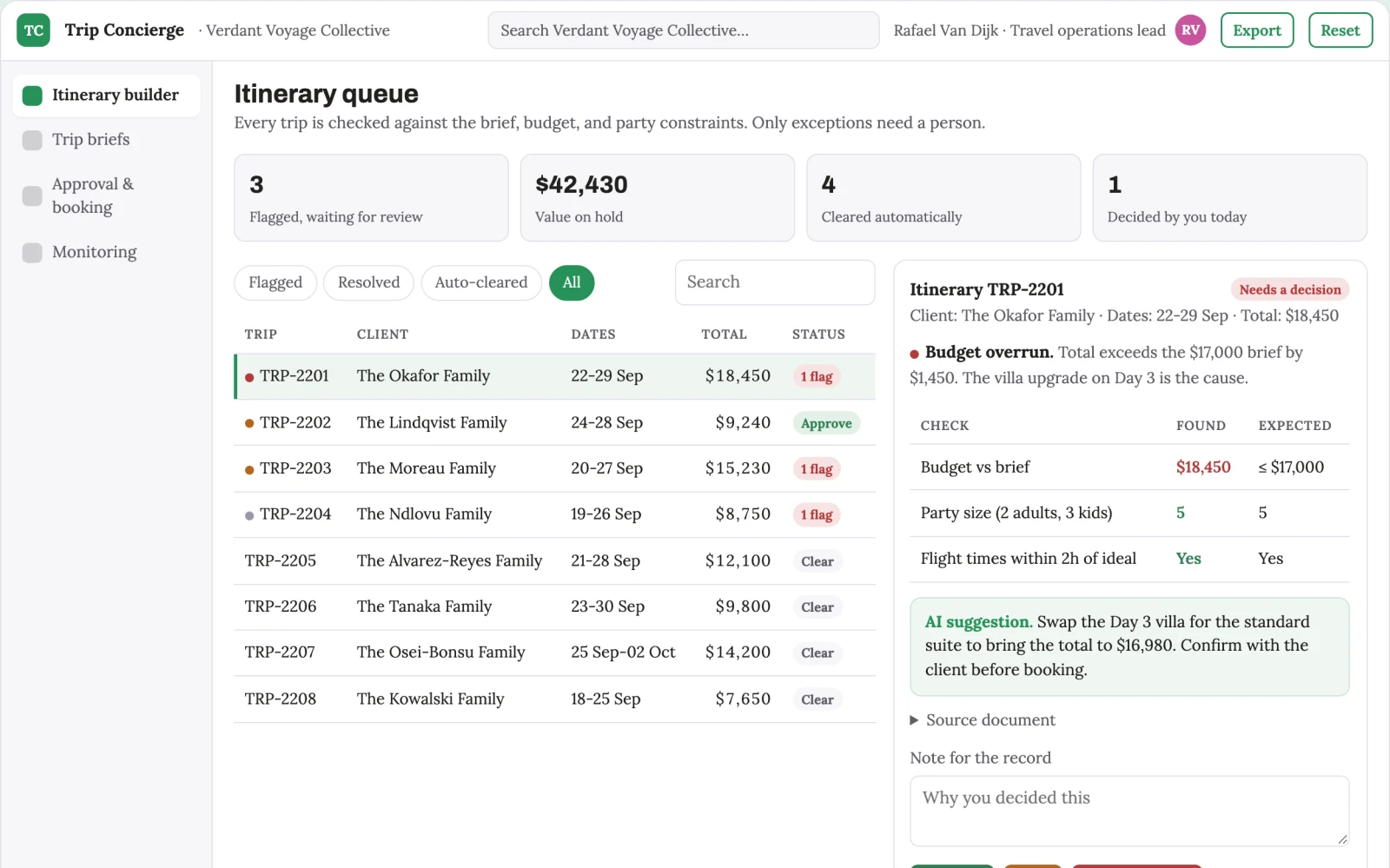
Key screens: Trip brief, itinerary builder, approval and booking dashboard. The main screen is the itinerary builder: a vertical timeline of the proposed trip with daily rhythm, priced components and distances on the left, and a right-hand panel showing live search results, constraints from the brief and client comments. Variants sit side by side for comparison, each with a clear price total and what changed between them. Status badges show drafted, awaiting approval, booked, monitored and flagged. The approval and booking dashboard lists every confirmable element with its confirmation reference and any partial failures needing human attention.
Accounts and administration
Client accounts and household profiles, trip versions, approval states for each itinerary and booking, booking execution log, supplier credential permissions, change history for price and schedule alerts, and an audit trail of every reservation action taken on a client's behalf.
Integrations and data access
Start with one flight and hotel aggregator API and email delivery. Then add rail operators, accommodation suppliers, calendar sync for departure monitoring, and payment processing for executed bookings.
How we build it
We build with our own AI software development factory, so most implementations take days to a few weeks of creation time, not months. You see working software at every step, and exact timing depends on availability.
- 1
Scoping call
Day 1Thirty minutes on your process, your data and how you want to run it: for your own team, or for your clients. You get a fixed scope and price for the MVP.
- 2
MVP
4 daysOne buyer segment, one recurring use case; first modules: the brief and clarifying questions interface, and the itinerary builder with three variants delivered as a reviewed summary with booking links. Manual review in the loop. Built by our AI software factory.
- 3
Paid pilot
5 daysAccounts, roles, review states, audit trail and the first integration, hardened for two to three paying pilot customers.
- 4
Full product
8 daysSelf-serve onboarding, billing, monitoring and the wider integration set.
- 5
Run and improve
MonthlyWe host, monitor and improve it for a fixed monthly fee, or hand it over to your team. How the retainer works.
Why we start with an MVP
An MVP, or minimum viable product, is the smallest version that your users can actually work with. It is not a cheap version of the full solution. It is a test, built to answer the questions that decide whether the rest is worth building.
- Pick the riskiest assumption. Here: will owner-managed travel agencies and concierge services serving time-poor families use it to solve "trip planning consumes three to fifteen hours of scattered research and still leaves clients unsure the pieces fit together"?
- Build only what tests it. One team, one use case, a few core modules. People do the rest by hand for now.
- Run a paid pilot. Run four weeks with three travel agencies handling real family briefs.
- Measure, then decide. Track average planning time saved per booked trip against the client's current baseline. Percentage of approved itineraries that convert to fully completed bookings without a stranded or partial reservation. Then expand, change course or stop, with evidence instead of opinions.
MVP scope for this solution. One buyer: family-focused travel agencies. One use case: a five to seven day coastal trip in southern Europe for a family with young children. First two modules: the brief and clarifying questions interface, and the itinerary builder with three variants delivered as a reviewed summary with booking links. No automated booking execution; the consultant confirms bookings manually while the workflow is validated.
After the MVP. After the paid pilot, automate booking execution for flights and accommodation through approved supplier connections, add continuous price and schedule monitoring with alerts, extend destination coverage beyond coastal Europe, and add voice interaction so briefs can be given while commuting or cooking.
What the build depends on. Agentic orchestration with web browsing and document parsing, persistent memory for household preferences, structured connections to booking sources, reliable partial failure handling so no user is stranded mid-booking, and voice and text interfaces.
Investment
A planning range to start the conversation, not a quote. You pay per phase, so you can stop after the MVP.
- Phase 1
MVP
One buyer segment, one recurring use case; first modules: the brief and clarifying questions interface, and the itinerary builder with three variants delivered as a reviewed summary with booking links. Manual review in the loop.
- Phase 2
Paid pilot
Accounts, roles, review states, audit trail and the first integration, hardened for two to three paying pilot customers.
- Phase 3
Full product
Self-serve onboarding, billing, monitoring and the wider integration set.
Indicative total, MVP to full product$26,000about 3 weeks of creation time · start with the MVP from $7,000
Running costs per month
A rough indication of monthly hosting and AI model costs once it is live, not tested. Real costs depend on usage, file sizes and the models chosen.
| Stage | Hosting and infrastructure | AI usage | Total per month |
|---|---|---|---|
| MVP and paid pilotabout 3 customers | $30–$60 | $40–$90 | $70–$150 |
| Full productabout 50 customers | $110–$210 | $280–$560 | $390–$770 |
Run it or resell it
For your own team
Owner-managed travel agencies and concierge services serving time-poor families run it inside the business: a short trip brief by voice or text, travel dates, budget, party composition, constraints such as children under ten or walking distance, and any loyalty or dietary preferences in, three calibrated itinerary variants, a booked and versioned trip plan with confirmation references, a plain summary of cancellation terms and a monitored reservation record until departure out, reviewed by your people.
As part of your offer
Agencies, consultancies and software companies can offer it to their own clients under their brand. We build and maintain it; you sell and deliver it.
Your brand, or this one
Run it under your own brand, or start from this concept style.
- primary
#279158 - accent
#c9549e - surface
#e4f1ea - ink
#22201e
- Headings
- Archivo
- Text
- Lora
- Voice
- Welcoming, lively, attentive
Selling it to your own clients: the go-to-market playbook
Pricing to test
Hypothesis: a flat ninety-nine dollar fee per planned trip paid by the agency or client, plus an affiliate commission from booking platforms when reservations complete, anchored on hours saved rather than trip cost.
Message to test
Describe the feeling you want from your holiday and receive three ready-to-approve itineraries, booked and monitored, without losing an evening to research.
Where to find buyers
Owner groups and forums for independent travel agencies, family parenting networks, travel trade associations, LinkedIn outreach to concierge and membership club operators, and partnerships with family-focused brands.
Lead magnet
A free five-day coastal itinerary for a sample family brief, delivered as a reviewed plan with live prices, showing exactly what the client would approve.
The first 30 days
- Week 1: build the brief and clarifying questions interface and hardcode the southern European coastal destination profile.
- Week 2: connect one aggregator API for flights and hotels and assemble the first reviewed itineraries.
- Week 3: deliver itineraries as a summary document with booking links to pilot agencies and gather consultant feedback.
- Week 4: tighten constraint filtering and variant calibration from real briefs and scope booking execution for the paid pilot.
Paid pilot
Run four weeks with three travel agencies handling real family briefs. Baseline: the current three to fifteen hours of client research and abandonment of stressed trips. Measure agency time per booked trip and client satisfaction with the approved itinerary. Decision: proceed if agencies book at least two trips per week through the workflow and report clear time savings over manual planning.
Success metrics
Average planning time saved per booked trip against the client's current baseline. Percentage of approved itineraries that convert to fully completed bookings without a stranded or partial reservation.
Retention and expansion
Each completed trip deepens the household profile, so repeat briefs return sharper variants faster, and monitoring continues until departure, giving agencies a recurring per-trip fee and a reason to route every client holiday through the platform.
Why clients would pick it
Accumulated household preference profiles, a curated map of reliable suppliers and tested failure handling for broken or revoked APIs make results better and safer over time, and trust with clients' money and limited leave days compounds with every completed trip.
Alternatives and positioning
Clients today use review sites, booking platforms and social media across a pile of browser tabs, or pay expensive human concierges who research manually. This differs by researching, comparing and booking in one guided flow at a fixed price, with human review only where judgement or money is involved.
Main delivery costs
Model inference and web research costs per trip, supplier and aggregator API access, platform development and maintenance, human consultant review time, and support for booking failures and changes.
Safeguards
Nothing is booked without explicit client approval of a specific variant; booking execution carries a per-trip spend limit and requires consultant sign-off above it; the system must never enter card details or hold payment credentials beyond approved processor tokens; it must not book non-refundable elements without flagged confirmation; partial failures pause execution and alert a human rather than leaving a client stranded; passport and identity documents are never stored; every booking action is logged with version history and reversal steps.