Polite Payment Recovery Agent
The agent writes genuinely human-sounding reminders and knows exactly when to stop and ask for approval.
- For
- Finance leads at small to mid-sized service businesses
- Solves
- Overdue invoices are chased inconsistently and smaller debts get written off.
- Delivers
- Personalised reminders, escalation drafts and an audit log of all follow-up actions
- Built in
- about 5 weeks of creation time, MVP in 6 days
- Investment
- $10,000 for the MVP, $40,500 for the full product
- Run it
- Inside your business, or as part of your offer to clients
What it does
For finance leads at small to mid-sized service businesses, turn accounting aging reports and customer history into personalised reminders and escalation drafts that recover cash early.
- Pull aging reports daily from accounting software.
- Draft personalised email reminders varying tone by days late and history.
- Send follow-up SMS after two days of no payment.
- Generate natural-sounding phone call scripts for unpaid invoices.
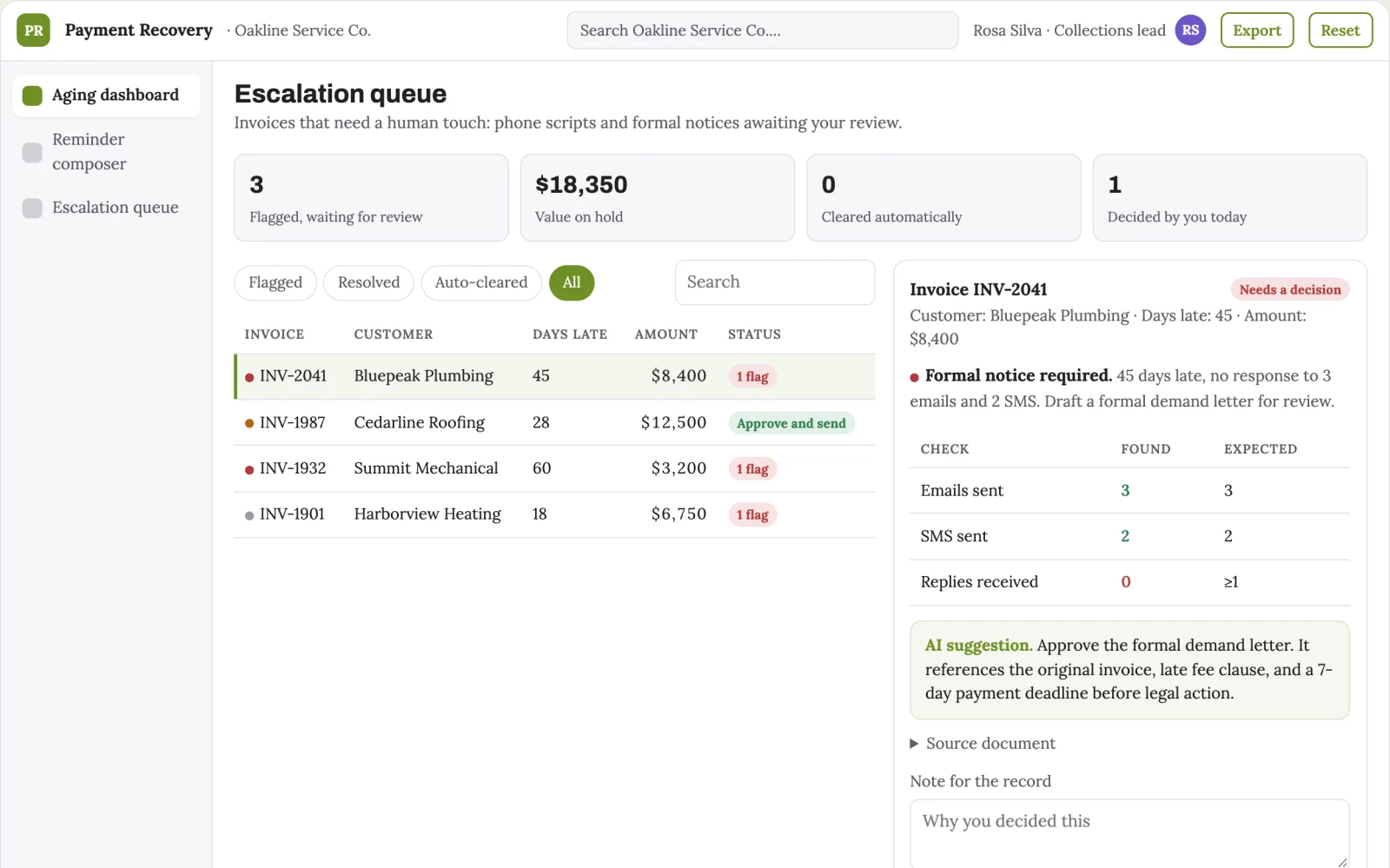
- Hold formal demand notices for human review and approval.
- Log all actions and responses back to customer notes.
What goes in, what comes out
- Accounting aging reports
- Customer payment history

AI drafts, people review. Operational coordination portal.
- Personalised reminders
- Escalation drafts
- An audit log of all follow-up actions
How it works
The workflow
- InStart with
Accounting aging reports and customer payment history
- 1
Connect accounting platform
- 2
Review aging report
- 3
Approve reminder rules
- 4
Let agent send emails and SMS
- 5
Review phone scripts
- 6
Approve formal notices
- 7
Monitor payment responses
- OutFinish with
Personalised reminders, escalation drafts and an audit log of all follow-up actions
AI does the heavy lifting, people stay in charge
Use language models to compose uniquely worded emails, SMS and phone scripts that match customer language and payment history. Keep escalation logic in deterministic rules. A human reviews and approves any formal demand or legal threat before it is sent.
What your team sees
Key screens: Aging dashboard, reminder composer, escalation queue. Use a dashboard showing overdue invoices by age and amount, a composer for personalised email and SMS drafts, and an escalation queue for phone call scripts and formal notices. Let users filter by customer and days late. Display sent, opened, replied and paid states. Provide a log of every action back to the customer record. In this product, the first view is aging dashboard, followed by reminder composer and escalation queue.
Accounts and administration
User roles for finance staff and approvers, reminder rule versions, approval states for formal notices, customer note updates, and a full audit trail of sent messages and responses.
Integrations and data access
Starts with Xero or QuickBooks for aging reports, then adds email and SMS providers, and later a phone system.
How we build it
We build with our own AI software development factory, so most implementations take days to a few weeks of creation time, not months. You see working software at every step, and exact timing depends on availability.
- 1
Scoping call
Day 1Thirty minutes on your process, your data and how you want to run it: for your own team, or for your clients. You get a fixed scope and price for the MVP.
- 2
MVP
6 daysOne buyer segment, one recurring use case. Manual review in the loop. Built by our AI software factory.
- 3
Paid pilot
7 daysAccounts, roles, review states, audit trail and the first integration, hardened for two to three paying pilot customers.
- 4
Full product
2 weeksSelf-serve onboarding, billing, monitoring and the wider integration set.
- 5
Run and improve
MonthlyWe host, monitor and improve it for a fixed monthly fee, or hand it over to your team. How the retainer works.
Why we start with an MVP
An MVP, or minimum viable product, is the smallest version that your users can actually work with. It is not a cheap version of the full solution. It is a test, built to answer the questions that decide whether the rest is worth building.
- Pick the riskiest assumption. Here: will finance leads at small to mid-sized service businesses use it to solve "overdue invoices are chased inconsistently and smaller debts get written off"?
- Build only what tests it. One team, one use case, a few core modules. People do the rest by hand for now.
- Run a paid pilot. A paid pilot with a service business proves it by comparing days sales outstanding before and after 30 days; the decision is to continue if overdue invoices reduce by at least 15 percent.
- Measure, then decide. Track two measurable outcomes are days sales outstanding reduction and percentage of overdue invoices paid within 14 days of first reminder. Then expand, change course or stop, with evidence instead of opinions.
MVP scope for this solution. One buyer, finance leads at service businesses, first two modules are aging dashboard and reminder composer, with manual review of every draft before sending.
After the MVP. Automate SMS sending and phone call placement after the paid pilot, then add rule tuning based on response rates and customer feedback.
What the build depends on. Needs API access to accounting software, a reliable email delivery service, and a text-to-speech or voice agent for calls.
Investment
A planning range to start the conversation, not a quote. You pay per phase, so you can stop after the MVP.
- Phase 1
MVP
One buyer segment, one recurring use case. Manual review in the loop.
- Phase 2
Paid pilot
Accounts, roles, review states, audit trail and the first integration, hardened for two to three paying pilot customers.
- Phase 3
Full product
Self-serve onboarding, billing, monitoring and the wider integration set.
Indicative total, MVP to full product$40,500about 5 weeks of creation time · start with the MVP from $10,000
Running costs per month
A rough indication of monthly hosting and AI model costs once it is live, not tested. Real costs depend on usage, file sizes and the models chosen.
| Stage | Hosting and infrastructure | AI usage | Total per month |
|---|---|---|---|
| MVP and paid pilotabout 3 customers | $50–$100 | $40–$90 | $90–$190 |
| Full productabout 50 customers | $190–$380 | $280–$560 | $470–$940 |
Run it or resell it
For your own team
Finance leads at small to mid-sized service businesses run it inside the business: accounting aging reports and customer payment history in, personalised reminders, escalation drafts and an audit log of all follow-up actions out, reviewed by your people.
As part of your offer
Agencies, consultancies and software companies can offer it to their own clients under their brand. We build and maintain it; you sell and deliver it.
Your brand, or this one
Run it under your own brand, or start from this concept style.
- primary
#6f9127 - accent
#6e54c9 - surface
#edf1e4 - ink
#22201e
- Headings
- Archivo
- Text
- Lora
- Voice
- Exact, sober, trustworthy
Selling it to your own clients: the go-to-market playbook
Pricing to test
Test pricing at $499 per month for up to 500 overdue invoices, as a hypothesis.
Message to test
Recover overdue invoices politely and consistently without sounding robotic.
Where to find buyers
Finance and operations communities, accounting software marketplaces, and small business forums.
Lead magnet
A free aging report analysis showing how much cash could be recovered with automated reminders.
The first 30 days
- Week 1: Connect to one accounting platform and build the aging dashboard.
- Week 2: Build the reminder composer for email drafts.
- Week 3: Add SMS drafting and customer history context.
- Week 4: Test with one friendly customer and log all actions.
Paid pilot
A paid pilot with a service business proves it by comparing days sales outstanding before and after 30 days; the decision is to continue if overdue invoices reduce by at least 15 percent.
Success metrics
Two measurable outcomes are days sales outstanding reduction and percentage of overdue invoices paid within 14 days of first reminder.
Retention and expansion
It keeps earning by continuously tuning reminder tone and timing based on response data, and by adding new accounting integrations and escalation channels.
Why clients would pick it
It gets harder to copy as it learns each customer's preferred tone and payment patterns, making escalation rules more effective over time.
Alternatives and positioning
Manual email chains and generic reminder templates; this differs by personalising every message and holding formal threats for human sign-off.
Main delivery costs
Main delivery costs are accounting platform integration, language model usage and phone call minutes.
Safeguards
Limits on message frequency per customer, mandatory human approval for formal notices, permissions restricting who can edit rules, and a hard stop on any legal or threatening language without sign-off.