Pass-Line Phone Agent
The agent is trained on the exact menu and cadence of a busy takeaway, with a clear human handoff path for off-script callers.
- For
- Owners and managers at busy neighbourhood takeaways
- Solves
- Phone orders during the dinner rush pull staff off the pass and produce misheard tickets.
- Delivers
- Confirmed digital tickets, SMS confirmations, call recordings, dashboard analytics
- Built in
- 10 days of creation time, MVP in 2 days
- Investment
- $5,000 for the MVP, $15,500 for the full product
- Run it
- Inside your business, or as part of your offer to clients
What it does
For owners and managers at busy neighbourhood takeaways, turn live menu data and spoken customer requests into confirmed digital tickets and SMS confirmations.
- Answer calls after one ring with a scripted greeting.
- Guide callers through menu items and modifiers.
- Mark items unavailable from live stock levels.
- Read back the full order and ask for confirmation.
- Send structured tickets to the kitchen display.
- Send SMS confirmation with collection or delivery details.
What goes in, what comes out
- Live menu data
- Stock levels
- Kitchen display system access
- Phone number

AI drafts, people review. Operational coordination portal.
- Confirmed digital tickets
- SMS confirmations
- Call recordings
- Dashboard analytics
How it works
The workflow
- InStart with
Live menu data, stock levels, kitchen display system access, phone number
- 1
Caller dials
- 2
Agent answers
- 3
Agent takes order against live menu
- 4
Agent reads back and confirms
- 5
Agent captures time slot and address
- 6
Ticket appears on kitchen screen
- 7
SMS goes to customer
- OutFinish with
Confirmed digital tickets, SMS confirmations, call recordings, dashboard analytics
AI does the heavy lifting, people stay in charge
Use a voice model to transcribe and understand conversational orders, including accents and background noise. Match spoken items to menu entries using fuzzy logic. A human manager reviews call replays and edits menu descriptions; no ticket is sent until the caller confirms.
What your team sees
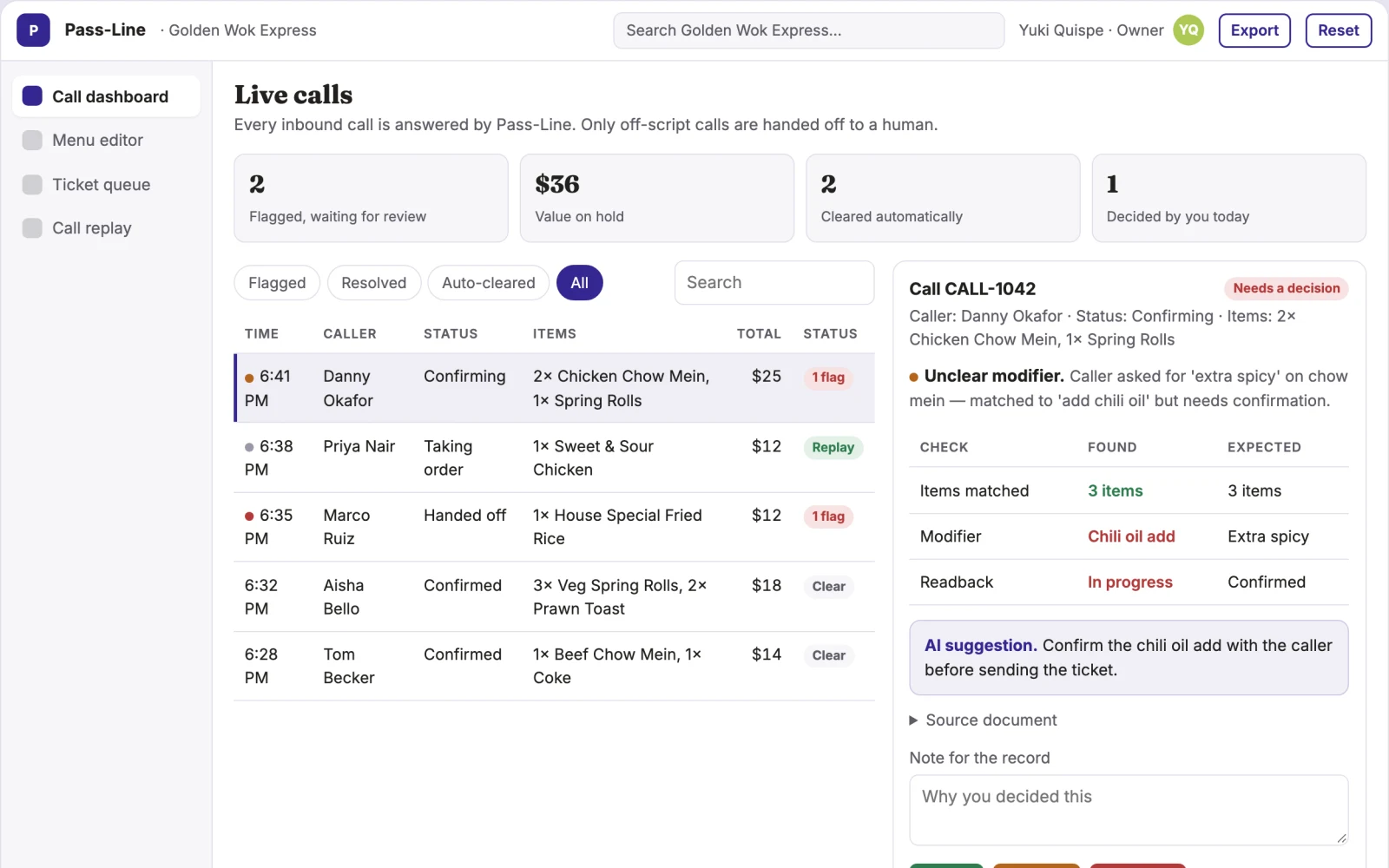
Key screens: Call dashboard, menu editor, ticket queue, call replay. Use a live call list with statuses (ringing, taking order, confirming, handed off), a menu editor for spoken descriptions and stock flags, a ticket queue mirroring the kitchen display, and a replay panel for any recorded call. In this product, the first view is call dashboard, followed by menu editor, ticket queue and call replay.
Accounts and administration
Manager accounts, call replay access, menu edit permissions, ticket version history, confirmation logs, audit trail of all agent actions
Integrations and data access
Kitchen display system, POS for stock levels, SMS gateway, phone system (Twilio or similar)
How we build it
We build with our own AI software development factory, so most implementations take days to a few weeks of creation time, not months. You see working software at every step, and exact timing depends on availability.
- 1
Scoping call
Day 1Thirty minutes on your process, your data and how you want to run it: for your own team, or for your clients. You get a fixed scope and price for the MVP.
- 2
MVP
2 daysOne buyer segment, one recurring use case. Manual review in the loop. Built by our AI software factory.
- 3
Paid pilot
3 daysAccounts, roles, review states, audit trail and the first integration, hardened for two to three paying pilot customers.
- 4
Full product
5 daysSelf-serve onboarding, billing, monitoring and the wider integration set.
- 5
Run and improve
MonthlyWe host, monitor and improve it for a fixed monthly fee, or hand it over to your team. How the retainer works.
Why we start with an MVP
An MVP, or minimum viable product, is the smallest version that your users can actually work with. It is not a cheap version of the full solution. It is a test, built to answer the questions that decide whether the rest is worth building.
- Pick the riskiest assumption. Here: will owners and managers at busy neighbourhood takeaways use it to solve "phone orders during the dinner rush pull staff off the pass and produce misheard tickets"?
- Build only what tests it. One team, one use case, a few core modules. People do the rest by hand for now.
- Run a paid pilot. Run a four-week paid pilot with one takeaway doing over 50 orders a night.
- Measure, then decide. Track reduction in misheard order tickets and increase in takeaway orders taken during peak hours. Then expand, change course or stop, with evidence instead of opinions.
MVP scope for this solution. One buyer (a pizza or curry house), one use case (takeaway phone orders), first two modules (call handling and ticket output), manual review of every call transcript before go-live
After the MVP. After the paid pilot, automate common substitutions and 'the usual' orders, add voice handoff to a human, integrate with delivery platforms, and add daily sales summaries.
What the build depends on. Reliable voice recognition model, low-latency telephony API, POS stock API, kitchen display screen with network access
Investment
A planning range to start the conversation, not a quote. You pay per phase, so you can stop after the MVP.
- Phase 1
MVP
One buyer segment, one recurring use case. Manual review in the loop.
- Phase 2
Paid pilot
Accounts, roles, review states, audit trail and the first integration, hardened for two to three paying pilot customers.
- Phase 3
Full product
Self-serve onboarding, billing, monitoring and the wider integration set.
Indicative total, MVP to full product$15,50010 days of creation time · start with the MVP from $5,000
Running costs per month
A rough indication of monthly hosting and AI model costs once it is live, not tested. Real costs depend on usage, file sizes and the models chosen.
| Stage | Hosting and infrastructure | AI usage | Total per month |
|---|---|---|---|
| MVP and paid pilotabout 3 customers | $30–$60 | $40–$90 | $70–$150 |
| Full productabout 50 customers | $110–$210 | $280–$560 | $390–$770 |
Run it or resell it
For your own team
Owners and managers at busy neighbourhood takeaways run it inside the business: live menu data, stock levels, kitchen display system access, phone number in, confirmed digital tickets, SMS confirmations, call recordings, dashboard analytics out, reviewed by your people.
As part of your offer
Agencies, consultancies and software companies can offer it to their own clients under their brand. We build and maintain it; you sell and deliver it.
Your brand, or this one
Run it under your own brand, or start from this concept style.
- primary
#352791 - accent
#acc954 - surface
#e6e4f1 - ink
#22201e
- Headings
- Fraunces
- Text
- Inter
- Voice
- Calm, reliable, step-by-step
Selling it to your own clients: the go-to-market playbook
Pricing to test
Test pricing at $299 per month per location, with a setup fee of $500 for menu training and integration.
Message to test
Never leave the pass for a phone call again, your takeaway line answers itself and sends tickets straight to the kitchen.
Where to find buyers
Local restaurant trade shows, takeaway owner Facebook groups, food service equipment suppliers, direct outreach to busy neighbourhood restaurants
Lead magnet
A free demo call where the agent takes a sample order from your menu and sends a test ticket to your phone.
The first 30 days
- Week 1: Build call handling flow and menu ingestion.
- Week 2: Integrate with one kitchen display and SMS.
- Week 3: Run live calls with a manager listening in.
- Week 4: Refine handoff and review dashboard, then launch pilot.
Paid pilot
Run a four-week paid pilot with one takeaway doing over 50 orders a night. Baseline current call order error rate and average handling time, then measure the agent's error rate and handling time. Decide to continue if error rate is below 5% and handling time is under three minutes.
Success metrics
Reduction in misheard order tickets, increase in takeaway orders taken during peak hours
Retention and expansion
Monthly subscription with ongoing menu updates, call replay reviews, and continuous model tuning based on new call patterns and regulars.
Why clients would pick it
Every call and menu edit improves the agent's understanding of that specific kitchen's language, substitutions and regulars, making it harder to replace.
Alternatives and positioning
Staff answering the phone with pen and paper, or a voicemail service. This differs by capturing the order conversationally and sending a structured ticket directly to the kitchen screen.
Main delivery costs
Voice API usage per minute, SMS costs, integration development, menu training time, support and call review labour
Safeguards
Agent must not take payment or personal data beyond name and address, must hand off to a human if the caller asks or seems confused, and must never mark an item available if stock is zero. All calls recorded and accessible only to managers.