Ninety Day Onboarding Conductor
The agent owns the full ninety day sequence across departments, so no single person has to hold the timeline in their head.
- For
- HR leads at mid-size professional services firms
- Solves
- New hires stall because IT, HR and managers each miss their piece of the first ninety days.
- Delivers
- Tracked onboarding sequence with automated tickets, emails and escalations
- Built in
- about 2 weeks of creation time, MVP in 2 days
- Investment
- $5,500 for the MVP, $17,500 for the full product
- Run it
- Inside your business, or as part of your offer to clients
What it does
For HR leads at mid-size professional services firms, turn a role template and starter details into a tracked onboarding sequence with automated tickets, emails and escalations.
- Create role templates with equipment, accounts, training and check-in dates.
- Trigger onboarding from a webhook or short form.
- Generate IT tickets and payroll notifications automatically.
- Send the starter a dated checklist page.
- Monitor completions and send escalating nudges.
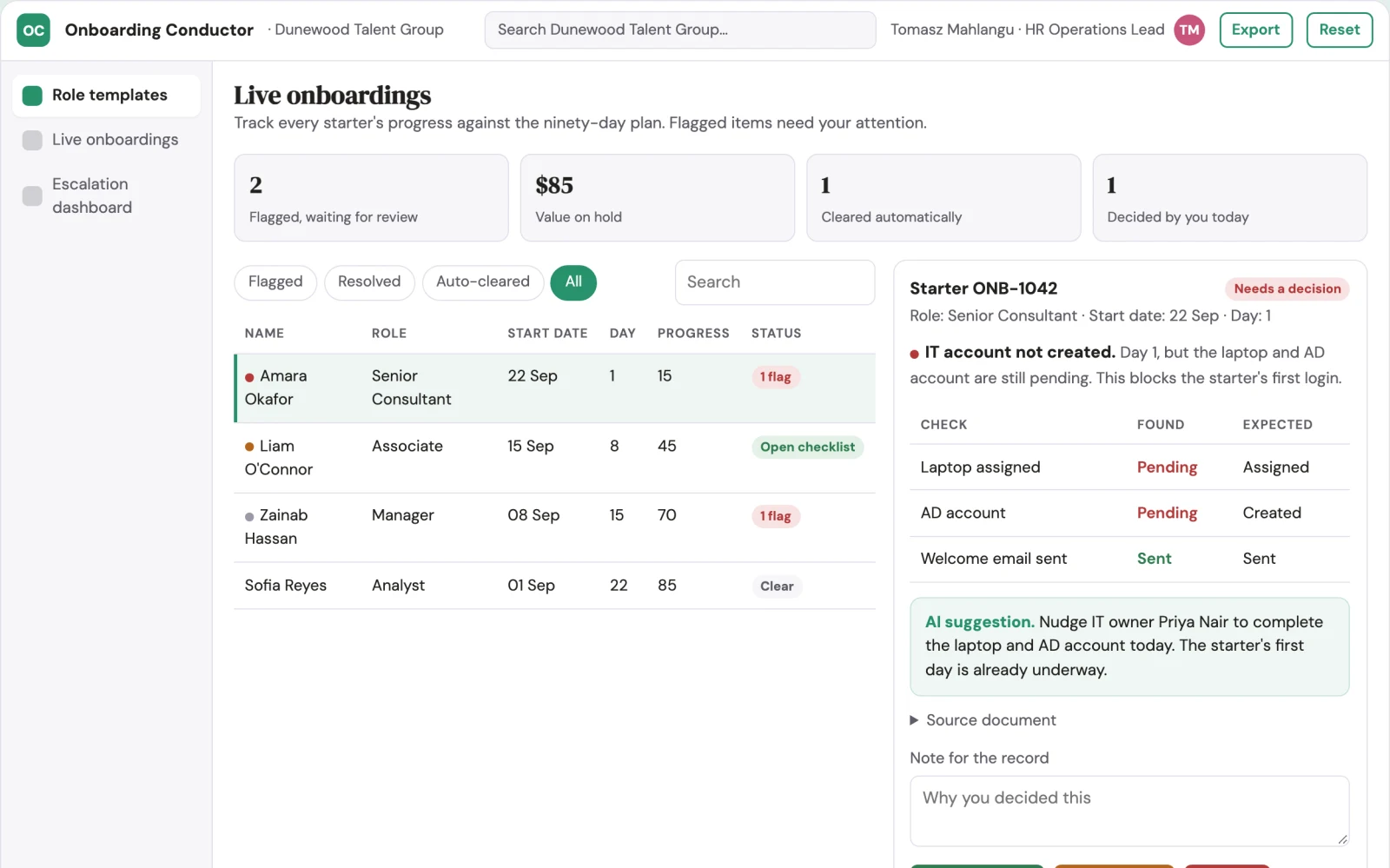
- Show a shared dashboard of all live onboardings and overdue steps.
What goes in, what comes out
- Role template
- Starter details

AI drafts, people review. Operational coordination portal.
- Tracked onboarding sequence with automated tickets
- Emails
- Escalations
How it works
The workflow
- InStart with
Role template and starter details
- 1
Define role template
- 2
Trigger onboarding
- 3
Create IT ticket and payroll notice
- 4
Send starter checklist
- 5
Monitor completions daily
- 6
Nudge manager then HR on missed deadlines
- 7
Flag overdue items on the dashboard
- OutFinish with
Tracked onboarding sequence with automated tickets, emails and escalations
AI does the heavy lifting, people stay in charge
Use language models to draft nudge messages and summarise stalled steps for managers. Keep all personally identifiable data out of the model; the agent only handles task metadata and notification text. A human reviews escalation wording and template logic before the agent sends anything.
What your team sees
Key screens: Role templates, live onboardings, escalation dashboard. Use a role template list with edit and duplicate actions, a live onboardings table showing each starter's progress against deadlines, and an escalation dashboard with overdue items, assigned owners and nudge history. Let users drill into a starter's checklist to see what is done, pending or blocked. Display statuses as on-track, at-risk and overdue. In this product, the first view is role templates, followed by live onboardings and escalation dashboard.
Accounts and administration
Role template versions, starter records, notification history, escalation states, manager and HR permissions, audit trail of every automated action and manual override.
Integrations and data access
HR system webhook, email service, IT ticketing system, payroll notification email, shared calendar, and a simple document signing tool.
How we build it
We build with our own AI software development factory, so most implementations take days to a few weeks of creation time, not months. You see working software at every step, and exact timing depends on availability.
- 1
Scoping call
Day 1Thirty minutes on your process, your data and how you want to run it: for your own team, or for your clients. You get a fixed scope and price for the MVP.
- 2
MVP
2 daysOne buyer segment, one recurring use case; first modules: role template builder and live onboarding tracker. Manual review in the loop. Built by our AI software factory.
- 3
Paid pilot
3 daysAccounts, roles, review states, audit trail and the first integration, hardened for two to three paying pilot customers.
- 4
Full product
6 daysSelf-serve onboarding, billing, monitoring and the wider integration set.
- 5
Run and improve
MonthlyWe host, monitor and improve it for a fixed monthly fee, or hand it over to your team. How the retainer works.
Why we start with an MVP
An MVP, or minimum viable product, is the smallest version that your users can actually work with. It is not a cheap version of the full solution. It is a test, built to answer the questions that decide whether the rest is worth building.
- Pick the riskiest assumption. Here: will HR leads at mid-size professional services firms use it to solve "new hires stall because IT, HR and managers each miss their piece of the first ninety days"?
- Build only what tests it. One team, one use case, a few core modules. People do the rest by hand for now.
- Run a paid pilot. A paid pilot with one firm tracks time spent per hire and missed deadlines for ten onboardings against a baseline of their previous ten.
- Measure, then decide. Track two measurable outcomes: percentage of onboarding steps completed on time and and hours saved per hire for HR and IT. Then expand, change course or stop, with evidence instead of opinions.
MVP scope for this solution. One buyer: HR leads at a single professional services firm. One use case: junior cohort onboarding. First two modules: role template builder and live onboarding tracker. Manual review of all generated emails and tickets before send.
After the MVP. After the paid pilot, automate policy document routing, integrate with learning management systems for training completion, and add predictive alerts for likely stalls based on historical patterns.
What the build depends on. A reliable webhook or form trigger, email delivery service, and a database for template and starter records.
Investment
A planning range to start the conversation, not a quote. You pay per phase, so you can stop after the MVP.
- Phase 1
MVP
One buyer segment, one recurring use case; first modules: role template builder and live onboarding tracker. Manual review in the loop.
- Phase 2
Paid pilot
Accounts, roles, review states, audit trail and the first integration, hardened for two to three paying pilot customers.
- Phase 3
Full product
Self-serve onboarding, billing, monitoring and the wider integration set.
Indicative total, MVP to full product$17,500about 2 weeks of creation time · start with the MVP from $5,500
Running costs per month
A rough indication of monthly hosting and AI model costs once it is live, not tested. Real costs depend on usage, file sizes and the models chosen.
| Stage | Hosting and infrastructure | AI usage | Total per month |
|---|---|---|---|
| MVP and paid pilotabout 3 customers | $30–$60 | $40–$90 | $70–$150 |
| Full productabout 50 customers | $110–$210 | $280–$560 | $390–$770 |
Run it or resell it
For your own team
HR leads at mid-size professional services firms run it inside the business: role template and starter details in, tracked onboarding sequence with automated tickets, emails and escalations out, reviewed by your people.
As part of your offer
Agencies, consultancies and software companies can offer it to their own clients under their brand. We build and maintain it; you sell and deliver it.
Your brand, or this one
Run it under your own brand, or start from this concept style.
- primary
#27916c - accent
#c9547d - surface
#e4f1ec - ink
#22201e
- Headings
- DM Serif Display
- Text
- DM Sans
- Voice
- Fair, human, straightforward
Selling it to your own clients: the go-to-market playbook
Pricing to test
Test a fixed monthly fee of USD 1,500 for up to twenty onboardings per month, then USD 50 per additional onboarding, as a hypothesis.
Message to test
Give every new hire a calm first ninety days without anyone chasing.
Where to find buyers
HR conferences, LinkedIn groups for HR leads, and direct outreach to professional services firms with hiring cohorts.
Lead magnet
A free onboarding sequence audit showing where your current process drops steps.
The first 30 days
- Week 1: Build role template builder and starter trigger form.
- Week 2: Connect email and IT ticket creation.
- Week 3: Build checklist page and daily monitoring.
- Week 4: Add escalation nudges and dashboard, then test with one firm.
Paid pilot
A paid pilot with one firm tracks time spent per hire and missed deadlines for ten onboardings against a baseline of their previous ten. Decision: continue if average missed deadlines drop by half and HR time per hire falls by at least two hours.
Success metrics
Two measurable outcomes: percentage of onboarding steps completed on time, and hours saved per hire for HR and IT.
Retention and expansion
The agent becomes the firm's onboarding memory; each new role template and escalation pattern improves the service, and the monthly fee keeps renewing as long as hiring continues.
Why clients would pick it
Each role template encodes your firm's specific equipment, training and check-in rhythm, and the escalation history builds a dataset that makes the agent smarter about which stalls matter.
Alternatives and positioning
Spreadsheets, shared calendars and email chains. This differs by giving the new starter one checklist and the agent does the chasing.
Main delivery costs
Integration work with HR systems and email, hosting, and a part-time onboarding specialist for template review and escalation tuning.
Safeguards
The agent must never send or store bank details, home addresses or other personally identifiable data; it only creates empty forms and notifies payroll. It must not contact the new starter about escalations, only managers and HR. All outbound messages require a human approval step for the first month, then a sample review.