Shift Cover Agent
The only cover system that combines live rota data, legal working-time rules and automated candidate messaging in one flow, so managers see a confirmed replacement or an alert without touching a phone.
- For
- Operations managers at care homes and hospitality groups
- Solves
- A team leader spends stressful hours phoning off-duty staff to cover a sick shift, and gaps often go unfilled.
- Delivers
- Confirmed replacement or an early alert when cover is impossible, plus a full message and response log
- Built in
- 10 days of creation time, MVP in 2 days
- Investment
- $5,500 for the MVP, $16,500 for the full product
- Run it
- Inside your business, or as part of your offer to clients
What it does
For operations managers at care homes and hospitality groups, turn live rota data, staff qualifications and working-time rules into a confirmed replacement or an early alert when cover is impossible.
- Import and refresh rota data from a spreadsheet or API.
- Filter off-duty staff by required qualifications and legal working-time limits.
- Rank candidates by priority rules such as recency and fairness.
- Send personalised shift offers via SMS or WhatsApp with a one-tap accept link.
- Automatically retry the next candidate after a decline or timeout.
- Notify the manager only when cover is confirmed or all options are exhausted.
What goes in, what comes out
- Live rota data
- Staff qualifications
- Working-time rules
- Sickness reports

AI drafts, people review. Operational coordination portal.
- Confirmed replacement or an early alert when cover is impossible
- Plus a full message
- Response log
How it works
The workflow
- InStart with
Live rota data, staff qualifications, working-time rules and sickness reports
- 1
Staff report sickness via form or SMS
- 2
The agent pulls the live rota
- 3
Filters by role and legal rules
- 4
Ranks candidates
- 5
Sends an offer to the first match
- 6
Waits for a response
- 7
Moves to the next candidate if needed
- 8
Notifies the manager with a confirmed cover or an alert
- OutFinish with
Confirmed replacement or an early alert when cover is impossible, plus a full message and response log
AI does the heavy lifting, people stay in charge
Use language models to parse free-text sickness reports and generate personalised shift offer messages. Use rule-based logic to check qualifications and working-time limits against structured rota data. A manager reviews the candidate ranking and message log before any offer is sent, and confirms the final cover or alert.
What your team sees
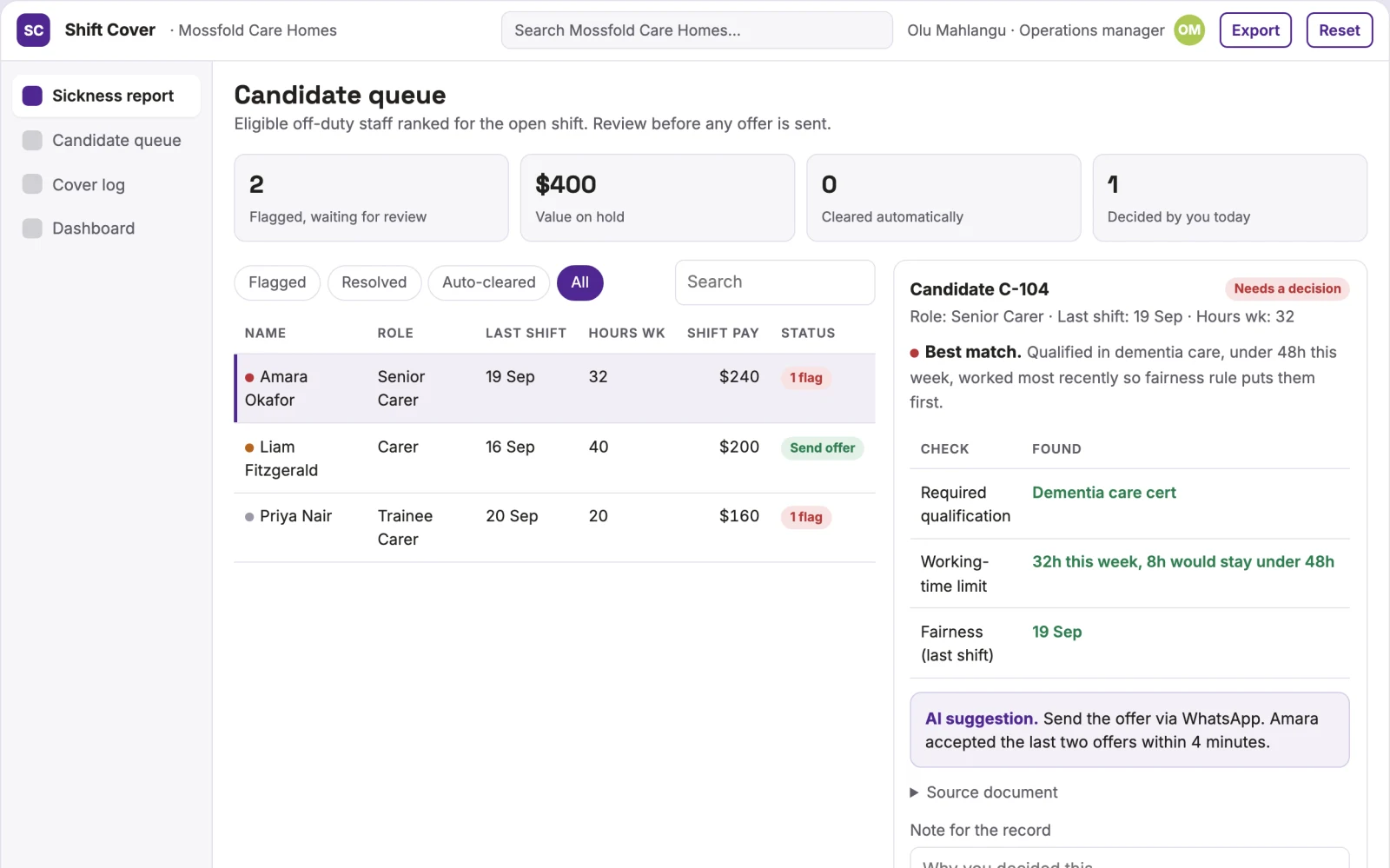
Key screens: Sickness report form, candidate queue, cover log. Use a simple form for staff to report absence, a central queue showing ranked candidates with their qualifications and recent shifts, and a log of all messages sent and responses. Display candidate status as pending, accepted, declined or expired. Provide a manager summary dashboard showing cover rates and response times. In this product, the first view is sickness report form, followed by candidate queue and cover log.
Accounts and administration
Manager accounts, rota data versioning, candidate ranking rules, message templates, approval of offers, audit trail of all attempts and responses, and a daily summary report.
Integrations and data access
Start with spreadsheet rota exports, SMS and WhatsApp APIs, and a simple staff directory. Later connect to HR systems for qualifications and to payroll for shift records.
How we build it
We build with our own AI software development factory, so most implementations take days to a few weeks of creation time, not months. You see working software at every step, and exact timing depends on availability.
- 1
Scoping call
Day 1Thirty minutes on your process, your data and how you want to run it: for your own team, or for your clients. You get a fixed scope and price for the MVP.
- 2
MVP
2 daysOne buyer segment, one recurring use case. Manual review in the loop. Built by our AI software factory.
- 3
Paid pilot
3 daysAccounts, roles, review states, audit trail and the first integration, hardened for two to three paying pilot customers.
- 4
Full product
5 daysSelf-serve onboarding, billing, monitoring and the wider integration set.
- 5
Run and improve
MonthlyWe host, monitor and improve it for a fixed monthly fee, or hand it over to your team. How the retainer works.
Why we start with an MVP
An MVP, or minimum viable product, is the smallest version that your users can actually work with. It is not a cheap version of the full solution. It is a test, built to answer the questions that decide whether the rest is worth building.
- Pick the riskiest assumption. Here: will operations managers at care homes and hospitality groups use it to solve "A team leader spends stressful hours phoning off-duty staff to cover a sick shift, and gaps often go unfilled"?
- Build only what tests it. One team, one use case, a few core modules. People do the rest by hand for now.
- Run a paid pilot. Run a four-week paid pilot with one care home site.
- Measure, then decide. Track cover rate for sick shifts within two hours and and average manager time spent on cover per absence. Then expand, change course or stop, with evidence instead of opinions.
MVP scope for this solution. One care home department, one role type, rota imported from a spreadsheet, and a basic rule set for working-time limits. First two modules are the sickness report form and the candidate queue with manual manager review of every offer before it is sent.
After the MVP. After the paid pilot, automate the sending of offers and retries without manager review, add multi-department rotas, integrate with HR systems for live qualification data, and add a fairness scoring model to balance shift distribution across staff.
What the build depends on. Needs clean rota data in a consistent format, a working SMS or WhatsApp gateway, and a current list of staff qualifications and working-time rules for the target role.
Investment
A planning range to start the conversation, not a quote. You pay per phase, so you can stop after the MVP.
- Phase 1
MVP
One buyer segment, one recurring use case. Manual review in the loop.
- Phase 2
Paid pilot
Accounts, roles, review states, audit trail and the first integration, hardened for two to three paying pilot customers.
- Phase 3
Full product
Self-serve onboarding, billing, monitoring and the wider integration set.
Indicative total, MVP to full product$16,50010 days of creation time · start with the MVP from $5,500
Running costs per month
A rough indication of monthly hosting and AI model costs once it is live, not tested. Real costs depend on usage, file sizes and the models chosen.
| Stage | Hosting and infrastructure | AI usage | Total per month |
|---|---|---|---|
| MVP and paid pilotabout 3 customers | $30–$60 | $40–$90 | $70–$150 |
| Full productabout 50 customers | $110–$210 | $280–$560 | $390–$770 |
Run it or resell it
For your own team
Operations managers at care homes and hospitality groups run it inside the business: live rota data, staff qualifications, working-time rules and sickness reports in, confirmed replacement or an early alert when cover is impossible, plus a full message and response log out, reviewed by your people.
As part of your offer
Agencies, consultancies and software companies can offer it to their own clients under their brand. We build and maintain it; you sell and deliver it.
Your brand, or this one
Run it under your own brand, or start from this concept style.
- primary
#4e2791 - accent
#acc954 - surface
#e9e4f1 - ink
#22201e
- Headings
- Space Grotesk
- Text
- Inter
- Voice
- Calm, reliable, step-by-step
Selling it to your own clients: the go-to-market playbook
Pricing to test
Test pricing at 150 USD per month per site, with a setup fee of 500 USD for data integration and rule configuration.
Message to test
Never phone around for cover again: get a confirmed replacement or an early alert, automatically and compliantly.
Where to find buyers
Care home operations conferences, hospitality management forums, LinkedIn groups for rota managers, and direct outreach to operations directors at mid-sized care groups.
Lead magnet
A free cover-rate audit: we analyse one month of your rota and absence data and show you how many shifts went unfilled and how much manager time was spent on phone calls.
The first 30 days
- Week 1: Onboard one care home department, import their rota spreadsheet, and configure working-time rules for one role type.
- Week 2: Build the sickness report form and the candidate queue with manual manager review.
- Week 3: Connect SMS and WhatsApp messaging and test the first live shift offer with a single candidate.
- Week 4: Run a full week of live sickness reports, log all attempts, and deliver a daily manager summary to measure cover rate and response time.
Paid pilot
Run a four-week paid pilot with one care home site. Baseline is their current cover rate and average time to fill a gap. Success is a cover rate above 90 percent and a 50 percent reduction in manager phone time, then the site commits to an annual contract.
Success metrics
Cover rate for sick shifts within two hours, and average manager time spent on cover per absence.
Retention and expansion
After the first delivery, the system becomes the default route for sickness cover, so it earns monthly subscription revenue and expands to more departments and role types as trust grows.
Why clients would pick it
The more rota data, qualification records and working-time rules we ingest, the more accurate the candidate ranking becomes, and the harder it is for a new entrant to match the compliance confidence and response-time track record.
Alternatives and positioning
Manual phone calls down a list of off-duty staff, shared spreadsheets, or group chat messages. This differs by automating the entire sequence from sickness report to confirmed cover, with compliance checks built in at every step.
Main delivery costs
Main delivery costs are integration engineering for rota data, SMS and WhatsApp message fees, cloud hosting, and ongoing rule maintenance for working-time legislation.
Safeguards
Managers must approve every offer before it is sent in the pilot phase. The system must not contact staff outside agreed working hours, must not override legal working-time limits, and must not share staff contact details beyond the offer message.