PalatePilot Wine Club
A taste model that learns continuously from every sip, voice note and return, not just a one-time quiz.
- For
- Subscription wine club operators and busy hosts who buy wine online
- Solves
- Subscription wine services ship the same generic bottles to everyone, leaving customers with unwanted stock and high churn.
- Delivers
- Personalised wine selection, shipment options, reorder schedule and taste profile report
- Built in
- about 3 weeks of creation time, MVP in 3 days
- Investment
- $6,000 for the MVP, $20,000 for the full product
- Run it
- Inside your business, or as part of your offer to clients
What it does
For subscription wine club operators and busy hosts who buy wine online, turn tasting notes, voice feedback, label photos, dining habits and local weather into a personalised wine selection and reorder schedule.
- Parse voice notes and label photos into structured taste attributes.
- Build a dynamic taste profile from ratings and returns.
- Generate three shipment options with predicted preference scores.
- Adjust recommendations based on weather, occasion and dining context.
- Trigger reorders when bottles are marked empty.
- Log returns and feed corrections back into the model.
What goes in, what comes out
- Tasting notes
- Voice feedback
- Label photos
- Dining habits
- Local weather
- Occasion mentions

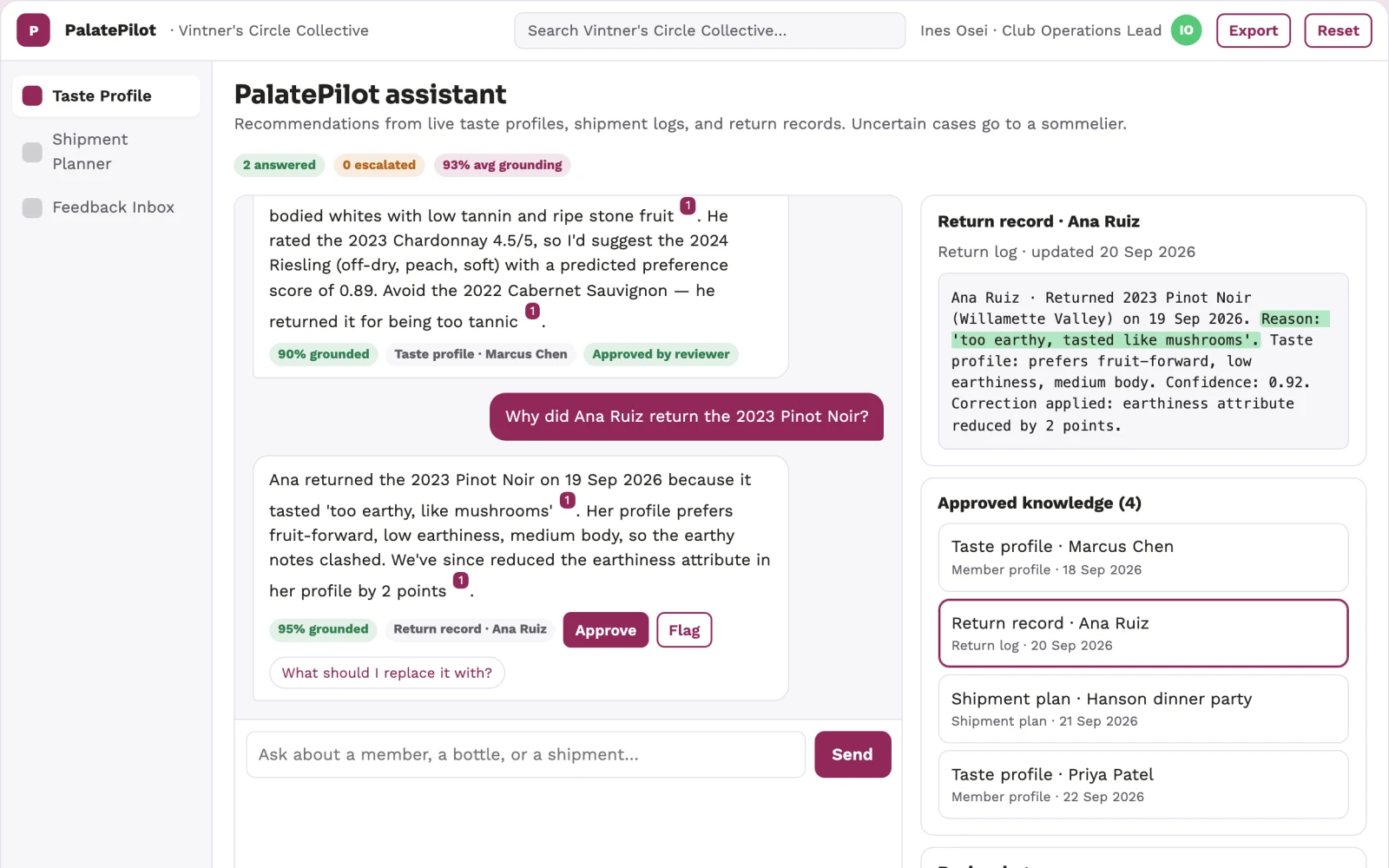
AI drafts, people review. Source-linked assistant and administrator console.
- Personalised wine selection
- Shipment options
- Reorder schedule
- Taste profile report
How it works
The workflow
- InStart with
Tasting notes, voice feedback, label photos, dining habits, local weather, occasion mentions
- 1
Capture feedback
- 2
Update taste profile
- 3
Cross-reference context
- 4
Generate options
- 5
Notify member
- 6
Receive choice or auto-select
- 7
Dispatch with reorder trigger
- OutFinish with
Personalised wine selection, shipment options, reorder schedule and taste profile report
AI does the heavy lifting, people stay in charge
Use language models to interpret taste descriptors from voice and text, and image recognition for labels and food photos. Keep factual bottle attributes in structured fields. Validate shipping eligibility through deterministic checks. A human sommelier reviews borderline predictions and return patterns before shipment changes are applied.
What your team sees
Key screens: Taste profile, shipment planner, feedback inbox. Use a dashboard for active subscriptions, a central profile view showing taste dimensions and confidence scores, and a right-hand panel for upcoming shipment options and user feedback. Let users compare three bottle suggestions side by side. Display auto-select, user-chosen and returned states. Provide a mobile-friendly voice note capture screen. In this product, the first view is taste profile, followed by shipment planner and feedback inbox.
Accounts and administration
Member accounts, taste profile versions, shipment history, feedback logs, return records, approval states for manual overrides, audit trail for model changes and permission levels for club staff.
Integrations and data access
Winery inventory APIs, shipping carrier systems, payment processors, weather data feeds, calendar and social media APIs.
How we build it
We build with our own AI software development factory, so most implementations take days to a few weeks of creation time, not months. You see working software at every step, and exact timing depends on availability.
- 1
Scoping call
Day 1Thirty minutes on your process, your data and how you want to run it: for your own team, or for your clients. You get a fixed scope and price for the MVP.
- 2
MVP
3 daysOne buyer segment, one recurring use case; first modules: taste profile builder and shipment planner. Manual review in the loop. Built by our AI software factory.
- 3
Paid pilot
4 daysAccounts, roles, review states, audit trail and the first integration, hardened for two to three paying pilot customers.
- 4
Full product
6 daysSelf-serve onboarding, billing, monitoring and the wider integration set.
- 5
Run and improve
MonthlyWe host, monitor and improve it for a fixed monthly fee, or hand it over to your team. How the retainer works.
Why we start with an MVP
An MVP, or minimum viable product, is the smallest version that your users can actually work with. It is not a cheap version of the full solution. It is a test, built to answer the questions that decide whether the rest is worth building.
- Pick the riskiest assumption. Here: will subscription wine club operators and busy hosts who buy wine online use it to solve "subscription wine services ship the same generic bottles to everyone, leaving customers with unwanted stock and high churn"?
- Build only what tests it. One team, one use case, a few core modules. People do the rest by hand for now.
- Run a paid pilot. Run a paid pilot with 50 existing subscribers for two months.
- Measure, then decide. Track monthly churn rate and average predicted vs actual satisfaction score per shipment. Then expand, change course or stop, with evidence instead of opinions.
MVP scope for this solution. One buyer: a small wine club operator. One use case: monthly subscription selection. First two modules: taste profile builder and shipment planner. Manual review by a sommelier before each dispatch.
After the MVP. Automate sommelier review for low-risk predictions, integrate with winery inventory systems, add gift label generation and cellar inventory management, and enable voice reordering through phone agents.
What the build depends on. Reliable image and speech recognition, access to wine label and tasting note datasets, regional alcohol shipping compliance data.
Investment
A planning range to start the conversation, not a quote. You pay per phase, so you can stop after the MVP.
- Phase 1
MVP
One buyer segment, one recurring use case; first modules: taste profile builder and shipment planner. Manual review in the loop.
- Phase 2
Paid pilot
Accounts, roles, review states, audit trail and the first integration, hardened for two to three paying pilot customers.
- Phase 3
Full product
Self-serve onboarding, billing, monitoring and the wider integration set.
Indicative total, MVP to full product$20,000about 3 weeks of creation time · start with the MVP from $6,000
Running costs per month
A rough indication of monthly hosting and AI model costs once it is live, not tested. Real costs depend on usage, file sizes and the models chosen.
| Stage | Hosting and infrastructure | AI usage | Total per month |
|---|---|---|---|
| MVP and paid pilotabout 3 customers | $30–$60 | $60–$120 | $90–$180 |
| Full productabout 50 customers | $110–$210 | $530–$1,050 | $640–$1,260 |
Run it or resell it
For your own team
Subscription wine club operators and busy hosts who buy wine online run it inside the business: tasting notes, voice feedback, label photos, dining habits, local weather, occasion mentions in, personalised wine selection, shipment options, reorder schedule and taste profile report out, reviewed by your people.
As part of your offer
Agencies, consultancies and software companies can offer it to their own clients under their brand. We build and maintain it; you sell and deliver it.
Your brand, or this one
Run it under your own brand, or start from this concept style.
- primary
#912758 - accent
#54c977 - surface
#f1e4ea - ink
#22201e
- Headings
- Sora
- Text
- Work Sans
- Voice
- Direct, upbeat, outcome-focused
Selling it to your own clients: the go-to-market playbook
Pricing to test
Test pricing at USD 49 per month for the subscription, plus a 15% margin on each bottle shipped. Premium tier at USD 79 per month adds custom labels and cellar management.
Message to test
Your wine club that learns your palate with every sip, not a one-time quiz.
Where to find buyers
Wine blogs, subscription box review sites, social media groups for home entertaining, partnerships with sommeliers and food influencers.
Lead magnet
Free taste profile report based on a sample of your past wine ratings and a personalised three-bottle recommendation list.
The first 30 days
- Week 1: Build taste profile capture and structured storage.
- Week 2: Implement label photo and voice note parsing.
- Week 3: Build shipment planner with three options and notification flow.
- Week 4: Run a manual pilot with 10 users, collect feedback and refine the model.
Paid pilot
Run a paid pilot with 50 existing subscribers for two months. Baseline: current churn rate of 8% per month. Decision: if churn drops below 4% and average rating of shipments rises by 20%, proceed to full rollout.
Success metrics
Monthly churn rate and average predicted vs actual satisfaction score per shipment.
Retention and expansion
The model improves with each return and rating, so the service becomes more accurate and harder to leave. Reorder triggers and contextual suggestions keep the engagement loop active.
Why clients would pick it
The proprietary taste profile dataset grows with every interaction, making predictions more accurate and switching costs higher over time.
Alternatives and positioning
Static wine quizzes, generic subscription boxes, manual sommelier consultations. This differs by using real-time feedback loops and contextual signals for every shipment.
Main delivery costs
Model inference, cloud hosting, sommelier review time, shipping integration fees, customer support.
Safeguards
Limit access to member data to authorised staff only. Require sommelier approval for any shipment change. Must not recommend alcohol to underage users or in prohibited regions. Log all model decisions and allow members to opt out of data collection.