Neighborhood Voice Walkthrough
A live, generative walkthrough that adapts to user questions, not a pre-recorded video.
- For
- Travel planners at boutique booking agencies
- Solves
- Travellers commit to trips without testing the rhythm of a neighbourhood.
- Delivers
- A live voice-guided neighbourhood preview with a trip plan and booking links
- Built in
- about 2 weeks of creation time, MVP in 2 days
- Investment
- $5,500 for the MVP, $18,000 for the full product
- Run it
- Inside your business, or as part of your offer to clients
What it does
For travel planners at boutique booking agencies, turn map data, street imagery and local reviews into a live, voice-guided neighbourhood preview that answers questions as the user walks.
- Generate a walking route from map data and street imagery.
- Narrate the walk with a voice agent.
- Answer questions about noise, safety, shops and landmarks.
- Adapt the route based on user preferences and queries.
- Save spots to a trip plan.
- Book hotels or experiences directly through the guide.
What goes in, what comes out
- Map data
- Street-level imagery
- Local business records
- Reviews
- Municipal data

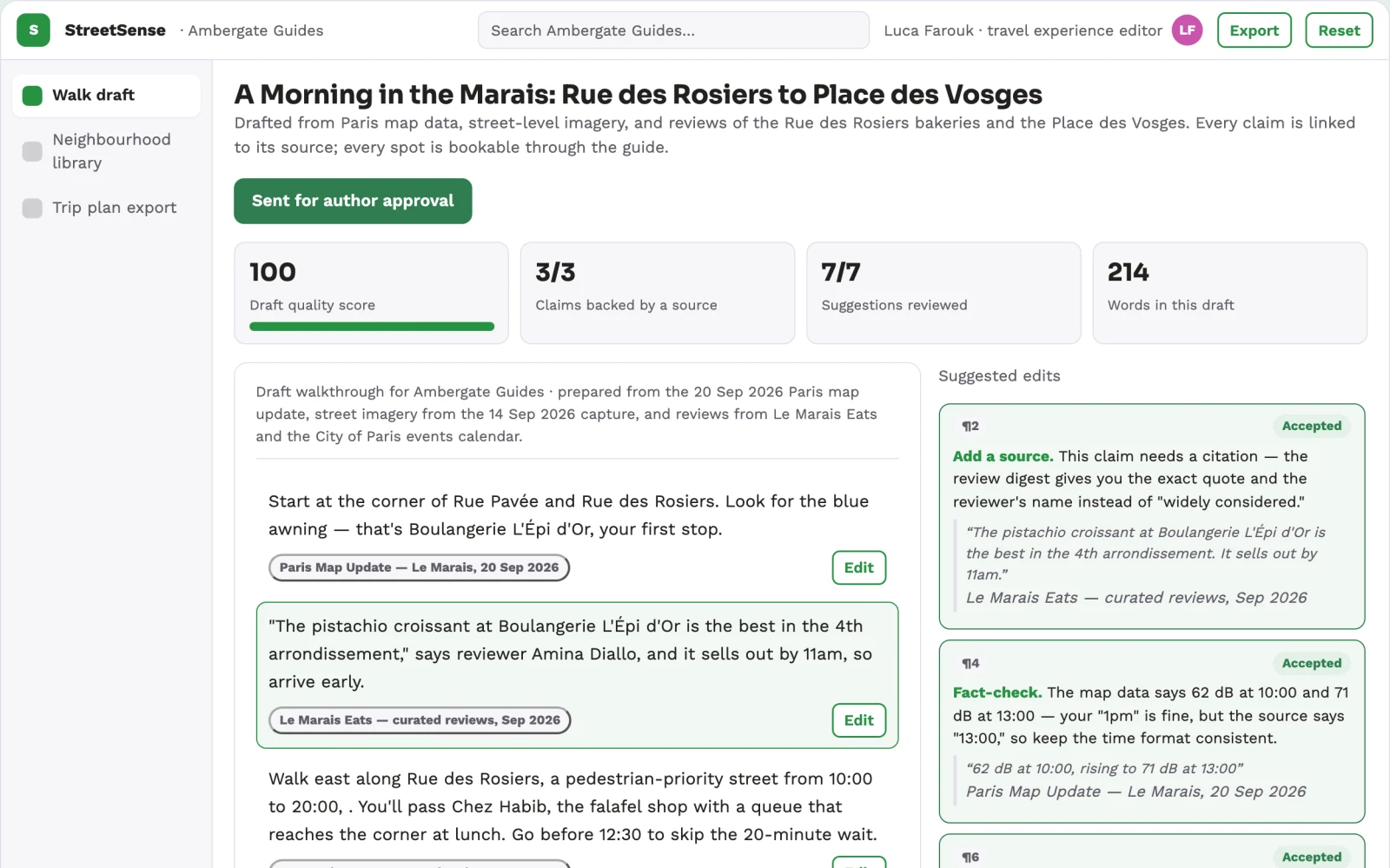
AI drafts, people review. Source-based content workspace with editorial delivery.
- A live voice-guided neighbourhood preview with a trip plan
- Booking links
How it works
The workflow
- InStart with
Map data, street-level imagery, local business records, reviews and municipal data
- 1
Choose a destination
- 2
Set preferences
- 3
Generate a walking route
- 4
Start the voice walk
- 5
Ask questions
- 6
Save or book spots
- 7
Export a trip plan
- OutFinish with
A live voice-guided neighbourhood preview with a trip plan and booking links
AI does the heavy lifting, people stay in charge
Use language models for voice interaction and route generation, and diffusion models for street-level imagery synthesis. Keep factual claims about businesses and conditions in structured fields. Verify details against real-time data sources where possible. A human editor reviews generated routes and answers for accuracy before publication.
What your team sees
Key screens: Destination picker, walk canvas, voice chat panel. Use a map-based picker for choosing a neighbourhood, a full-screen first-person walk canvas with a floating voice chat panel, and a side panel for saved spots and trip plan. Let users interrupt the narration anytime. Display the current street, nearby points of interest, and a transcript of the conversation. In this product, the first view is destination picker, followed by walk canvas and voice chat panel.
Accounts and administration
User accounts, walk history, saved spots, booking records, content versioning, approval workflow for new neighbourhoods, audit trail of AI-generated claims.
Integrations and data access
Map APIs, street view services, local business databases, booking platforms, and payment gateways.
How we build it
We build with our own AI software development factory, so most implementations take days to a few weeks of creation time, not months. You see working software at every step, and exact timing depends on availability.
- 1
Scoping call
Day 1Thirty minutes on your process, your data and how you want to run it: for your own team, or for your clients. You get a fixed scope and price for the MVP.
- 2
MVP
2 daysOne buyer segment, one recurring use case; first modules: route generation and voice Q&A. Manual review in the loop. Built by our AI software factory.
- 3
Paid pilot
3 daysAccounts, roles, review states, audit trail and the first integration, hardened for two to three paying pilot customers.
- 4
Full product
6 daysSelf-serve onboarding, billing, monitoring and the wider integration set.
- 5
Run and improve
MonthlyWe host, monitor and improve it for a fixed monthly fee, or hand it over to your team. How the retainer works.
Why we start with an MVP
An MVP, or minimum viable product, is the smallest version that your users can actually work with. It is not a cheap version of the full solution. It is a test, built to answer the questions that decide whether the rest is worth building.
- Pick the riskiest assumption. Here: will travel planners at boutique booking agencies use it to solve "travellers commit to trips without testing the rhythm of a neighbourhood"?
- Build only what tests it. One team, one use case, a few core modules. People do the rest by hand for now.
- Run a paid pilot. A paid pilot with 5 travel agencies proves the value by measuring the number of bookings made after a preview versus before.
- Measure, then decide. Track number of completed walks per user; booking conversion rate after a walk. Then expand, change course or stop, with evidence instead of opinions.
MVP scope for this solution. One buyer: travel planners at boutique agencies. One use case: pre-trip neighbourhood previews for remote workers. First two modules: route generation and voice Q&A. Manual review of all generated content before it goes live.
After the MVP. After the paid pilot, automate content verification with real-time data feeds and expand to more neighbourhoods and languages.
What the build depends on. Reliable map and street imagery APIs, a robust voice agent framework, and a content moderation pipeline.
Investment
A planning range to start the conversation, not a quote. You pay per phase, so you can stop after the MVP.
- Phase 1
MVP
One buyer segment, one recurring use case; first modules: route generation and voice Q&A. Manual review in the loop.
- Phase 2
Paid pilot
Accounts, roles, review states, audit trail and the first integration, hardened for two to three paying pilot customers.
- Phase 3
Full product
Self-serve onboarding, billing, monitoring and the wider integration set.
Indicative total, MVP to full product$18,000about 2 weeks of creation time · start with the MVP from $5,500
Running costs per month
A rough indication of monthly hosting and AI model costs once it is live, not tested. Real costs depend on usage, file sizes and the models chosen.
| Stage | Hosting and infrastructure | AI usage | Total per month |
|---|---|---|---|
| MVP and paid pilotabout 3 customers | $30–$60 | $70–$140 | $100–$200 |
| Full productabout 50 customers | $110–$210 | $700–$1,400 | $810–$1,610 |
Run it or resell it
For your own team
Travel planners at boutique booking agencies run it inside the business: map data, street-level imagery, local business records, reviews and municipal data in, a live voice-guided neighbourhood preview with a trip plan and booking links out, reviewed by your people.
As part of your offer
Agencies, consultancies and software companies can offer it to their own clients under their brand. We build and maintain it; you sell and deliver it.
Your brand, or this one
Run it under your own brand, or start from this concept style.
- primary
#279143 - accent
#c954ac - surface
#e4f1e8 - ink
#22201e
- Headings
- Sora
- Text
- Work Sans
- Voice
- Welcoming, lively, attentive
Selling it to your own clients: the go-to-market playbook
Pricing to test
Test a subscription at $15 per month for unlimited previews and full voice interaction, with affiliate commissions from bookings.
Message to test
Feel a neighbourhood before you book, with a voice guide that answers your questions.
Where to find buyers
Digital nomad forums, family travel groups, and travel agency partnerships.
Lead magnet
A free 5-minute demo walk of a sample neighbourhood with voice interaction.
The first 30 days
- Week 1: Build route generation for one neighbourhood.
- Week 2: Integrate voice agent with common questions.
- Week 3: Test with 10 users and refine.
- Week 4: Launch MVP with three preset routes.
Paid pilot
A paid pilot with 5 travel agencies proves the value by measuring the number of bookings made after a preview versus before. Baseline is current booking conversion; decision is to expand if conversion improves by 20%.
Success metrics
Number of completed walks per user; booking conversion rate after a walk.
Retention and expansion
Users return for new neighbourhoods and updated information, and the subscription renews monthly.
Why clients would pick it
Each new neighbourhood adds proprietary route data and verified local knowledge, making it harder for competitors to replicate the depth and accuracy.
Alternatives and positioning
People use static photos, review sites and pre-recorded 360 videos. This differs by offering a conversational, adaptive preview that feels like a real walk.
Main delivery costs
Cloud compute for image generation and voice models, data licensing for maps and reviews, and human editors for content review.
Safeguards
Limit access to verified neighbourhoods, require human review of all generated content, and do not provide unverified safety or health claims. Must not generate misleading or outdated information.