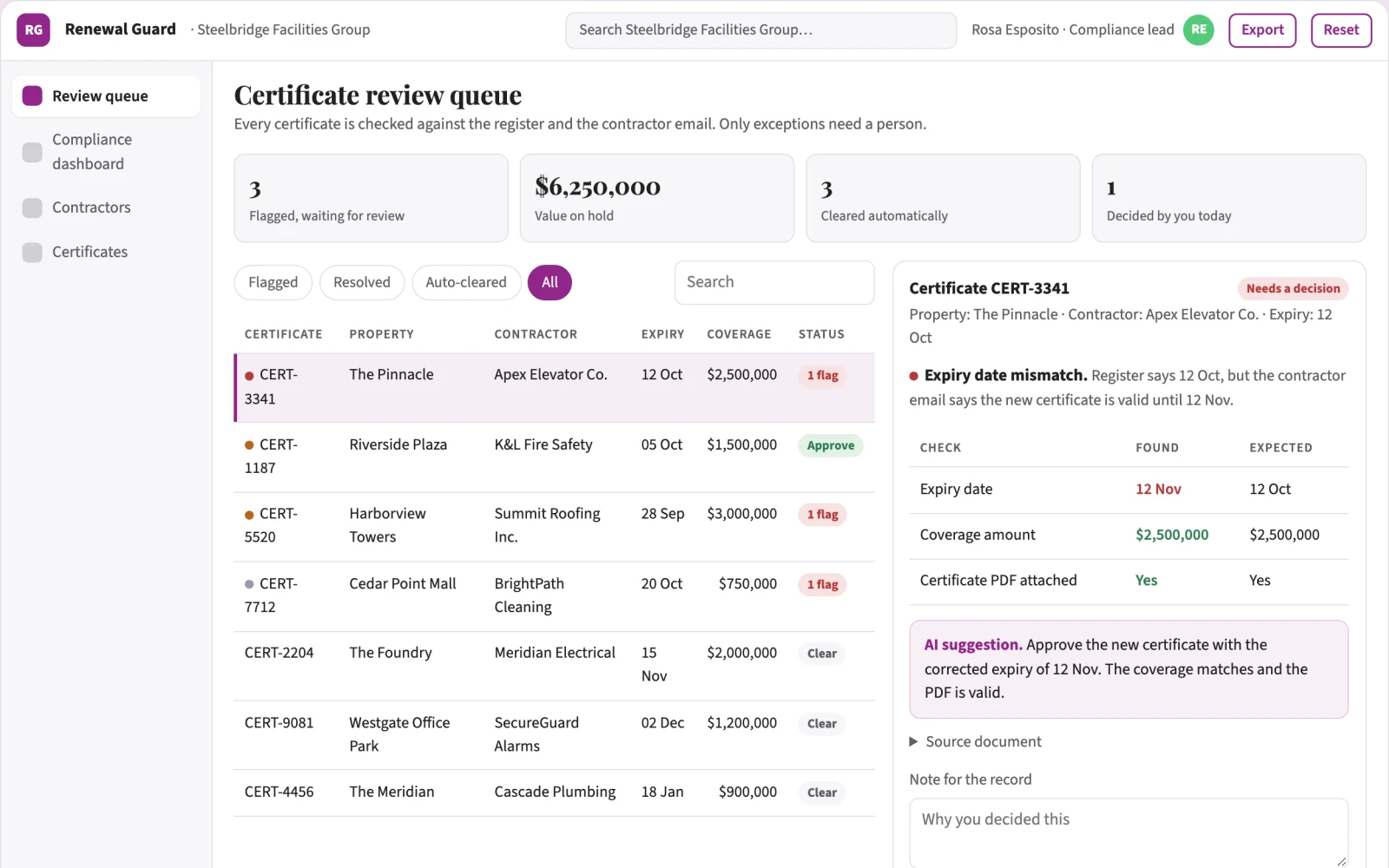
Automated Compliance Renewal Manager
Every certificate and licence is tracked from expiry to renewal, with contractor chasing handled automatically.
- For
- Facilities leads at property management firms
- Solves
- Compliance certificates expire unnoticed, leading to fines or insurance invalidation.
- Delivers
- Automated renewal schedule, calendar invites, structured filing system, compliant register
- Built in
- about 3 weeks of creation time, MVP in 3 days
- Investment
- $6,000 for the MVP, $20,000 for the full product
- Run it
- Inside your business, or as part of your offer to clients
What it does
For facilities leads, turn a manual spreadsheet of expiry dates into a fully managed renewal schedule and compliant filing system.
- Parse expiry dates from supplier lists.
- Schedule automated outreach to contractors.
- Parse contractor reply emails for appointment slots.
- Send calendar invites to site contacts.
- Monitor inbox for new certificate PDFs.
- Rename and store files in structured folders.
What goes in, what comes out
- Supplier list
- Expiry dates
- Email addresses for contractors
- Site contacts

AI drafts, people review. Evidence review and quality assurance workspace.
- Automated renewal schedule
- Calendar invites
- Structured filing system
- Compliant register
How it works
The workflow
- InStart with
Supplier list, expiry dates, email addresses for contractors and site contacts
- 1
Ingest register
- 2
Trigger outreach
- 3
Parse reply
- 4
Book slot
- 5
Send invite
- 6
Monitor inbox
- 7
Rename file
- 8
Flag for review
- 9
File compliant
- OutFinish with
Automated renewal schedule, calendar invites, structured filing system, compliant register
AI does the heavy lifting, people stay in charge
Use natural language processing to extract dates and availability from contractor emails. Use optical character recognition to verify certificate details. A human reviewer must validate the certificate content before it is marked compliant.
What your team sees
Key screens: Compliance dashboard, contractor booking interface, document review queue. Use a dashboard for status overview, a booking form for contractor communication, and a review area for PDFs. The first view is the dashboard, followed by the booking interface and document review queue.
Accounts and administration
User roles for managers and reviewers, audit trail of actions, version history of the register, approval states for certificates
Integrations and data access
Google Calendar, Outlook, Gmail/IMAP, cloud storage (Google Drive/OneDrive)
How we build it
We build with our own AI software development factory, so most implementations take days to a few weeks of creation time, not months. You see working software at every step, and exact timing depends on availability.
- 1
Scoping call
Day 1Thirty minutes on your process, your data and how you want to run it: for your own team, or for your clients. You get a fixed scope and price for the MVP.
- 2
MVP
3 daysOne buyer segment, one recurring use case. Manual review in the loop. Built by our AI software factory.
- 3
Paid pilot
4 daysAccounts, roles, review states, audit trail and the first integration, hardened for two to three paying pilot customers.
- 4
Full product
6 daysSelf-serve onboarding, billing, monitoring and the wider integration set.
- 5
Run and improve
MonthlyWe host, monitor and improve it for a fixed monthly fee, or hand it over to your team. How the retainer works.
Why we start with an MVP
An MVP, or minimum viable product, is the smallest version that your users can actually work with. It is not a cheap version of the full solution. It is a test, built to answer the questions that decide whether the rest is worth building.
- Pick the riskiest assumption. Here: will facilities leads at property management firms use it to solve "compliance certificates expire unnoticed, leading to fines or insurance invalidation"?
- Build only what tests it. One team, one use case, a few core modules. People do the rest by hand for now.
- Run a paid pilot. A paid pilot proves it by tracking a specific set of high-risk certificates (e.g., fire safety) for three months, comparing the time spent on admin before and after, and measuring the number of renewals completed on time.
- Measure, then decide. Track percentage of renewals completed on time and hours saved per month on admin tasks. Then expand, change course or stop, with evidence instead of opinions.
MVP scope for this solution. First cut: one property portfolio, one inspection type (e.g., fire alarms), manual review of the first batch of certificates
After the MVP. Automate the human review step using OCR to verify certificate validity, integrate with accounting software for invoice matching, and add multi-language support for international sites
What the build depends on. Stable internet connection, access to contractor email inboxes, ability to send emails on behalf of the user
Investment
A planning range to start the conversation, not a quote. You pay per phase, so you can stop after the MVP.
- Phase 1
MVP
One buyer segment, one recurring use case. Manual review in the loop.
- Phase 2
Paid pilot
Accounts, roles, review states, audit trail and the first integration, hardened for two to three paying pilot customers.
- Phase 3
Full product
Self-serve onboarding, billing, monitoring and the wider integration set.
Indicative total, MVP to full product$20,000about 3 weeks of creation time · start with the MVP from $6,000
Running costs per month
A rough indication of monthly hosting and AI model costs once it is live, not tested. Real costs depend on usage, file sizes and the models chosen.
| Stage | Hosting and infrastructure | AI usage | Total per month |
|---|---|---|---|
| MVP and paid pilotabout 3 customers | $30–$60 | $80–$160 | $110–$220 |
| Full productabout 50 customers | $110–$210 | $880–$1,750 | $990–$1,960 |
Run it or resell it
For your own team
Facilities leads at property management firms run it inside the business: supplier list, expiry dates, email addresses for contractors and site contacts in, automated renewal schedule, calendar invites, structured filing system, compliant register out, reviewed by your people.
As part of your offer
Agencies, consultancies and software companies can offer it to their own clients under their brand. We build and maintain it; you sell and deliver it.
Your brand, or this one
Run it under your own brand, or start from this concept style.
- primary
#91278a - accent
#54c979 - surface
#f1e4f0 - ink
#22201e
- Headings
- Playfair Display
- Text
- Source Sans 3
- Voice
- Solid, practical, on-schedule
Selling it to your own clients: the go-to-market playbook
Pricing to test
Test pricing at 50 USD per unit per month as a hypothesis
Message to test
Never miss a compliance deadline again with fully automated certificate tracking and renewal
Where to find buyers
LinkedIn, industry property management forums, trade publications
Lead magnet
Free audit of current compliance register
The first 30 days
- Week 1: Ingest register and set up calendar triggers.
- Week 2: Test contractor outreach and reply parsing.
- Week 3: Implement PDF monitoring and renaming.
- Week 4: Enable manual review workflow and dashboard.
Paid pilot
A paid pilot proves it by tracking a specific set of high-risk certificates (e.g., fire safety) for three months, comparing the time spent on admin before and after, and measuring the number of renewals completed on time.
Success metrics
Percentage of renewals completed on time, hours saved per month on admin tasks
Retention and expansion
Earns recurring revenue as long as the client has certificates to manage, with upsells for additional inspection types
Why clients would pick it
The value comes from the specific parsing logic for contractor emails and the integration with calendar systems, which becomes harder to replicate as the library of contractor communication styles grows
Alternatives and positioning
Excel spreadsheets, manual calendar reminders, generic email automation tools
Main delivery costs
Server hosting, API costs for email parsing and calendar integration
Safeguards
Strict permission settings to prevent the system from cancelling existing appointments, manual override buttons for complex contractor replies, and a requirement for human approval before marking a certificate as compliant