Utility Carbon Reporter
A single pipeline that turns raw utility bills into a client-ready, methodology-cited report with a human approval step built in, without spreadsheets.
- For
- Sustainability leads at facilities management companies, commercial property managers and mid-sized logistics firms
- Solves
- Manual sustainability reporting from utility bills is repetitive, error prone and steals time from client relationships.
- Delivers
- Client-ready carbon reports with methodology notes, charts, source citations and year-on-year comparisons
- Built in
- about 2 weeks of creation time, MVP in 2 days
- Investment
- $5,500 for the MVP, $17,000 for the full product
- Run it
- Inside your business, or as part of your offer to clients
What it does
For sustainability leads at facilities management companies, commercial property managers and mid-sized logistics firms, turn utility invoices and meter data feeds into client-ready carbon reports with methodology notes and year-on-year comparisons.
- Extract line items from utility invoices and meter feeds.
- Classify energy, water and waste categories.
- Map each line to an emissions factor from a maintained library.
- Calculate scope 1 and 2 emissions with standard factors.
- Build a draft report in the client's template with charts and citations.
- Route the draft to a human reviewer for approval or correction.
What goes in, what comes out
- Utility invoices
- Meter data feeds
- Client templates
- Emissions factor preferences

AI drafts, people review. Evidence-backed analysis and reporting workspace.
- Client-ready carbon reports with methodology notes
- Charts
- Source citations
- Year-on-year comparisons
How it works
The workflow
- InStart with
Utility invoices, meter data feeds, client templates and emissions factor preferences
- 1
Connect utility accounts or forward invoices
- 2
Ingest and extract line items
- 3
Classify categories
- 4
Map emissions factors
- 5
Calculate scope 1 and 2 totals
- 6
Generate draft report with charts and methodology
- 7
Review and approve
- 8
Then export client-ready PDF
- OutFinish with
Client-ready carbon reports with methodology notes, charts, source citations and year-on-year comparisons
AI does the heavy lifting, people stay in charge
Use language models and OCR to extract and classify line items from varied invoice formats, and rule-based mapping to emissions factors. Keep extracted values in structured fields with confidence scores. A human reviewer checks numbers and adds notes before any report is sent.
What your team sees
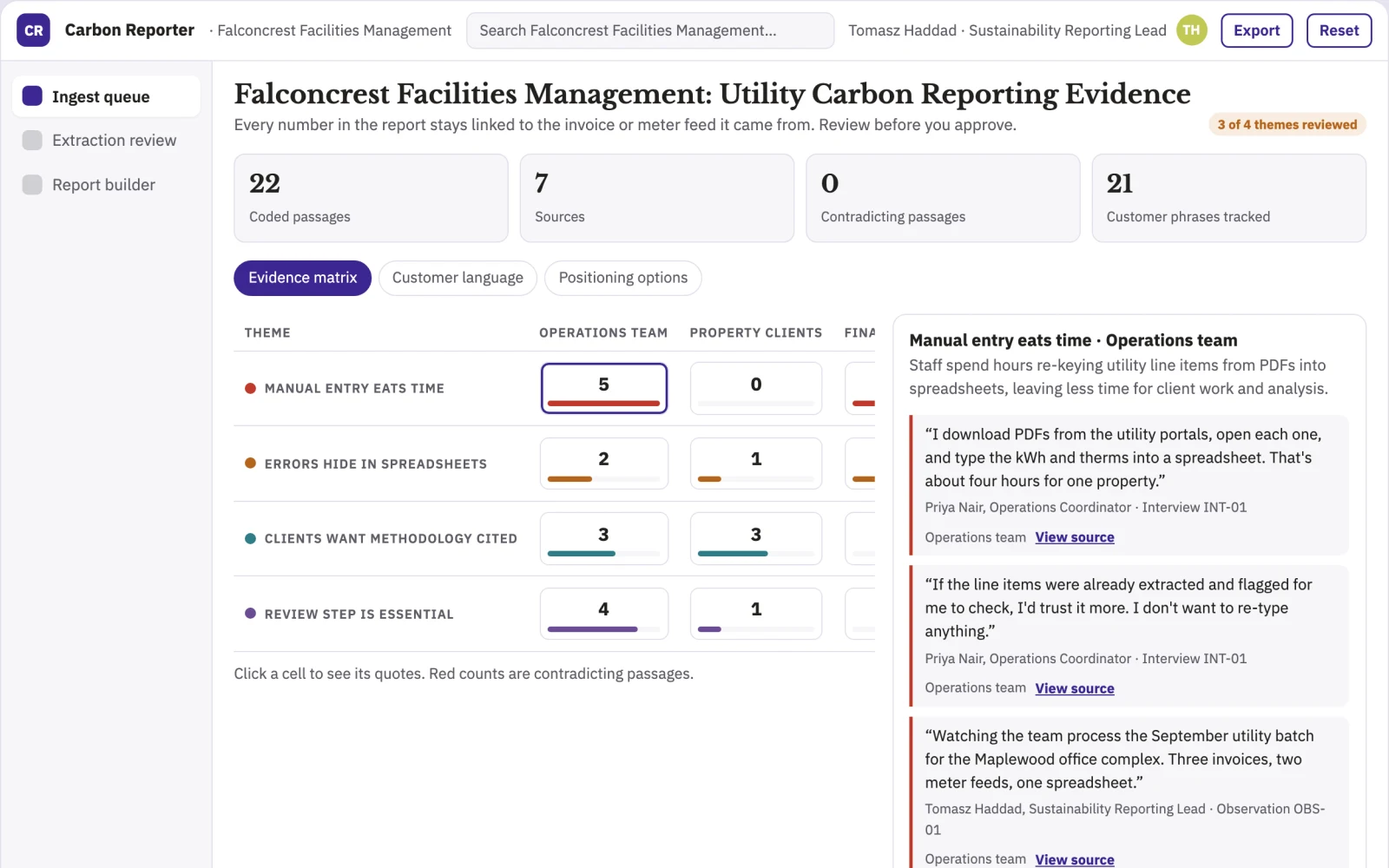
Key screens: Ingest queue, extraction review, calculation workspace, report builder. Use a dashboard for incoming bills and data feeds, a line-item extraction view with confidence flags, a calculation panel with emissions factors, and a report preview with charts and methodology notes. Display statuses: ingested, extracted, calculated, awaiting review, approved. In this product, the first view is ingest queue, followed by extraction review and report builder.
Accounts and administration
Accounts for reviewers and approvers, report versioning, approval states, audit trail of extraction and calculation steps, and permissions per client account.
Integrations and data access
Utility provider portals and APIs, email inbox for forwarded invoices, PDF parsers, and export to PDF or CSV for client reports.
How we build it
We build with our own AI software development factory, so most implementations take days to a few weeks of creation time, not months. You see working software at every step, and exact timing depends on availability.
- 1
Scoping call
Day 1Thirty minutes on your process, your data and how you want to run it: for your own team, or for your clients. You get a fixed scope and price for the MVP.
- 2
MVP
2 daysOne buyer segment, one recurring use case; first modules: invoice ingestion and emissions calculation with a single global factor. Manual review in the loop. Built by our AI software factory.
- 3
Paid pilot
3 daysAccounts, roles, review states, audit trail and the first integration, hardened for two to three paying pilot customers.
- 4
Full product
6 daysSelf-serve onboarding, billing, monitoring and the wider integration set.
- 5
Run and improve
MonthlyWe host, monitor and improve it for a fixed monthly fee, or hand it over to your team. How the retainer works.
Why we start with an MVP
An MVP, or minimum viable product, is the smallest version that your users can actually work with. It is not a cheap version of the full solution. It is a test, built to answer the questions that decide whether the rest is worth building.
- Pick the riskiest assumption. Here: will sustainability leads at facilities management companies, commercial property managers and mid-sized logistics firms use it to solve "manual sustainability reporting from utility bills is repetitive, error prone and steals time from client relationships"?
- Build only what tests it. One team, one use case, a few core modules. People do the rest by hand for now.
- Run a paid pilot. A paid pilot with one facilities management client for three months, measuring report cycle time and error rate against their current manual baseline.
- Measure, then decide. Track report cycle time reduced from five days to under one day. Error rate in emissions calculations reduced to zero in approved reports. Then expand, change course or stop, with evidence instead of opinions.
MVP scope for this solution. One buyer: facilities management companies. One use case: electricity reporting. First two modules: invoice ingestion and emissions calculation with a single global factor. Manual review of every report before export.
After the MVP. After the paid pilot, automate water and waste categories, add provider-specific parsing rules, integrate with meter APIs, and offer automatic year-on-year comparisons and client-branded PDF generation.
What the build depends on. Technical build needs access to OCR and language model APIs, a structured emissions factor database, and a secure document storage layer.
Investment
A planning range to start the conversation, not a quote. You pay per phase, so you can stop after the MVP.
- Phase 1
MVP
One buyer segment, one recurring use case; first modules: invoice ingestion and emissions calculation with a single global factor. Manual review in the loop.
- Phase 2
Paid pilot
Accounts, roles, review states, audit trail and the first integration, hardened for two to three paying pilot customers.
- Phase 3
Full product
Self-serve onboarding, billing, monitoring and the wider integration set.
Indicative total, MVP to full product$17,000about 2 weeks of creation time · start with the MVP from $5,500
Running costs per month
A rough indication of monthly hosting and AI model costs once it is live, not tested. Real costs depend on usage, file sizes and the models chosen.
| Stage | Hosting and infrastructure | AI usage | Total per month |
|---|---|---|---|
| MVP and paid pilotabout 3 customers | $30–$60 | $80–$160 | $110–$220 |
| Full productabout 50 customers | $110–$210 | $880–$1,750 | $990–$1,960 |
Run it or resell it
For your own team
Sustainability leads at facilities management companies, commercial property managers and mid-sized logistics firms run it inside the business: utility invoices, meter data feeds, client templates and emissions factor preferences in, client-ready carbon reports with methodology notes, charts, source citations and year-on-year comparisons out, reviewed by your people.
As part of your offer
Agencies, consultancies and software companies can offer it to their own clients under their brand. We build and maintain it; you sell and deliver it.
Your brand, or this one
Run it under your own brand, or start from this concept style.
- primary
#3c2791 - accent
#c1c954 - surface
#e7e4f1 - ink
#22201e
- Headings
- Libre Baskerville
- Text
- IBM Plex Sans
- Voice
- Calm, reliable, step-by-step
Selling it to your own clients: the go-to-market playbook
Pricing to test
Test pricing at USD 1,500 per client per month, with a setup fee of USD 5,000, as a hypothesis.
Message to test
Turn your utility bills into client-ready carbon reports without touching a spreadsheet.
Where to find buyers
Industry associations for facilities management, sustainability conferences, LinkedIn groups for property managers, and direct outreach to firms with public sustainability commitments.
Lead magnet
A free sample report generated from one month of a prospect's electricity bills, showing the format and methodology.
The first 30 days
- Week 1: Set up ingestion for one utility type and build extraction pipeline.
- Week 2: Implement emissions calculation with a single global factor.
- Week 3: Build the draft report template with charts and methodology notes.
- Week 4: Test with a friendly client, refine review workflow and prepare pilot materials.
Paid pilot
A paid pilot with one facilities management client for three months, measuring report cycle time and error rate against their current manual baseline. Decision to continue if cycle time drops by at least 50% and the client approves reports without major corrections.
Success metrics
Report cycle time reduced from five days to under one day. Error rate in emissions calculations reduced to zero in approved reports.
Retention and expansion
It keeps earning through monthly subscription, with the system learning provider-specific formats and building a library of client templates that make each report faster to produce.
Why clients would pick it
The emissions factor library and provider-specific parsing rules grow with every client, making the system faster and more accurate over time while competitors start from scratch.
Alternatives and positioning
Spreadsheets and manual data entry, generic accounting software, or outsourced consultants. This differs by automating the extraction and calculation while keeping a human in the review loop.
Main delivery costs
Main delivery costs are cloud hosting, OCR and language model API usage, and initial integration work per utility provider.
Safeguards
Limit access to approved reviewers only, require human approval before any report is exported, log all corrections and overrides, and never auto-send reports without an explicit approval step. It must not calculate emissions for categories without a verified factor.