Monthly Personal AI Tailor
A subscription that learns your exact body and style preferences over time, delivering a perfectly fitting garment every month without any measuring tape or in-person visits.
- For
- Busy professionals who hate shopping and value fit
- Solves
- Off-the-rack clothes rarely fit and custom tailoring is slow, costly and inconvenient.
- Delivers
- One custom garment per month, fit rating feedback loop
- Built in
- about 3 weeks of creation time, MVP in 4 days
- Investment
- $7,500 for the MVP, $26,500 for the full product
- Run it
- Inside your business, or as part of your offer to clients
What it does
For busy professionals who hate shopping and value fit, turn smartphone photos, style preferences and occasion details into a perfectly fitting custom garment delivered monthly.
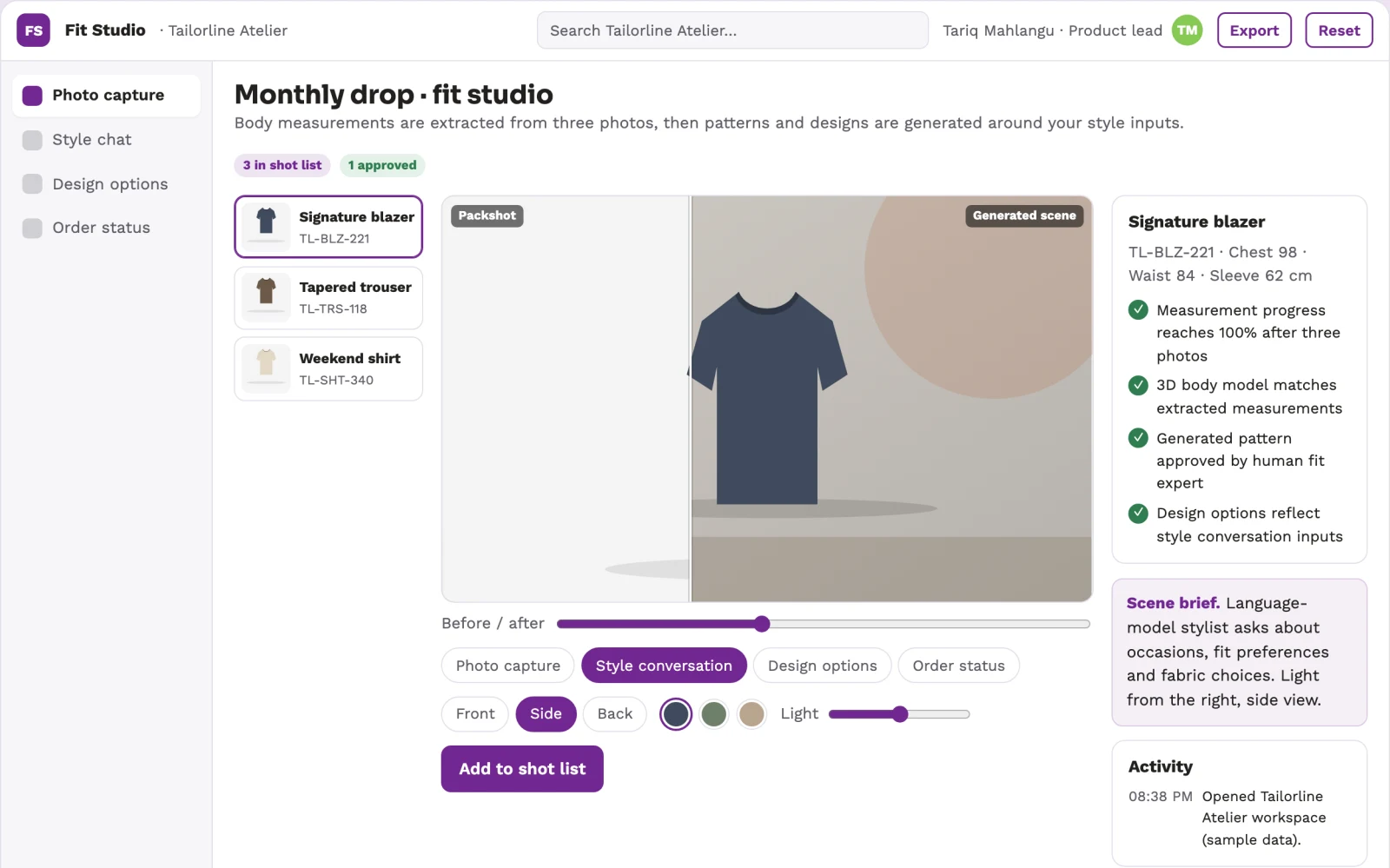
- Extract body measurements from three photos.
- Build a 3D body model.
- Generate garment patterns from style inputs.
- Offer design variations with fit adjustments.
- Place on-demand manufacturing order.
- Collect post-delivery ratings for learning.
What goes in, what comes out
- Three smartphone photos in form-fitting clothes
- Style preferences
- Occasion details

AI drafts, people review. Visual production platform with managed creative review.
- One custom garment per month
- Fit rating feedback loop
How it works
The workflow
- InStart with
Three smartphone photos in form-fitting clothes, style preferences, occasion details
- 1
Take three photos
- 2
Upload them
- 3
Have a style conversation
- 4
Review generated designs
- 5
Confirm fit tweaks
- 6
Place order
- 7
Rate the delivered garment
- OutFinish with
One custom garment per month, fit rating feedback loop
AI does the heavy lifting, people stay in charge
Use computer vision to extract measurements and build a 3D body model, generative AI to create garment patterns and design options, and a language model for the stylist conversation. A human fit expert reviews the generated pattern and measurements before manufacturing to ensure accuracy.
What your team sees
Key screens: Photo capture, style conversation, design options, order status. Use a guided photo capture flow with on-screen instructions, a chat interface for style preferences, a gallery of generated design options with fit tweaks, and a simple order tracking view. Let users rate each garment after delivery. Display measurement progress, design approval and shipping status. In this product, the first view is photo capture, followed by style conversation, design options and order status.
Accounts and administration
User accounts, measurement history, style profile, order status, delivery address, payment method, and a record of past garments and ratings.
Integrations and data access
Payment gateway, shipping carrier API, on-demand manufacturing partner system, and a customer relationship management database for style and fit history.
How we build it
We build with our own AI software development factory, so most implementations take days to a few weeks of creation time, not months. You see working software at every step, and exact timing depends on availability.
- 1
Scoping call
Day 1Thirty minutes on your process, your data and how you want to run it: for your own team, or for your clients. You get a fixed scope and price for the MVP.
- 2
MVP
4 daysOne buyer segment, one recurring use case; first modules: photo-to-measurement pipeline and simple style preference input via text and color swatches. Manual review in the loop. Built by our AI software factory.
- 3
Paid pilot
5 daysAccounts, roles, review states, audit trail and the first integration, hardened for two to three paying pilot customers.
- 4
Full product
8 daysSelf-serve onboarding, billing, monitoring and the wider integration set.
- 5
Run and improve
MonthlyWe host, monitor and improve it for a fixed monthly fee, or hand it over to your team. How the retainer works.
Why we start with an MVP
An MVP, or minimum viable product, is the smallest version that your users can actually work with. It is not a cheap version of the full solution. It is a test, built to answer the questions that decide whether the rest is worth building.
- Pick the riskiest assumption. Here: will busy professionals who hate shopping and value fit use it to solve "off-the-rack clothes rarely fit and custom tailoring is slow, costly and inconvenient"?
- Build only what tests it. One team, one use case, a few core modules. People do the rest by hand for now.
- Run a paid pilot. Run a paid pilot with 20 professionals for two months.
- Measure, then decide. Track percentage of garments rated as a good fit and monthly subscription renewal rate. Then expand, change course or stop, with evidence instead of opinions.
MVP scope for this solution. One buyer: busy professionals. One use case: custom button-down shirts. First two modules: photo-to-measurement pipeline and simple style preference input via text and color swatches. Manual review of measurements and patterns by a fit expert before sending to a small-batch manufacturer.
After the MVP. Automate the fit expert review with more accurate vision models, add voice stylist conversations, expand to trousers, jackets and dresses, and integrate directly with on-demand factories for faster turnaround.
What the build depends on. Accurate computer vision for body measurement, generative AI for pattern creation, a reliable on-demand manufacturing partner, and a secure payment and order management system.
Investment
A planning range to start the conversation, not a quote. You pay per phase, so you can stop after the MVP.
- Phase 1
MVP
One buyer segment, one recurring use case; first modules: photo-to-measurement pipeline and simple style preference input via text and color swatches. Manual review in the loop.
- Phase 2
Paid pilot
Accounts, roles, review states, audit trail and the first integration, hardened for two to three paying pilot customers.
- Phase 3
Full product
Self-serve onboarding, billing, monitoring and the wider integration set.
Indicative total, MVP to full product$26,500about 3 weeks of creation time · start with the MVP from $7,500
Running costs per month
A rough indication of monthly hosting and AI model costs once it is live, not tested. Real costs depend on usage, file sizes and the models chosen.
| Stage | Hosting and infrastructure | AI usage | Total per month |
|---|---|---|---|
| MVP and paid pilotabout 3 customers | $40–$80 | $150–$310 | $190–$390 |
| Full productabout 50 customers | $160–$320 | $2,100–$4,200 | $2,260–$4,520 |
Run it or resell it
For your own team
Busy professionals who hate shopping and value fit run it inside the business: three smartphone photos in form-fitting clothes, style preferences, occasion details in, one custom garment per month, fit rating feedback loop out, reviewed by your people.
As part of your offer
Agencies, consultancies and software companies can offer it to their own clients under their brand. We build and maintain it; you sell and deliver it.
Your brand, or this one
Run it under your own brand, or start from this concept style.
- primary
#712791 - accent
#87c954 - surface
#ede4f1 - ink
#22201e
- Headings
- Sora
- Text
- Work Sans
- Voice
- Curious, rigorous, user-led
Selling it to your own clients: the go-to-market playbook
Pricing to test
Test pricing at $99 per month for one garment, with an option to add extra pieces at a 20% discount. No inventory costs as each item is made on demand.
Message to test
Get a perfectly fitting custom garment every month, designed by AI that learns your style.
Where to find buyers
LinkedIn ads targeting professionals, partnerships with fitness and fashion influencers, and content marketing on style and fit.
Lead magnet
A free fit analysis report based on three photos, showing your body measurements and recommended garment styles.
The first 30 days
- Week 1: Build the photo capture flow and measurement extraction pipeline.
- Week 2: Partner with a small-batch shirt manufacturer and test sample fits.
- Week 3: Launch a basic style preference form and design generation.
- Week 4: Onboard first 10 pilot customers and collect initial fit ratings.
Paid pilot
Run a paid pilot with 20 professionals for two months. Baseline: their current fit satisfaction and return rate. Decision: if at least 80% of garments are rated as a good fit and 70% of customers renew, proceed to full launch.
Success metrics
Percentage of garments rated as a good fit and monthly subscription renewal rate.
Retention and expansion
Each month the AI learns from fit ratings and style feedback, improving the next garment. Customers receive a garment that fits better over time, making the subscription increasingly valuable and hard to cancel.
Why clients would pick it
The accumulated fit and style data for each customer becomes more accurate with every garment, creating a switching cost and a dataset that improves the AI's pattern generation for non-standard body types.
Alternatives and positioning
Off-the-rack shopping with multiple returns, traditional bespoke tailoring, or online made-to-measure services that require manual measurements. This differs by being fully automated, subscription-based and continuously learning from customer feedback.
Main delivery costs
On-demand manufacturing per garment, shipping, AI compute for vision and pattern generation, and fit expert review time for quality control.
Safeguards
Limit photo uploads to three per session, require explicit consent for body data processing, allow users to delete their body model and history, and ensure the AI does not generate garments outside approved style categories or fabric options. A human fit expert must approve every pattern before manufacturing.