Affinity Match Introductions
Introductions based on what both members chose to share about their interests and writing, with a clear explanation of the match and nothing read without consent.
- For
- Matchmaking services and member communities that introduce people on shared interests rather than photos
- Solves
- Dating apps reduce people to photos and bios, missing the deeper signals of shared curiosity and tone.
- Delivers
- A weekly introduction with a plain explanation of shared interests, and a member view of all material used
- Built in
- about 2 weeks of creation time, MVP in 2 days
- Investment
- $5,500 for the MVP, $18,000 for the full product
- Run it
- Inside your business, or as part of your offer to clients
What it does
For matchmaking services, turn the essays, reading lists, playlists and interests that opted-in members choose to share into a weekly introduction to one other opted-in member, with a plain explanation of what they have in common.
- Let members upload or link the essays, reading lists and playlists they want to share.
- Summarise that material into topic and tone profiles.
- Compare opted-in members weekly.
- Explain each match in plain words.
- Send an introduction only when both members accept.
- Let members see, edit and delete everything used.
What goes in, what comes out
- Essays
- Reading lists
- Playlists
- Interest answers
- Links that members add on purpose

AI drafts, people review. Transparent opportunity matching and shortlist platform.
- A weekly introduction with a plain explanation of shared interests
- A member view of all material used
How it works
The workflow
- InStart with
Essays, reading lists, playlists, interest answers and links that members add on purpose
- 1
Join and consent
- 2
Choose what to share
- 3
Build the interest profile
- 4
Weekly comparison
- 5
Matchmaker review
- 6
Both members accept
- 7
Introduction sent
- OutFinish with
A weekly introduction with a plain explanation of shared interests, and a member view of all material used
AI does the heavy lifting, people stay in charge
Language models summarise the material each member has explicitly shared (essays, reading lists, playlists, interest answers) into topic and tone profiles and compare opted-in members only. A matchmaker checks every introduction and its explanation before it is sent.
What your team sees
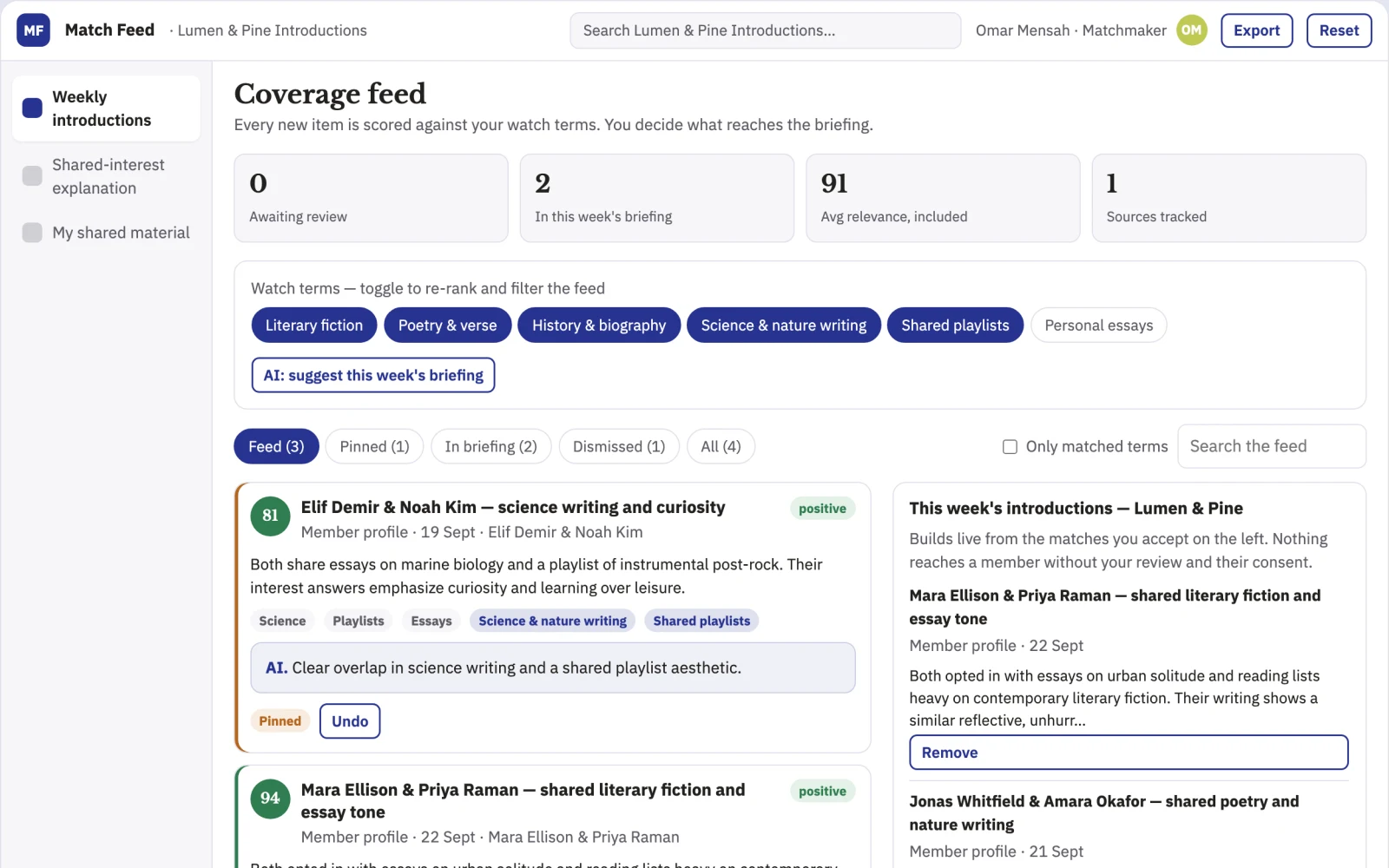
Key screens: Weekly introduction, Shared-interest explanation, My shared material. The introduction shows one other member and the specific overlaps behind the match; members can see and edit exactly which of their own material is used.
Accounts and administration
Consent records for both members, shared-material inventory per member, match history, acceptance records, matchmaker review notes and deletion log.
Integrations and data access
Member uploads and links (documents, reading lists, playlists), the service's member database and email for introductions. No social media scraping.
How we build it
We build with our own AI software development factory, so most implementations take days to a few weeks of creation time, not months. You see working software at every step, and exact timing depends on availability.
- 1
Scoping call
Day 1Thirty minutes on your process, your data and how you want to run it: for your own team, or for your clients. You get a fixed scope and price for the MVP.
- 2
MVP
2 daysOne buyer segment, one recurring use case; first modules: ingestion and weekly match. Manual review in the loop. Built by our AI software factory.
- 3
Paid pilot
3 daysAccounts, roles, review states, audit trail and the first integration, hardened for two to three paying pilot customers.
- 4
Full product
6 daysSelf-serve onboarding, billing, monitoring and the wider integration set.
- 5
Run and improve
MonthlyWe host, monitor and improve it for a fixed monthly fee, or hand it over to your team. How the retainer works.
Why we start with an MVP
An MVP, or minimum viable product, is the smallest version that your users can actually work with. It is not a cheap version of the full solution. It is a test, built to answer the questions that decide whether the rest is worth building.
- Pick the riskiest assumption. Here: will matchmaking services and member communities that introduce people on shared interests rather than photos use it to solve "dating apps reduce people to photos and bios, missing the deeper signals of shared curiosity and tone"?
- Build only what tests it. One team, one use case, a few core modules. People do the rest by hand for now.
- Run a paid pilot. A paid pilot with 40 opted-in members over 4 weeks.
- Measure, then decide. Track share of introductions accepted by both members and share leading to a second conversation. Then expand, change course or stop, with evidence instead of opinions.
MVP scope for this solution. One buyer: a matchmaking service or members' community. One use case: weekly introductions from shared reading and writing. First two modules: shared-material profiles and weekly matching. A matchmaker reviews every introduction.
After the MVP. After the pilot, add group introductions for events and interest circles, and automated drafting of match explanations, with matchmaker review kept for edge cases.
What the build depends on. Language models for summarising shared material, a vector store for comparison, consent and deletion management, and a matchmaker review queue.
Investment
A planning range to start the conversation, not a quote. You pay per phase, so you can stop after the MVP.
- Phase 1
MVP
One buyer segment, one recurring use case; first modules: ingestion and weekly match. Manual review in the loop.
- Phase 2
Paid pilot
Accounts, roles, review states, audit trail and the first integration, hardened for two to three paying pilot customers.
- Phase 3
Full product
Self-serve onboarding, billing, monitoring and the wider integration set.
Indicative total, MVP to full product$18,000about 2 weeks of creation time · start with the MVP from $5,500
Running costs per month
A rough indication of monthly hosting and AI model costs once it is live, not tested. Real costs depend on usage, file sizes and the models chosen.
| Stage | Hosting and infrastructure | AI usage | Total per month |
|---|---|---|---|
| MVP and paid pilotabout 3 customers | $30–$60 | $40–$90 | $70–$150 |
| Full productabout 50 customers | $110–$210 | $280–$560 | $390–$770 |
Run it or resell it
For your own team
Matchmaking services and member communities that introduce people on shared interests rather than photos run it inside the business: essays, reading lists, playlists, interest answers and links that members add on purpose in, a weekly introduction with a plain explanation of shared interests, and a member view of all material used out, reviewed by your people.
As part of your offer
Agencies, consultancies and software companies can offer it to their own clients under their brand. We build and maintain it; you sell and deliver it.
Your brand, or this one
Run it under your own brand, or start from this concept style.
- primary
#273391 - accent
#bfc954 - surface
#e4e6f1 - ink
#22201e
- Headings
- Libre Baskerville
- Text
- IBM Plex Sans
- Voice
- Energetic, specific, results-minded
Selling it to your own clients: the go-to-market playbook
Pricing to test
Test pricing: USD 19 per member per month for weekly introductions, or a white-label licence for matchmaking services from USD 1,500 per month.
Message to test
One thoughtful introduction a week, based on what you both chose to share.
Where to find buyers
Matchmaking agencies, alumni and professional communities, book clubs and newsletter communities.
Lead magnet
A free interest profile: members add three things they love and get a short summary of their top themes.
The first 30 days
- Week 1: Consent flow and shared-material upload.
- Week 2: Interest profiles and comparison.
- Week 3: Match explanations and matchmaker review.
- Week 4: Pilot with 40 opted-in members.
Paid pilot
A paid pilot with 40 opted-in members over 4 weeks. Baseline: acceptance rate of the service's current introductions. Decision: continue if at least half of introductions are accepted by both members.
Success metrics
Share of introductions accepted by both members and share leading to a second conversation.
Retention and expansion
Weekly introductions keep members engaged, and each accepted or declined match improves the next one.
Why clients would pick it
Explanations members trust, a pool of opted-in members and matchmaker feedback on what worked make the matching harder to copy over time.
Alternatives and positioning
Dating apps rely on photos and short bios; human matchmakers are thorough but expensive. This gives interest-based introductions at a lower cost, with consent built in.
Main delivery costs
Model costs for summarising shared material, vector storage, consent and deletion tooling, and matchmaker time for reviewing introductions.
Safeguards
Both members must opt in before either is suggested to the other. Only material a member uploads or links on purpose is used; the product never scrapes social media or reads private messages. Members can remove any item or leave at any time, and their profile is deleted. It must not infer sensitive traits such as health, religion or sexuality, and it must not contact anyone who has not joined.